Khor Fakkan — Sharjah's quiet enclave on the east coast
Khor Fakkan guide: the beach and corniche, Al Rabi watchtower hike, Shark Island, Al Rafisah dam, and why this Sharjah exclave sits on Fujairah's coast.
From Dubai/Sharjah/RAK: Dibba Musandam trip & dhow cruise
Quick facts
- Distance from Dubai
- ~1.5–2 hours by car via E44 and the east coast road
- Status
- Sharjah territory, geographically enclosed within Fujairah
- Best for
- Quiet beach time, a short hike, a container-port curiosity
- Currency
- AED (same as Dubai)
- Typical visit
- Half day, usually combined with Fujairah
A Sharjah exclave on Fujairah’s coast
Khor Fakkan is one of the UAE’s genuine geographic oddities: it belongs to Sharjah, but it sits entirely on the east coast, physically surrounded by Fujairah territory rather than connected to the rest of Sharjah’s land near Dubai. The name means roughly “creek of the two jaws,” describing the bay’s distinctive curved shape, pinched between two headlands that give the town a natural amphitheater feel when viewed from the water or from the hills above it.
Most visitors reach Khor Fakkan as an extension of a Fujairah day trip rather than a standalone destination, and that’s the sensible way to plan it — there’s enough here for a rewarding half day, not a full one on its own.
Beyond tourism, Khor Fakkan is also home to one of the UAE’s most significant container ports, a genuinely deep natural harbor that’s made it an important shipping hub since well before it developed any tourist infrastructure — a detail that surprises visitors expecting a purely sleepy beach town.
Why Khor Fakkan belongs to Sharjah at all
The UAE’s internal borders were largely settled through agreements among the Trucial States’ ruling families in the decades before and just after the 1971 federation, and several of those agreements left coastal towns attached to an emirate other than the one physically surrounding them — a pattern that also produced Dibba Al-Hisn, Sharjah’s other east-coast exclave just north of Khor Fakkan. These arrangements generally reflected historical tribal allegiances and pre-existing rule rather than geographic logic, and they were preserved rather than redrawn when the modern federation formed, since renegotiating borders after unification would have reopened disputes the founding rulers had deliberately chosen to leave settled.
In practical terms for a visitor, the border is invisible — there’s no checkpoint or crossing to notice, and daily life, licensing (including alcohol rules, which follow Sharjah’s dry policy here despite the Fujairah surroundings), and municipal services all run through Sharjah’s administration rather than Fujairah’s. It’s worth knowing before you arrive, mainly because it explains why alcohol isn’t available in Khor Fakkan’s hotels and restaurants even though it’s sold in nearby Fujairah resorts just a short drive away.
Diving and marine life near Khor Fakkan
Khor Fakkan sits close enough to Dibba Rock and the wider stretch of Gulf of Oman reef sites that dive operators based in Fujairah and Dibba routinely include Khor Fakkan’s waters in their site rotation, particularly for boat dives departing from the town’s own small harbor rather than Al Aqah further south — see diving and snorkeling in the UAE for how this stretch compares to sites elsewhere. The bay’s sheltered shape also makes it a reasonable spot for beginner sea kayaking and paddleboarding on calmer days, rented informally through a handful of small operators along the corniche rather than the larger resort-operated setups found at Fujairah’s beach hotels.
Turtles are occasionally spotted in the bay itself, particularly in the calmer months, though — as with most wildlife sightings along this coast — it’s a possibility rather than something to plan a visit around.
Weather and when to go
Khor Fakkan follows the same broad seasonal pattern as the rest of the UAE’s east coast: hot and humid from June through September, with the Gulf of Oman’s higher humidity often making it feel more oppressive than Dubai’s drier Gulf-side heat despite similar temperatures on paper. October through April brings the most comfortable conditions for the watchtower hike and any time spent walking the corniche, and it’s the period when the amphitheatre and dam areas see the most local weekend visitors. See Dubai’s weather month by month for the wider regional context.
Where to eat
Dining in Khor Fakkan is modest and locally oriented — simple seafood restaurants and cafes along the corniche serve grilled fish and Arabic staples at prices well below Dubai or even Fujairah’s resort restaurants, generally AED 30–70 (8–19 USD) per person for a casual meal. There’s no resort dining scene here in the way Al Aqah has one, which is consistent with Khor Fakkan’s role as a day-visit stop rather than an overnight base for most tourists.
The port: an unlikely global shipping hub
Khor Fakkan’s Container Terminal, operated by Gulftainer, ranks among the busiest ports in the region, and its significance comes down to geography as much as capacity: because it sits on the Gulf of Oman side of the UAE rather than inside the Arabian Gulf, cargo routed through Khor Fakkan avoids transiting the Strait of Hormuz entirely for certain shipping routes — a genuinely useful feature for global logistics given how frequently the Strait features in regional geopolitical tension.
It’s a detail most visitors never think about while walking the corniche, but it’s the actual economic backbone of the town far more than tourism is, and it’s part of why Khor Fakkan has functioning municipal infrastructure and a settled population well beyond what its modest tourist profile would suggest on its own.
The port itself isn’t set up for visitor access or tours, so this is background context rather than something to build a visit around — but it explains the container cranes visible from parts of the corniche and the watchtower trail, an odd juxtaposition against the beach and mountain scenery that surrounds them.
Khor Fakkan beach and corniche
The town’s beach curves along the full length of the bay, backed by a landscaped corniche promenade with palm trees, benches, and a handful of casual cafes — quieter and less developed than Fujairah’s Al Aqah resort strip, and largely used by local families rather than tour groups. The clean, gently shelving sand and calm, sheltered water (a direct result of the bay’s enclosed shape) make it a comfortable swimming spot without much in the way of currents or waves, a contrast to more exposed sections of UAE coastline.
Unlike Al Aqah, there’s little in the way of resort infrastructure directly on this stretch, so it works better as a mid-trip stop for a walk and a swim than as a base for an overnight stay — most visitors basing in the area choose Fujairah’s Al Aqah strip and treat Khor Fakkan as a day visit.
Al Rabi Tower and the watchtower hike
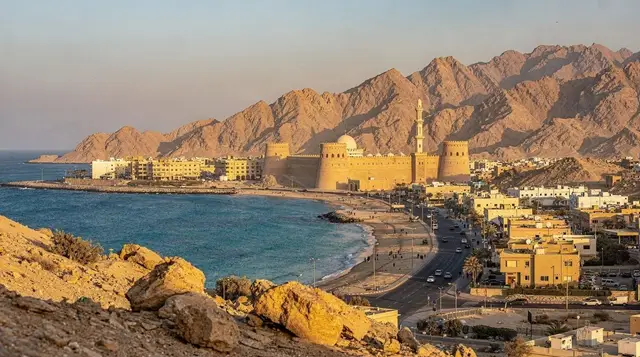
Above the town, a restored hilltop watchtower — sometimes referred to locally as Al Rabi Tower — marks the endpoint of a short, well-defined hiking trail that climbs from near the corniche to a genuinely commanding view over the bay, the port, and the curve of the coastline in both directions. The tower’s exact age and origin are debated, with some accounts tying it to older coastal defense structures along this stretch that predate the modern country, though most of what’s visible today reflects restoration work rather than an untouched historical structure.
The climb takes roughly 30–45 minutes at a moderate pace and is unshaded for most of the route, making early morning or late afternoon the sensible times to attempt it outside the cooler winter months, when heat exhaustion risk on the exposed trail rises sharply. Proper shoes matter more here than the modest distance suggests, since the path is uneven rock and gravel rather than a paved walkway.
Khor Fakkan vs Fujairah: which to prioritize
| Khor Fakkan | Fujairah (Al Aqah) | |
|---|---|---|
| Beach and swimming | Calm, sheltered, quieter | More developed resort beach |
| Snorkeling | Limited (Shark Island as a landmark, not a reef) | Strong (Snoopy Island) |
| Hiking | Al Rabi Tower watchtower trail | None comparable |
| Alcohol | Not available (Sharjah dry policy) | Available in licensed hotels |
| Best treated as | Half-day extension | Full-day or overnight base |
If you only have time for one, Fujairah’s Al Aqah strip covers more ground; Khor Fakkan rewards travelers who’ve already done Fujairah and want a quieter, more active half-day extension.
Shark Island
Just off the main beach, a small rocky islet locally known as Shark Island — named for a fin-like silhouette rather than any actual shark population worth worrying about — is a popular photo subject and a short swim or kayak from shore for visitors comfortable in open water. It’s not a snorkeling destination on the level of Fujairah’s Snoopy Island further down the coast, but it adds a distinctive visual anchor to Khor Fakkan’s bay that shows up in most photographs of the town taken from the corniche or the watchtower trail.
Al Rafisah Dam and the amphitheatre
A short drive inland into the mountains behind Khor Fakkan, Al Rafisah Dam is a small reservoir set among rocky hills, popular with UAE residents for picnicking and pedal-boat rentals on the water rather than as a major sightseeing stop — it’s a pleasant, low-key contrast to the coastal scenery, and one of the more accessible mountain-lake settings in the country given how few natural or reservoir lakes the UAE has at all.
Closer to town, Khor Fakkan’s amphitheatre, an open-air venue built directly into the hillside overlooking the bay, hosts occasional cultural and community events; even without an event scheduled, the structure itself and the view from its seating are worth the short stop if you’re already exploring the area around the watchtower trail.
Getting to Khor Fakkan
By car, Khor Fakkan is roughly 1.5–2 hours from central Dubai, following the same E44 mountain crossing used to reach Fujairah, then continuing north along the coastal road for around 20–30 minutes past Al Aqah. There’s no practical public transport route, so a rental car or an organized tour that includes the wider east-coast area is the realistic option. See day trips from Dubai to Khor Fakkan for a self-drive itinerary that pairs it with Fujairah in a single day.
For travelers continuing further north toward Oman’s Musandam peninsula, the port town of Dibba sits just beyond Khor Fakkan, and operators running Dibba Musandam dhow cruise trips from Dubai, Sharjah, or RAK pass directly through this stretch of coast, making it easy to fold a Khor Fakkan stop into the same day as a dhow cruise departure rather than treating them as separate trips. The same Dibba dhow cruise is worth booking directly if Musandam’s fjords, rather than Khor Fakkan itself, are the main draw of your east-coast day.
Khor Fakkan with kids and less mobile travelers
The corniche and beach are flat, easy walking suitable for any age or mobility level, making them the sensible focus for families or travelers who’d rather skip the watchtower hike. The trail itself, while short, involves uneven footing and a genuine incline that isn’t stroller-friendly and can be tiring for young children in warmer weather — treat it as an activity for older kids and adults, and let younger children enjoy the beach and corniche instead while the rest of the group makes the climb.
Is Khor Fakkan worth visiting?
On its own, it’s a modest stop — a nice beach, a good short hike, and a curious geopolitical footnote rather than a headline attraction. Combined with a Fujairah day trip, though, it adds real value: the watchtower hike and the amphitheatre give a different kind of experience than Al Aqah’s resort beach and Snoopy Island snorkeling, and the drive between the two takes only 20–30 minutes. Visitors with a single day on the east coast and no particular pull toward hiking are better served spending the full day at Fujairah’s beaches and Al Bidyah Mosque; those with an extra half day, or a specific interest in the watchtower view, should add Khor Fakkan to the itinerary.
See best day trips from Dubai for how a combined Fujairah–Khor Fakkan day compares to other single-day options from Dubai.
Combining Khor Fakkan with the rest of the east coast
Because Khor Fakkan, Dibba, and Fujairah’s Al Aqah strip all sit within a roughly 30-minute drive of each other, a single overnight or long day trip can realistically cover all three without feeling rushed: a morning snorkel at Snoopy Island, an early-afternoon drive up to Khor Fakkan for the beach and watchtower hike, and, for travelers with an extra day, a Musandam dhow cruise departing from near Dibba to close out the trip. This kind of multi-stop east-coast loop makes considerably better use of the two-hour drive from Dubai than a single-site visit does, since the mountain crossing itself takes roughly the same time regardless of how many stops you make on the other side.
See Dubai to Musandam day trip and Dubai’s guide to Oman for how a Musandam extension fits into the same trip.
Khor Fakkan’s role in the wider container shipping network
Beyond the town-level detail covered above, Khor Fakkan’s port fits into a broader pattern along the UAE’s east coast: Fujairah, just south, hosts a major bunkering and oil-storage hub for the same Strait-of-Hormuz-avoidance logic that makes Khor Fakkan valuable, and together the two ports give the UAE a genuine east-coast alternative to routing everything through Gulf-side facilities like Jebel Ali. For a visitor, none of this changes what there is to see, but it explains why this stretch of coastline supports more permanent infrastructure — proper roads, hospitals, and municipal services — than its modest population and tourist profile alone would suggest.
This context is also part of why alcohol licensing, municipal administration, and other Sharjah-specific rules follow the emirate rather than the surrounding Fujairah territory: a working port town needs consistent governance, and the historical exclave arrangement, however geographically odd, has functioned without practical friction for decades.
What to bring for the watchtower hike
Because the Al Rabi Tower trail is short but genuinely unshaded and uneven underfoot, a few small items matter more than they would on a typical UAE day-trip stop. Proper closed shoes with grip — trainers or light hiking shoes rather than sandals — handle the loose rock and gravel far better than casual footwear. A refillable water bottle is worth carrying even for the relatively short 30–45 minute climb, since there’s no water source along the route itself. A hat and sunscreen matter more here than at the beach below, given the lack of shade and the added exposure of climbing rather than walking flat ground. Starting early morning, ideally by 8–9am outside the cooler winter months, avoids both the worst of the heat and gives the clearest light for photos from the top.
None of this applies to the corniche or beach below, both flat and easy at any time of day — the extra preparation is specifically for the hike itself.
Frequently asked questions about Khor Fakkan
Is Khor Fakkan part of Sharjah or Fujairah?
Administratively it belongs to Sharjah, despite being geographically enclosed within Fujairah’s territory — one of several exclaves along the UAE’s east coast left over from historical boundary agreements between the emirates.
How long does the Al Rabi Tower hike take?
Roughly 30–45 minutes at a moderate pace each way, on an unshaded, uneven trail — proper shoes and water are worth bringing regardless of season.
Can I combine Khor Fakkan with a Fujairah day trip?
Yes, easily — the two sit about 20–30 minutes apart by car, and most visitors treat Khor Fakkan as a half-day extension of a Fujairah visit rather than a separate trip.
Is there good snorkeling at Khor Fakkan?
It’s more limited than Fujairah’s Snoopy Island further south — Shark Island is a photogenic landmark and a swim destination, but it isn’t a dedicated snorkeling reef site on the same level.
Is Khor Fakkan a major shipping port?
Yes — its natural deep-water harbor supports one of the UAE’s significant container ports, an active commercial operation alongside the town’s tourism side.
Do I need a car to visit Khor Fakkan?
Effectively yes, or a booked tour — there’s no practical public transport route from Dubai or Fujairah to Khor Fakkan.
Is Al Rafisah Dam worth the detour?
If you’re already in the Khor Fakkan area and enjoy a quiet natural setting, yes — it’s a modest but pleasant stop, though not worth a dedicated separate trip from Dubai on its own.
Can I drink alcohol in Khor Fakkan?
No — because it’s Sharjah territory, Khor Fakkan follows Sharjah’s dry policy, even though it’s surrounded by Fujairah, where licensed hotels do serve alcohol. Don’t expect a minibar or bar service at hotels here.
Is Khor Fakkan safe to visit?
Yes, it’s a quiet, low-crime town by any measure, including relative to the rest of the UAE, which itself has a low crime rate overall.
How does Khor Fakkan compare to Fujairah for a beach day?
Khor Fakkan’s beach is calmer and quieter with fewer amenities; Fujairah’s Al Aqah has more resort infrastructure, better snorkeling access via Snoopy Island, and a livelier overall beach scene. Most visitors get the fuller experience by combining both rather than choosing one over the other.
Is there anywhere to stay overnight in Khor Fakkan itself?
A handful of smaller hotels exist in town, but most visitors base themselves in Fujairah’s Al Aqah resort strip or Dubai and treat Khor Fakkan as a day visit rather than an overnight stay, given the limited accommodation choice compared to nearby options.
Is Khor Fakkan worth visiting if I only have one day on the east coast?
If it’s genuinely your only day, prioritize Fujairah’s Al Aqah beach, Snoopy Island, and Al Bidyah Mosque first, and only add Khor Fakkan if you have a spare two to three hours left in the afternoon — it’s a strong complement to a Fujairah day rather than a standalone reason to make the drive.
Top experiences
Bookable activities with verified prices and instant confirmation on GetYourGuide.