Old Dubai — Al Fahidi, the souks and the Creek
Old Dubai guide: Al Fahidi district, gold and spice souks, the AED 1 abra crossing, honest bargaining tips, and how it compares to Downtown for a base.
Walking tour in old Dubai: souks, abra boat & old town
Quick facts
- Covers
- Bur Dubai and Deira, either side of Dubai Creek
- Metro line
- Green Line (Al Fahidi, Al Ras, Baniyas Square stations)
- Abra crossing
- AED 1 (0.30 USD) shared, AED 20–30 (5–8 USD) private
- Best for
- Culture, souks, budget accommodation, photography
- Typical hotel price
- AED 200–450/night (55–125 USD)
What Old Dubai covers
Old Dubai isn’t an official district name — it’s the shorthand for the area on both banks of Dubai Creek, Bur Dubai on the south side and Deira on the north, where the city actually started before the skyline moved south along Sheikh Zayed Road. This is where wind-tower houses, working gold and spice markets, and a AED 1 boat crossing still function as daily infrastructure rather than staged attractions, which makes it the sharpest contrast to Downtown or the Marina anywhere in the city. It’s also the cheapest part of Dubai to eat and sleep in, and one of the few areas where walking is both possible and rewarding.
Most first-time visitors treat Old Dubai as a half-day excursion from a Downtown or Marina hotel, but it holds up as a full day if you factor in the museum, both souks, and a sit-down meal in Deira. See the old Dubai walking guide for a self-paced route that covers the district in roughly four to five hours.
Al Fahidi Historical District
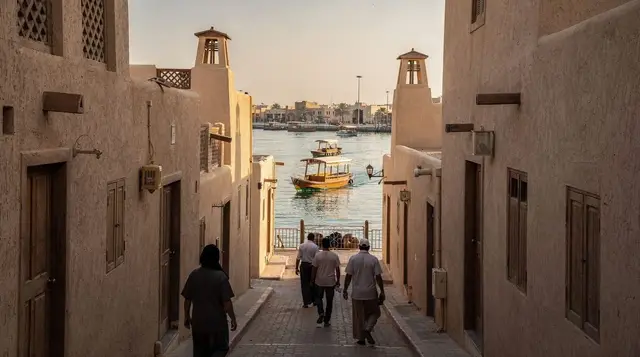
On the Bur Dubai side, Al Fahidi is a preserved quarter of coral-and-gypsum houses topped with wind towers — the pre-air-conditioning cooling system that gives the neighborhood its distinctive skyline of squat wind-catchers instead of high-rises. Narrow, shaded lanes connect small museums, art galleries, and the Dubai Museum housed in the Al Fahidi Fort, the oldest surviving structure in the city, though as of recent years the fort building itself has been undergoing renovation with a temporary museum housed nearby — check current status before planning around it specifically.
The district is walkable and genuinely pleasant even at midday thanks to the shade from tightly packed buildings, unlike the fully open souk lanes elsewhere. The Al Fahidi historical district guide covers which galleries are worth the stop and which are aimed squarely at tour groups. A guided version that bundles Al Fahidi with the souks and an abra ride is available via Old Dubai walking tour with souks and abra crossing, useful if you’d rather have context on the buildings than read plaques.
The souks: gold, spice and textile
Deira, across the Creek, holds the two markets most visitors come for. The Gold Souk is a covered arcade of jewelry shops with window displays stacked floor to ceiling in 22- and 24-karat gold — prices are pegged to the daily gold rate plus a workmanship charge, and that charge is negotiable, often by 20–30% off the first quoted price. The Gold Souk guide explains how the pricing actually works so you’re not negotiating blind.
A few minutes’ walk away, the Spice Souk is smaller and more atmospheric — sacks of saffron, dried limes, frankincense, and cardamom spill into the lane, and vendors are generally more relaxed about letting you smell and browse without buying. It’s also one of the better places in the city for cheap, packable gifts. See the Spice Souk guide for what’s actually good value versus what’s marked up for tourists (saffron in particular is frequently sold as a higher grade than it is — buy from a stall with visible turnover, not the first one that waves you in).
The wider Dubai souks guide covers bargaining etiquette across all of them: start around 40–50% of the asking price, expect to settle around 20–30% off, and be willing to walk away, since that’s often what triggers the real final offer.
The abra crossing the Creek
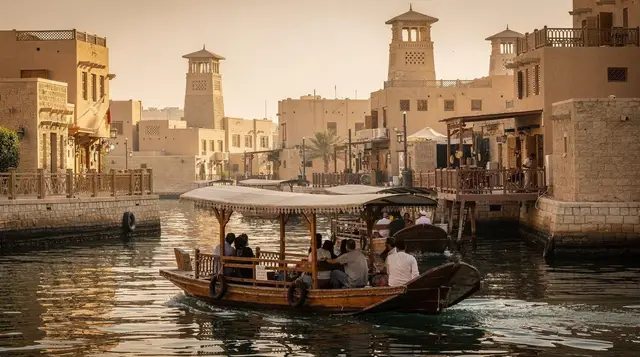
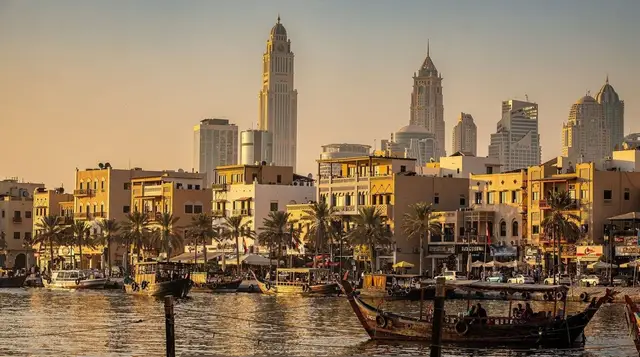
The abra — a small wooden motorboat — has crossed Dubai Creek between Bur Dubai and Deira for longer than any bridge or tunnel has existed here, and it’s still the fastest way across for foot traffic at AED 1 (about 0.30 USD) for a shared crossing, paid to the boatman once aboard. It takes roughly five minutes and gives a low, on-the-water view of the dhow wharfage — traditional cargo boats still loading goods bound for Iran and East Africa, a genuinely working part of the port rather than a re-creation. A private abra, chartered for a longer loop up and down the Creek, runs AED 20–30 (5–8 USD) for up to 20 minutes and is worth it once for the photos, though the AED 1 public crossing captures the experience just as well for a first ride.
Full detail in the abra Dubai Creek guide.
For a version that packages the abra with a souk walk and street food stops, Old Town souks, street food and abra tour covers the district in a single guided session, and Dubai Frame, Creek souks and Blue Mosque guided tour pairs it with the Dubai Frame and Jumeirah’s Blue Mosque area for a fuller half-day.
Combining Old Dubai with a broader city day
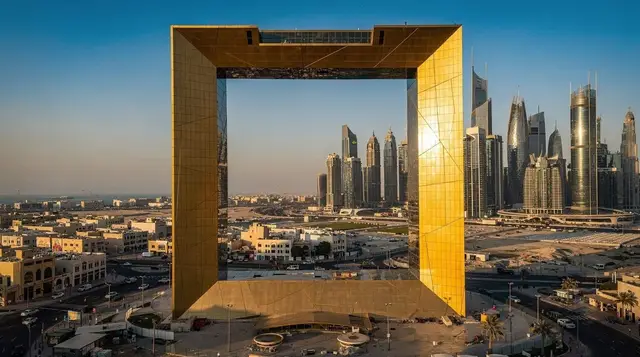
Because Old Dubai sits between Downtown and the Marina geographically as well as culturally, it slots naturally into a day that also touches Deira’s waterfront or the Dubai Frame, the picture-frame-shaped structure straddling old and new Dubai near Zabeel Park, which is designed explicitly to look toward Old Dubai on one side and the modern skyline on the other. A day that opens with Al Fahidi in the cooler morning hours, moves to the souks by late morning, crosses via abra for lunch in Deira, and finishes with the Dubai Frame in the late afternoon covers the full arc of the city’s transformation in a single loop. See the Dubai Frame guide for how that stop fits into the sequence and what it costs to go up.
Getting there and where to stay
The Green Line metro serves this area directly — Al Fahidi station for Bur Dubai’s historic quarter, Al Ras or Baniyas Square for the Deira souks — a change from the Red Line if you’re coming from Downtown, the Marina, or the airport, so budget an extra 10–15 minutes for the transfer at Union or BurJuman station. A Nol card covers both lines. Taxis from Downtown run about AED 25–35 (7–10 USD) and 15–20 minutes.
This is also the best-value area in Dubai to sleep: mid-range hotels in Bur Dubai and Deira run AED 200–450/night (55–125 USD), roughly half what a comparable Downtown or Marina room costs, and you’re still only 20–25 minutes by metro from the Burj Khalifa. The tradeoff is fewer beach and nightlife options within walking distance. See Bur Dubai guide and Deira neighborhood guide for area-specific hotel picks.
Food in Old Dubai
This is the best district in Dubai for cheap, authentic food, and it’s not close. Deira and Bur Dubai have dense concentrations of Iranian, Pakistani, Afghan, and Indian restaurants serving the communities who’ve lived and worked in this part of the city for generations, not tourists — a full biryani or karahi meal runs AED 15–30 (4–8 USD), and portions are generous. Al Ustad Special Kabab in Bur Dubai, a decades-old Iranian kebab spot, is a genuine local institution rather than a curated “heritage” restaurant built for visitors. Karama, just south of Bur Dubai, extends this further with some of the cheapest and best South Asian food in the city.
For a slightly more polished but still reasonably priced experience, several restaurants along the Deira waterfront serve grilled fish and seafood with Creek views, running AED 60–100 (16–27 USD) per person. The Dubai street food guide and Dubai cheap eats guide both draw heavily on this district for their recommendations, since it’s where Dubai’s actual working-class food culture is concentrated rather than the resort and mall dining that dominates elsewhere.
What to wear and practical etiquette
Old Dubai is more conservative in practice than Downtown or the Marina, even though the dress code rules are technically the same citywide — shoulders and knees covered is a stronger expectation here, particularly around the mosque areas and in the souks themselves, where you’re moving through a genuinely local commercial district rather than a tourist-oriented one. Photographing people directly, especially women, without asking first is both a courtesy issue and something that can draw a sharp response from vendors or bystanders; photographing the buildings, boats, and market stalls themselves is generally fine and expected.
Vendors in the souks are more assertive than in a mall — being called out to and invited into a shop is normal here and not a sign of a scam, just a different retail culture than most Western visitors are used to. A polite “no thank you” while continuing to walk works fine if you’re not interested; stopping to engage signals interest even if you don’t intend to buy, and can lead to a longer negotiation than you wanted.
Wider Deira: beyond the tourist core
Deira extends well beyond the Gold and Spice Souks into a dense grid of residential and commercial streets that most tour itineraries skip entirely. The Deira Fish Market, relocated to a newer waterfront facility, is worth an early-morning visit (before 8am) to see the actual wholesale trade in action — fresh catch from local waters laid out for buyers, with the option to have a stall grill your selection at an attached restaurant for a small fee. Naif Souk, a few streets back from the Gold Souk, sells textiles, household goods, and clothing at prices aimed at residents rather than tourists, and gives a clearer sense of how this part of the city actually functions day to day.
Few visitors make it this far into Deira, which is exactly what makes it worth the extra 20-minute walk for anyone who’s already done the standard Gold Souk and Spice Souk loop.
Photography in Old Dubai
This is one of the most photogenic districts in the city precisely because so little of it has been redesigned for photo ops. The wind-tower silhouettes of Al Fahidi against a clear morning sky, the abra wharfage with stacked dhow cargo, and the layered stalls of the Spice Souk all reward slower, more deliberate shooting than the skyline shots most visitors leave Dubai with. Early morning light (before 9am) is softest across the sand-colored Al Fahidi buildings, while late afternoon suits the Creek and abra crossing, when the water catches the lower sun. As noted above, always ask before photographing people directly, particularly women — the buildings, boats, and stalls themselves are fair game without asking.
Is Old Dubai worth a full day?
Yes, and it’s arguably the most underrated stop on a standard Dubai itinerary — most first-timers give it two rushed hours between other bookings when it rewards a slower half-day at minimum. The souks are genuinely functioning markets rather than staged tourist versions, the abra is cheap infrastructure rather than a paid attraction dressed up as one, and the food in Deira (particularly the Iranian, Pakistani, and Indian restaurants along the Creek) is both better and cheaper than almost anywhere in Downtown. The honest caveat: come outside midday in summer, since the souk lanes and Creek-side walkways are largely uncovered and the heat there is unforgiving compared to Downtown’s air-conditioned corridors.
For where this fits in a broader trip, see the 3-day Dubai itinerary, which typically places Old Dubai on day two.
Old Dubai’s mosques and religious sites
The Bur Dubai Grand Mosque and several smaller neighborhood mosques punctuate this district, and while most are not open to non-Muslim visitors for interior access, they’re worth noting as you walk past — their architecture, with traditional minarets and coral-stone construction in the older examples, contrasts sharply with the newer, larger mosques built elsewhere in the city. For an actual interior visit open to all visitors regardless of faith, the Jumeirah Mosque (technically outside Old Dubai proper, in Jumeirah) is the standard recommendation, with guided tours explaining Islamic practice and architecture; abayas and headscarves are provided free at the entrance for anyone not already appropriately dressed.
See Jumeirah Mosque visit guide for visiting hours and tour timing, since it operates on a specific guided-tour schedule rather than open walk-in access.
Museums beyond Al Fahidi Fort
Old Dubai’s museum offerings extend past the main Dubai Museum. The Coffee Museum, tucked into a restored courtyard house in Al Fahidi, covers the history and preparation of Arabic coffee with tastings included in the entry fee — a small, quick stop that pairs naturally with a walk through the surrounding lanes. The Al Shindagha Museum, on the Bur Dubai side near the Creek mouth, is a larger, more recently developed complex spanning several historic buildings and covering Dubai’s pearling, seafaring, and early trading history in more depth than the standard Dubai Museum does.
Both are covered in the Dubai museums guide, the Coffee Museum guide, and the Al Shindagha Museum guide, and either is a reasonable substitute if the main fort museum is closed for renovation during your visit.
A self-guided half-day route
For visitors piecing together their own route rather than joining a guided tour, this sequence covers the district’s highlights in roughly four to five hours without doubling back:
| Time | Stop | Notes |
|---|---|---|
| 9:00am | Al Fahidi Historical District | Cooler morning light, shaded lanes |
| 10:15am | Coffee Museum | Quick stop, tastings included |
| 11:00am | Abra crossing to Deira | AED 1 shared crossing, ~5 minutes |
| 11:15am | Gold Souk & Spice Souk | Bargain the workmanship charge, not the gold rate |
| 12:30pm | Lunch in Deira | Iranian, Pakistani or Indian, AED 15–30/person |
| 1:30pm | Naif Souk or Deira Fish Market | Optional, for the 20-minute-further crowd |
If you’d rather have a guide narrate the route instead of self-navigating, half-day city tour with Blue Mosque, Creek and souks covers a similar arc with transport included.
Frequently asked questions about Old Dubai
Is Old Dubai safe to walk around?
Yes, it’s one of the safer, more low-key parts of the city, though it can feel crowded and chaotic in the souk lanes during peak shopping hours in the evening — keep bags zipped in dense crowds as a routine precaution, not because of any specific known risk.
How much does the abra cost?
AED 1 (about 0.30 USD) for a shared crossing paid directly to the boatman. A private charter for a longer Creek loop runs AED 20–30 (5–8 USD) for around 20 minutes.
Can I bargain in the Gold Souk?
Yes — the workmanship charge on top of the daily gold rate is negotiable, typically by 20–30%. The gold rate itself is fixed and not up for negotiation.
Is Old Dubai walkable or do I need a taxi between sights?
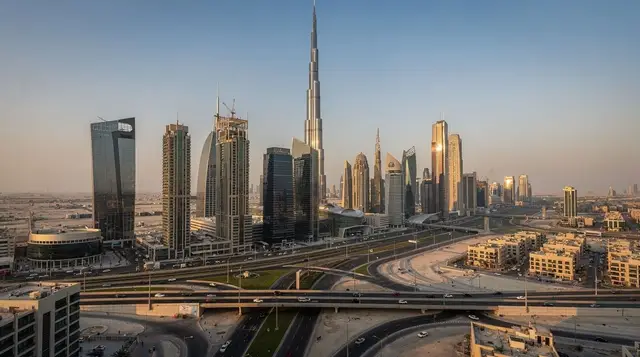
The core sights — Al Fahidi, the Gold Souk, the Spice Souk, and the Creek — are connected by the abra and short walks, making this one of the most walkable areas in Dubai, unlike the highway-divided newer districts.
What’s the best time of day to visit the souks?
Early morning (before 10am) or after 4pm, once the midday heat eases and vendors are more active; many stalls are quieter and less enjoyable to browse at peak midday heat.
Is the Dubai Museum at Al Fahidi Fort still open?
The historic fort building has undergone renovation work in recent years; check current status before your trip since exhibits may be temporarily relocated nearby rather than closed outright.
How does Old Dubai compare to Downtown for a first-time visitor?
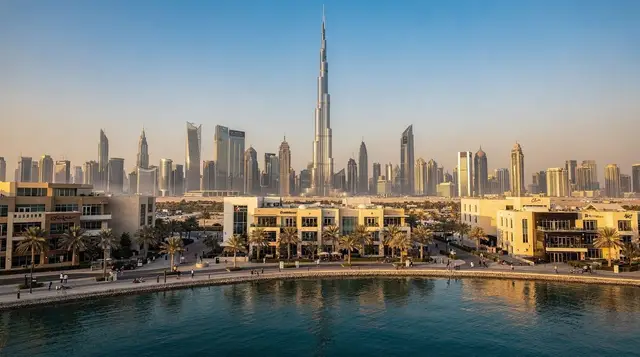
Downtown gives you the modern skyline and the Burj Khalifa; Old Dubai gives you the pre-oil-boom city and a sense of how recent Dubai’s transformation actually is. Most itineraries benefit from including both rather than choosing one over the other.
Is Old Dubai a good base for a budget trip?
Yes, generally the best in the city — hotel prices in Bur Dubai and Deira run 40–50% below Downtown or Marina equivalents, food is markedly cheaper, and the metro connects both areas directly to the rest of the city in 20–30 minutes.
What should I buy in the souks that’s actually good value?
Spices (saffron, cardamom, dried limes), textiles, and gold workmanship on pieces you’d buy anyway are the strongest value categories; avoid souvenir-shop “antiques” and pashminas marketed as cashmere, both of which are almost always synthetic reproductions regardless of what a vendor claims.
Can I do Old Dubai in half a day if I’m short on time?
Yes — a tight but workable half-day covers Al Fahidi’s lanes, one abra crossing, and either the Gold Souk or Spice Souk (not comfortably both) in around three hours, though a full day lets you cover both souks plus a sit-down meal without rushing.
Is Old Dubai suitable for visitors with limited mobility?
Partially — Al Fahidi’s paved lanes and the abra boats themselves are manageable, but some souk alleys are narrow, uneven, and crowded, and few buildings in the historic quarter have step-free access given their age and original construction.
Is Naif Souk worth visiting alongside the Gold and Spice Souks?
Yes, if you have an extra 20 minutes — it sells textiles, household goods, and clothing at prices aimed at residents rather than tourists, giving a clearer sense of Deira’s everyday commercial life than the more visitor-oriented Gold and Spice Souks.
Can I visit Old Dubai on foot from a Downtown hotel?
Not comfortably — the districts aren’t adjacent, so a taxi (AED 25–35, 15–20 minutes) or the Green Line metro is the practical way in, though once you’ve arrived, the core sights themselves are genuinely walkable.
Top experiences
Bookable activities with verified prices and instant confirmation on GetYourGuide.