Old Dubai walking guide: Al Fahidi, the Creek, and the souks on foot
Walking tour in old Dubai: souks, abra boat & old town
What's the best way to see Old Dubai on foot?
Start at Al Fahidi Historical Neighbourhood in Bur Dubai in the early morning or late afternoon, walk its wind-tower lanes for 45-60 minutes, cross Dubai Creek by shared abra for 1 AED, then walk the Spice Souk and Gold Souk on the Deira side. The full loop takes 3-4 hours including the crossing, costs almost nothing beyond a coffee and the abra fare, and is the single best way to understand pre-oil Dubai in a morning.
Why walk Old Dubai instead of driving through it
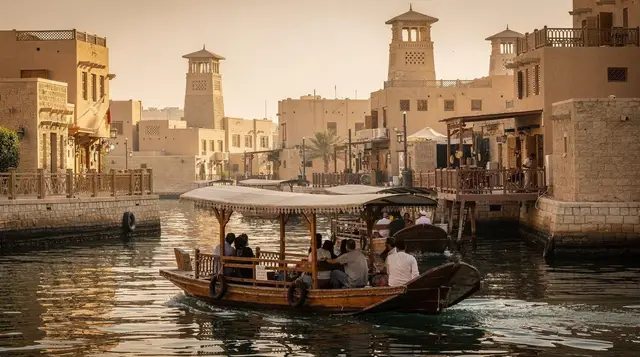
Old Dubai is the one part of the city that rewards slow travel over the usual taxi-to-attraction pattern everywhere else favors. The area straddling Dubai Creek — Bur Dubai on one bank, Deira on the other — is compact enough to cover on foot in a morning, and its value is almost entirely textural: wind-tower buildings, a working waterway still crossed by wooden boats, and souks that function as actual markets rather than staged attractions. None of that comes through from a car window.
This guide lays out a realistic, self-guided walking route with honest timing, not an idealized itinerary that ignores heat, crowding, or the fact that some of what you’ll read about online (like Dubai Museum’s opening hours) changes without much notice.
| Where | Al Fahidi (Bur Dubai) to the Deira souks, via the Creek |
| Cost | Near-free; abra crossing 1 AED (0.30 USD) each way |
| Time needed | 3-4 hours for the full loop |
| Getting there | Al Fahidi/Al Ghubaiba metro, Green Line |
| Best time | Before 10am or after 4pm, year-round |
The route in outline
The logical loop starts at Al Fahidi Historical Neighbourhood in Bur Dubai, moves toward the Creek, crosses by abra, and finishes in the Deira souks. Reversing it works just as well — start in Deira if you’re staying on that side. Either direction, the walk covers roughly 2-3km of actual distance, most of it flat, and none of it requires a car or taxi until you’re ready to leave at the end.
This guided walking tour through old Dubai, the souks, and an abra boat ride covers the same loop with a local guide filling in context a self-guided walk won’t give you, which is worth considering if history and stories matter more to you than moving at your own pace.
A short history: why the architecture looks the way it does
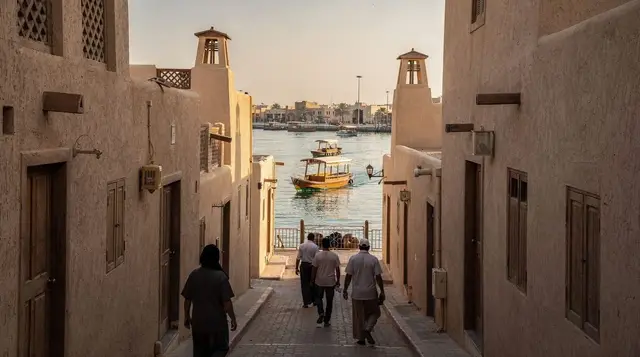
Al Fahidi’s older name, Bastakiya, comes from Bastak, a town in Persia whose merchant families settled here in the early 1900s, drawn by Dubai’s tax-free port status at the time. The wind towers (barjeel) they brought with them are the neighborhood’s defining feature: a chimney-like structure open on four sides that catches wind from whichever direction it blows and funnels it down into the room below, cooling interiors by several degrees without any moving parts or electricity.
It’s worth actually standing under one and looking up rather than just photographing the exterior — the airflow is noticeable even on a still, hot day, and it’s a genuinely clever piece of pre-modern engineering that gets glossed over if you’re only looking at building facades from the lane below.
By the 1980s much of the neighborhood had fallen into disrepair as Dubai’s population and wealth grew and building moved toward glass and concrete elsewhere in the city. A conservation push starting in the late 1980s and continuing through the 2000s restored the surviving houses rather than demolishing them, which is why Al Fahidi today reads as a coherent, walkable historic quarter rather than a handful of isolated preserved buildings — a rarer outcome in a region where rapid redevelopment more often won out.
Stop one: Al Fahidi’s wind-tower lanes
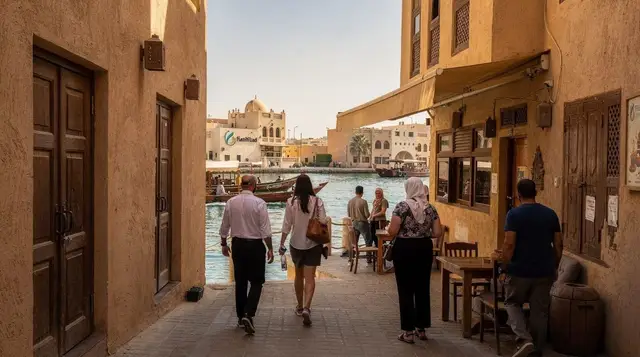
Al Fahidi (also called Bastakiya) is Dubai’s best-preserved pre-oil neighborhood — a grid of narrow sandy-colored lanes lined with coral-and-gypsum houses topped by barjeel wind towers, a pre-air-conditioning cooling technology that channels breeze down into the rooms below. Walking these lanes for 45-60 minutes is the core of the experience: courtyard art galleries (XVA Gallery is the best known), small museums, and cafés occupy restored houses, and there’s genuinely no bad direction to wander since the neighborhood is small enough that you won’t get meaningfully lost.
The full Al Fahidi guide covers specific galleries, the Coffee Museum, and the Sheikh Mohammed Centre for Cultural Understanding’s guided programs in more depth. For this walking route, the takeaway is simple: budget an hour, go early, and don’t rush past the wind towers without looking up — the engineering is the actual point of the neighborhood.
Two heritage houses worth the detour
Two specific buildings just outside the main Al Fahidi grid reward a short detour if you have the extra 30-45 minutes. Sheikh Saeed Al Maktoum House, on the Creek waterfront a short walk from Al Fahidi, was the residence of Dubai’s former ruler and now houses a photography collection documenting the city before the oil-fueled construction boom — genuinely striking if you want to see what the Creek and the city looked like within living memory, since the contrast with the skyline visible today is stark. Heritage House and the neighboring Al Ahmadiya School, on the Deira side near the Gold Souk, show a similarly preserved merchant-family home and Dubai’s oldest semi-formal school building.
Note that opening hours and even operating status for smaller heritage sites like these change periodically for renovation, so it’s worth a quick check before building your timing around a specific one.
Stop two: the Textile Souk and Al Seef
Between Al Fahidi and the Creek’s edge sits the Bur Dubai Textile Souk, a covered market of fabric shops selling everything from cheap pashminas to genuinely good tailoring cloth, and it’s a reasonable place to practice a bit of low-stakes bargaining before tackling the more consequential negotiations at the Gold Souk. Continuing toward the water brings you to Al Seef, a newer heritage-style waterfront development built to complement (not replace) the historic area — modern cafés and shops in an old-Dubai-inspired shell, worth a coffee stop but not mistaken for the genuine historic fabric of Al Fahidi itself.
Stop three: crossing by abra
The abra crossing is the hinge of the whole walk and arguably the single best-value experience in Dubai: a shared wooden motor launch ferries passengers across the Creek for 1 AED (0.30 USD), a fare that has stayed nominal for decades specifically to keep it accessible as everyday transport, not a tourist gimmick. Boats leave when full rather than on a schedule, so waits are rarely more than a few minutes at either the Bur Dubai (near the Textile Souk) or Deira abra stations. The crossing itself takes 5-10 minutes and gives a low, on-the-water view of the Creek that no bridge or tunnel replicates.
Full details, including where exactly to catch one and the difference between shared and private abras, are in the dedicated abra and Creek guide.
This old town, Creek, abra, and souks guided walking tour builds the crossing into a structured route if you’d rather not figure out which dock to use on your own.
Stop four: the Deira souks
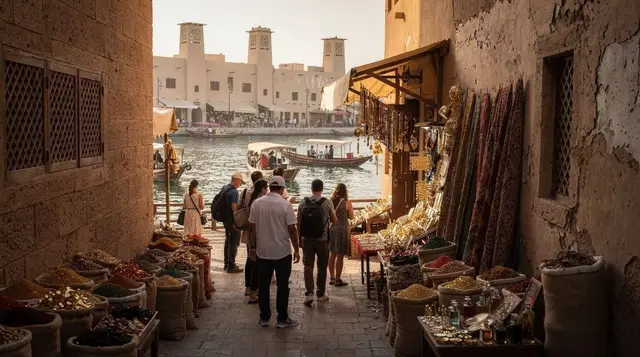
Stepping off the abra on the Deira side puts you within a few minutes’ walk of the Spice Souk and, a bit further on, the Gold Souk. The Spice Souk is the smaller, more casually browsable of the two — sacks of saffron, dried limes, frankincense, and dates spill out from narrow shopfronts, and vendors expect (and enjoy) a bit of haggling over spice blends and dried fruit. The Gold Souk is a bigger commitment: hundreds of shops under a covered arcade, windows stacked with gold jewelry priced by weight against the day’s international gold rate, and a much more serious bargaining culture if you’re actually buying rather than looking.
Both get their own full guides — Spice Souk and Gold Souk — with pricing and bargaining specifics; the souks overview guide compares all of Deira’s markets side by side, including the Perfume Souk most visitors miss.
This old town, souks, street food, and abra ride tour pairs the souk walk with food stops, which is a reasonable way to end the route if you haven’t eaten since breakfast.
Realistic timing for the whole loop
A comfortable version of this walk runs: 60 minutes in Al Fahidi, 20 minutes through the Textile Souk and Al Seef, 15 minutes for the abra crossing including the wait, and 60-90 minutes in the Deira souks, for a total of roughly 3 hours of active walking plus whatever time you spend sitting for coffee or tea. Add 30-45 minutes if you stop at a museum along the way. Compressing it to under 2 hours is possible but rushes the part (Al Fahidi) that’s actually worth lingering in.
Heat, timing, and when to skip it entirely
This is an outdoor walking route with limited air-conditioned refuge, which makes seasonal timing more important here than almost anywhere else in Dubai. From November through March, any time of day works reasonably well, though even then, midday sun in the shadeless souk lanes is uncomfortable. From June through September, with temperatures regularly hitting 40-48°C, doing this walk after 10am is genuinely unpleasant and not advisable for anyone with heat sensitivity — start at 7-8am instead, or shift the whole plan to an evening version after 5pm when the souks are still open and the worst heat has passed. See when to visit Dubai for the fuller seasonal picture.
What to wear and bring
Modest dress applies throughout this route, not just inside the mosque area near Jumeirah — shoulders and knees covered is the practical standard in Al Fahidi and the souks, and it’s also simply more comfortable in direct sun than shorts and a tank top. Bring water; refill points are limited between Al Fahidi and the Deira side, though souk cafés sell cold drinks cheaply. Wear shoes that handle uneven paving and a wobbly step down into the abra — flip-flops work but aren’t ideal on the boat’s metal deck. See the dress code guide for the broader rules that apply citywide.
Where the walk fits into a Dubai itinerary
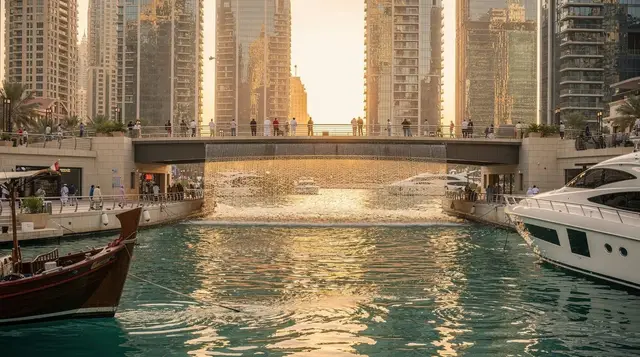
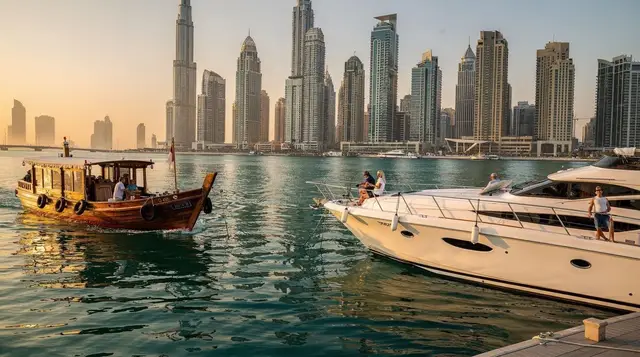
For first-time visitors building a first Dubai itinerary, Old Dubai works best as a half-day slotted opposite the modern city — pairing a morning here with an afternoon at Downtown Dubai or the Marina gives a useful before-and-after contrast that a lot of visitors say sharpens their sense of the city more than either half alone. It also fits naturally into a one-day Dubai itinerary if old and new are both priorities and time is tight, since the whole loop compresses to a morning without feeling rushed.
The old versus new Dubai comparison tour guide covers how operators package this contrast if you’d rather not self-guide either half.
Combining the walk with a Creek dinner cruise
A number of visitors do this walking route in the morning and a Creek dhow dinner cruise the same evening, which works well logistically since both are centered on the same stretch of water — you’ll recognize the Creek’s banks and the abra crossing from a different angle after dark. See the dhow cruise guide for how that pairs with the daytime walk, and note that doing both isn’t repetitive since the water-level evening cruise and the on-foot daytime walk show genuinely different sides of the same waterway.
Etiquette while you walk
Al Fahidi in particular sits next to the Sheikh Mohammed Centre for Cultural Understanding, an organization whose entire purpose is helping visitors understand local customs respectfully, and its presence is a useful cue for how to behave in the surrounding lanes: photograph buildings and street scenes freely, but ask before photographing people directly, especially in the souks where shopkeepers are working, not posing. The Emirati culture and etiquette guide covers this in more depth, including dress, photography norms, and how Ramadan changes the rhythm of this specific area.
Pairing the walk with the rest of a Dubai day
Because the loop compresses to a single morning, it pairs naturally with an afternoon elsewhere in the city rather than needing to stand alone as a full day. A morning here followed by an afternoon at Downtown Dubai or the Dubai Marina gives a useful old-versus-new contrast that sharpens most visitors’ sense of the city more than either half alone. For travelers who’ve already booked a guided version of this same route, this article works better as background reading before the tour than as a separate walk to repeat afterward — the context a guide adds is the main value a booked tour offers over the free self-guided version.
Where to base yourself for this walk
Staying in Deira or Bur Dubai puts you within easy walking distance of the entire route without needing transport at all. Staying further out — Marina, Downtown, or Jumeirah — means a 20-40 minute taxi or metro ride to either end of the walk, which is still entirely manageable via Dubai’s metro Green Line, which serves both banks of the Creek near this area. The neighborhood guide to Deira and the guide to Bur Dubai go into more detail on staying in either area specifically for easy access to this walk.
Museum access and what to check before relying on it
Small heritage sites and museums along this route — Dubai Museum at Al Fahidi Fort, Sheikh Saeed Al Maktoum House, Heritage House — periodically close for renovation or shift their published hours without much notice, more so than a major paid attraction elsewhere in the city with a dedicated visitor-services team. Building your timing around the walk itself (the lanes, the crossing, the souks) rather than a specific museum stop protects the plan if one particular site turns out closed on the day; treat any museum entry as a welcome bonus rather than the anchor of the route.
Budget breakdown for the full walk
This is one of the cheapest half-days Dubai offers, and it’s worth stating the numbers plainly: the abra crossing is 1 AED (0.30 USD) each way, so 2 AED round trip. Coffee or tea at an Al Fahidi café runs AED 15-30 (4-8 USD). A small spice or dried-fruit purchase in the Spice Souk might run AED 20-50 (5-14 USD) if you buy anything at all, and browsing costs nothing. Museum entries where open are typically AED 5-25 (1-7 USD). Realistically, a full morning here costs under AED 100 (27 USD) per person even with a coffee stop and a small souvenir, which makes it one of the better value-for-time activities in a city where most attractions charge AED 150+ for entry alone.
Common mistakes visitors make on this walk
The most frequent one is timing: arriving at midday in summer and giving up on the walk within 20 minutes because of the heat, then writing off Old Dubai as overrated. The area itself isn’t the problem — the timing is. A second common mistake is treating the Gold Souk as a quick photo stop rather than budgeting real time for it if buying is even a remote possibility, since a rushed few minutes isn’t enough to compare shops or negotiate seriously.
A third is skipping the abra crossing entirely in favor of a taxi or the Metro’s Al Ghubaiba or Union stations, which get you to roughly the same place but miss the actual point of the route — the water-level crossing is the connective experience tying Al Fahidi to the Deira souks, not a logistics inconvenience to route around.
An evening version of the same walk
Everything above assumes a morning start, but an evening version — starting around 5-6pm — works well too, particularly outside peak summer. The souks stay open into the evening (most shops trade until 9-10pm), the light is softer for photos, and the temperature drop after sunset makes the walk more comfortable even in shoulder-season months. The trade-off is that Al Fahidi’s galleries and smaller museums typically close earlier (often by 5-6pm), so an evening version favors the souk-and-abra half of the route over the historical-neighborhood half. If you want both halves properly, split them across a morning and a separate evening rather than trying to force the full loop into one late-afternoon window.
A note on the neighborhood’s ongoing restoration
Al Fahidi’s conservation work isn’t a finished, static project — some buildings continue to undergo restoration or repurposing as galleries, cafés, and cultural spaces on a rolling basis, meaning the specific mix of what’s open and what’s under scaffolding can shift between visits. This is worth knowing simply so a scaffolded building here or there doesn’t read as neglect; it’s part of an ongoing, deliberate effort to keep the neighborhood functioning rather than freezing it as a museum piece.
Photography along the route
Al Fahidi’s lanes photograph well at almost any time of day thanks to the warm tone of the coral-and-gypsum walls, but the wind towers themselves are best shot in the hour after sunrise or before sunset, when low-angle light picks out the texture of the lattice openings. The abra crossing gives a genuinely unusual low-angle shot of the Creek and the Deira skyline that most visitors never think to take since they’re focused on the far bank rather than looking back. In the souks, ask before photographing individual vendors or their faces directly — shooting the general scene, stacked goods, or a shopfront from a respectful distance is fine and rarely an issue, but a close portrait shot of someone working deserves a quick, friendly ask first.
The best photo spots guide covers the wider city’s viewpoints if Old Dubai’s more intimate scale isn’t what you’re after that day.
The loop, stop by stop
| Stop | Time | What to look for |
|---|---|---|
| Al Fahidi lanes | 45-60 min | Wind towers, courtyard galleries, Coffee Museum |
| Textile Souk / Al Seef | 20 min | Fabric bargaining, a coffee stop |
| Abra crossing | 10-15 min | Low, on-the-water view of the Creek |
| Deira Spice Souk | 30-45 min | Saffron, dried limes, frankincense |
| Deira Gold Souk | 45-60 min | Gold priced by weight, serious bargaining |
The bottom line
Old Dubai’s walking route is inexpensive, genuinely rewarding, and one of the few Dubai experiences that isn’t better with a bigger budget — a guided tour adds context, but the self-guided version costs next to nothing and covers the same ground. Go early, wear something you can move in, and treat the abra crossing as the highlight it is rather than a logistics step between two more “important” stops.
Frequently asked questions about Old Dubai walking guide
How long does the Old Dubai walking route take?
Budget 3-4 hours for the full loop: Al Fahidi (45-60 minutes), the abra crossing (10-15 minutes including the wait), and the Deira souks (90 minutes to 2 hours if you browse). It can be compressed to 2 hours if you skip the souks or extended to a half-day with museum stops and a tea break.What time of day is best for walking Old Dubai?
Before 10am or after 4pm, year-round. The alleys of Al Fahidi have some shade from tall buildings, but the Creek-side walk and souk lanes get direct sun. From June to September, an early-morning start (before 9am) is close to mandatory — afternoon heat at 40-48°C makes the walk genuinely unpleasant and mildly risky.Is the Old Dubai walk free?
Walking the lanes and browsing the souks costs nothing. The only unavoidable expense is the abra crossing at 1 AED (0.30 USD) per person each way. Museum entries (where open) typically run AED 5-25. A guided version with a local guide costs more but adds context you won't get wandering solo.Do I need a guide for Old Dubai, or is self-guided fine?
Self-guided works well if you've read up on what you're looking at beforehand, since there's minimal on-site signage explaining the wind-tower architecture or the neighborhood's history. A guided walking tour adds real value here specifically because context (not just scenery) is what makes Al Fahidi interesting, and a guide will also know which galleries and courtyard cafés are worth a stop that day.Is Old Dubai safe to walk around, including after dark?
Yes — Dubai has very low street crime, and Old Dubai is no exception. The main practical consideration after dark isn't safety but that the souks and abra crossing are more atmospheric and functional in daylight or early evening; some alleys in Al Fahidi are quiet and poorly lit late at night, which is more a navigation inconvenience than a safety concern.Can I do the Old Dubai walk with young kids or limited mobility?
With kids, yes — it's flat, short, and the abra crossing is genuinely fun for children. With limited mobility, it's harder: Al Fahidi's lanes are narrow, sometimes uneven sandstone-effect paving, and the abra requires stepping down into a low, gently rocking boat without a ramp, which is difficult for wheelchair users or anyone unsteady on their feet.What should I wear for the Old Dubai walk?
Shoulders and knees covered for both men and women — this is the most conservative part of Dubai and also the area with a working mosque and cultural center. Comfortable closed or sturdy sandal-style shoes for uneven paving, sun protection, and a bottle of water, since shaded rest points are limited between the neighborhood and the souks.Can I combine the Old Dubai walk with a Downtown or Marina day?
Yes — the loop compresses to a single morning, leaving the afternoon free for Downtown Dubai or the Marina. Many first-time visitors pair a morning here with an afternoon at the Burj Khalifa or Dubai Mall for a useful old-versus-new contrast within one day.Is the self-guided walk worth doing if I've already booked a guided tour?
Not usually necessary to do both in full — a guided tour covers the same core loop with added local context. If you've booked a guided version, this route is more useful as background reading beforehand than as a separate walk to repeat afterward.
Top experiences
Bookable activities with verified prices and instant confirmation on GetYourGuide.