Abra ride on Dubai Creek: the 1 AED crossing everyone should try
Dubai: old town, Creek, abra boat & souks guided walking tour
How much does an abra ride across Dubai Creek cost?
A shared abra crossing between Bur Dubai and Deira costs 1 AED (about 0.30 USD) per person, paid in cash to the boatman on board. It's one of the cheapest transport options anywhere in Dubai and has stayed at this nominal fare for decades specifically to keep it accessible as everyday transport for residents, not just a tourist novelty.
What an abra is
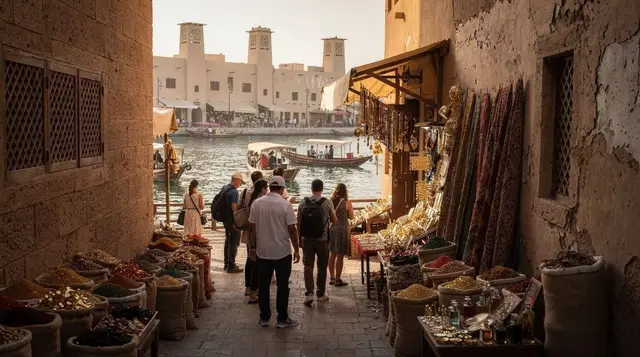
An abra is a traditional wooden motor launch — low-slung, open-sided, with simple bench seating running down the middle — that has ferried passengers across Dubai Creek for generations, long before bridges and tunnels gave drivers an alternative route between the Creek’s two banks. It remains genuine working transport today, not a preserved-for-tourism relic: residents and commuters use it daily alongside visitors, and it’s still often the fastest way to get between Deira and Bur Dubai for anyone starting or ending their trip near either bank.
The fare: honestly, still 1 AED
The shared abra crossing costs 1 AED per person — around 0.30 USD — paid in cash directly to the boatman once aboard, or occasionally at a small ticket kiosk beforehand depending on the station. This nominal fare has held for a remarkably long time specifically because the crossing is treated as essential public transport rather than a revenue-generating tourist activity, and it remains one of the very few things in Dubai that costs almost nothing regardless of the city’s broader cost of living. Bring a 1 AED coin or small note; boatmen can generally make change for slightly larger bills but appreciate exact fare given the volume of passengers they handle.
This old town, Creek, abra, and souks guided walking tour builds the crossing into a structured route with a guide, useful if you’d rather not work out which station to use on your own.
A short history of the abra
Abras have carried passengers across Dubai Creek since well before the city’s oil-era transformation, back when the Creek was the primary artery of Dubai’s trading economy and there was no bridge or tunnel connecting Deira and Bur Dubai at all. For generations, the abra wasn’t an option among several ways to cross — it was the only way, which is part of why the fare has stayed so deliberately low even as bridges, a tunnel, and the Metro’s Green Line have since given commuters faster alternatives. Dubai’s transport authority maintains the service today less as a tourist attraction than as a continued public transit commitment, a rare piece of the city’s pre-development infrastructure still functioning essentially as it always has.
Modernization: newer abras alongside the traditional fleet
In recent years, Dubai’s transport authority has introduced a newer generation of abras — cleaner-burning engines, slightly more comfortable seating, and in some cases fully electric propulsion — running alongside the traditional wooden-hulled fleet on the same routes. Both versions charge the same 1 AED shared fare, and which one shows up for your specific crossing is essentially random rather than something you can request. Purists sometimes prefer the older wooden boats for the authentic creak-and-diesel-engine experience, but the newer boats are just as functional and, if anything, slightly smoother.
Where to catch one
The two main shared abra stations sit roughly opposite each other on the Creek: the Bur Dubai Abra Station, near the Textile Souk and a short walk from Al Fahidi, and the Deira Old Souk Abra Station, near the Spice Souk and a short walk from the Gold Souk. Both are easy to find — look for a cluster of waiting boats and a steady flow of foot traffic feeding toward the water — and neither requires advance booking or a ticket purchased in advance for the standard shared crossing.
How the shared crossing actually works
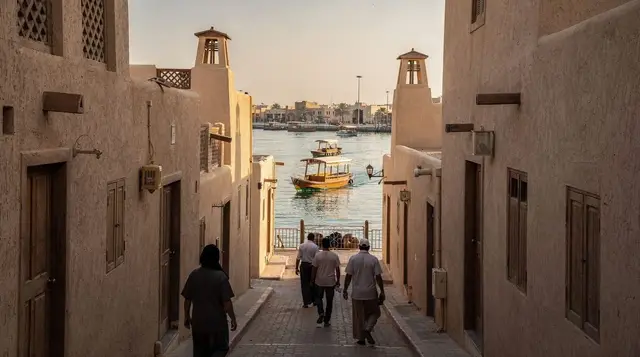
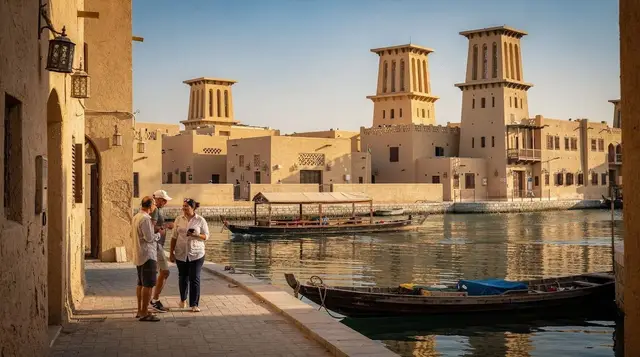
Boats depart once full rather than on a fixed schedule, so there’s no timetable to plan around — you simply arrive, board the next boat with space, and it leaves within a few minutes. A typical shared abra seats 20-25 passengers along its central bench, facing outward toward the water on either side. The crossing itself takes 5-10 minutes, giving a low, close-to-the-water view of the Creek, the working dhows moored along both banks, and the wind-tower rooflines of Old Dubai — a perspective no bridge or road route replicates.
Private (chartered) abras
Beyond the point-to-point shared crossing, you can hire a private abra for a leisurely sightseeing loop along the Creek rather than a direct crossing — a boatman will negotiate a price, typically in the range of AED 100-150 per boat for roughly 30 minutes, for you and your group to have the boat to yourselves rather than sharing with other passengers. This suits couples, families, or small groups wanting unhurried photos and a slower pace along the water without needing to disembark at a fixed opposite station. Negotiate the price and duration clearly before boarding, since terms aren’t standardized the way the shared fare is.
Etiquette on board
There’s no formal boarding order or ticket check on the shared crossing — passengers step aboard as space allows, generally filling from the far end toward the entry point, and it’s normal (and expected) to shuffle along the bench to make room for others rather than leaving a gap. Offering a seat to elderly passengers or anyone visibly struggling with the step down is a small, genuinely appreciated courtesy, consistent with everyday local norms rather than a tourist-specific expectation. Loud conversation or disruptive behavior is uncommon and mildly frowned upon; most crossings are quiet, functional trips rather than a social occasion, even for tourists riding purely for the experience.
Abra versus bridge, tunnel, or Metro
Dubai has several road bridges, a tunnel, and the Metro’s Green Line connecting Deira and Bur Dubai now, all faster for a purely practical crossing than waiting for and riding an abra. The abra remains the better choice specifically when the crossing itself is part of the point — sightseeing, photography, or simply wanting the traditional experience — rather than when speed matters most. For a purely functional cross-Creek trip with luggage or in a hurry, a taxi via one of the bridges or the Metro’s Al Ghubaiba and Al Ras stations covers the same route faster, if with far less character.
Timing your crossing
The abra runs into the evening (roughly until 10-11pm depending on season and demand), which opens up a genuinely different, quieter, and arguably more atmospheric version of the ride after dark, when the Creek’s buildings and passing dhows are lit up and reflected on the water. Daytime crossings are busier and more purely functional — useful if you’re simply getting from one souk to another — while an evening or early-night crossing works better as a standalone experience in its own right. Midday in summer (June-September) is the least pleasant time, given the lack of shade on the open-sided boats and the surrounding heat, though the short duration of the ride limits the discomfort compared to a longer outdoor activity.
This walking tour of old Dubai, the souks, and an abra boat ride times its Creek crossing within a broader guided route, useful if you want the ride bundled with commentary on what you’re seeing along both banks.
Combining the abra with the souks and Old Dubai
Most visitors treat the abra as the connective piece of a longer Old Dubai visit rather than a standalone destination — crossing from Al Fahidi on the Bur Dubai side to the Gold and Spice Souks on the Deira side, or vice versa. See the Old Dubai walking guide for a full route built around this exact crossing, with realistic timing for the whole loop.
This old town, souks, street food, and abra ride tour pairs the crossing with food stops on both banks, a reasonable structure if you want to eat your way through the visit rather than just walk it.
Abra versus a dhow dinner cruise: not the same thing
It’s worth being clear about the distinction, since first-time visitors sometimes conflate the two: the abra is a short, cheap, functional (or lightly touristic) crossing lasting minutes, while a dhow dinner cruise is a two-hour evening experience with a buffet meal and entertainment, priced from roughly AED 100-250 depending on route and operator. They’re genuinely complementary rather than substitutes — riding an abra during a daytime souks visit and booking a separate dhow cruise for an evening meal covers two different, non-repetitive experiences on the same waterway.
The dhow cruise guide and the Creek versus Marina cruise comparison cover that separate experience in full.
Accessibility and practical notes
Boarding involves a step down from the dock into a boat that sits low in the water and rocks slightly, which can be difficult for wheelchair users, anyone with significant mobility limitations, or very young children without assistance — boatmen generally help passengers on and off, but there’s no ramp or lift at either station. There’s no dedicated seating priority system on the shared crossing; it’s informally first-come, first-seated. Life jackets aren’t provided or required for this short, calm-water crossing, consistent with its treatment as everyday local transport rather than a formal tourist boat ride.
Weather and seasonal notes
The Creek is sheltered water, so the crossing is smooth in nearly all conditions, though occasional shamal wind spells (roughly December-February) can add a bit of chop. Rain is rare in Dubai generally, but on the infrequent occasions it happens, the open-sided abra offers no real shelter — a minor consideration given how uncommon rain is here. See Dubai weather month by month for the fuller seasonal picture beyond this specific crossing.
Photography from the water
The abra gives a genuinely different photo angle than shooting from either bank — a low, close-to-the-water perspective on the Creek’s working dhows, the Gold and Spice Souk buildings, and Al Fahidi’s wind towers. Sunset and shortly after dark tend to produce the most striking shots, when the warm evening light or the buildings’ lighting reflects on the water’s surface. Holding a phone or camera securely matters more here than on solid ground, given the boat’s gentle rocking motion.
Riding an abra with kids
Children generally love the abra — it’s short, novel, and the low, open boat gives a genuinely exciting view of the water for young passengers. The main practical consideration is the step down into the boat, which is a bigger gap for a small child than an adult, so keep a firm hand on younger kids during boarding and disembarking specifically. There’s no seating restriction by age; children sit on the same bench seating as everyone else, with a parent alongside.
Old crossing, new skyline: the contrast worth noticing
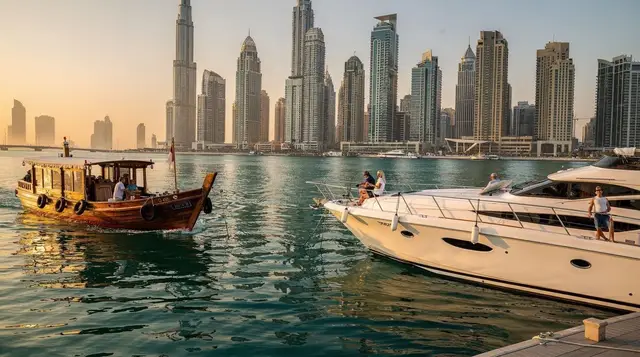
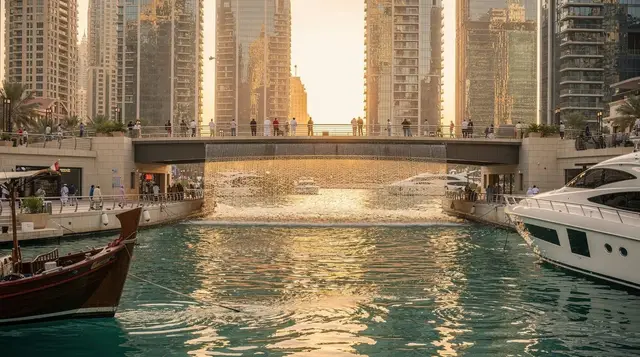
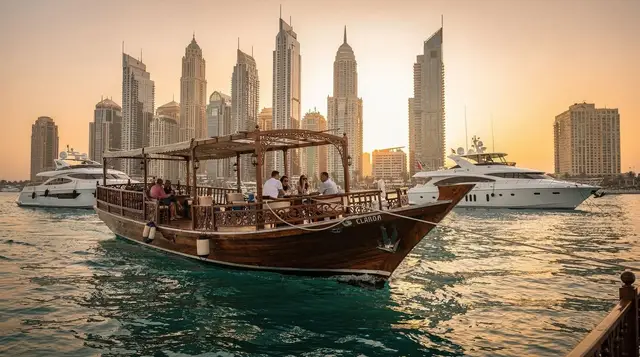
Part of what makes the abra experience land emotionally for a lot of visitors is the contrast it sits inside: a centuries-old form of transport, still running exactly as it always has, within sight (in some spots) of Dubai’s ultra-modern skyline just a few kilometers away. Riding the abra right after visiting Downtown Dubai or before an evening at Dubai Creek Harbour’s newer, high-rise waterfront development sharpens this contrast more than experiencing either extreme in isolation — it’s a genuinely useful way to feel the span of Dubai’s transformation within a single day rather than reading about it.
Abra fare versus other ways across the Creek
The abra’s 1 AED fare only makes sense next to what the alternatives actually cost, so here’s the comparison:
| Option | Cost | Time | Best for |
|---|---|---|---|
| Shared abra | ~1 AED | 5-10 min crossing + wait | The experience itself, souk-to-souk hops |
| Metro (Green Line) | ~3-7.5 AED | 10-15 min incl. walk | Speed, luggage, air conditioning |
| Taxi via bridge/tunnel | ~15-30 AED | 15-25 min depending on traffic | Door-to-door, groups, heat avoidance |
| Private chartered abra | ~AED 100-150/boat | ~30 min loop | Photos, couples, unhurried sightseeing |
None of these fully substitutes for the others — the abra wins on character and price, the Metro on reliability, and a taxi on convenience when you’re carrying bags or traveling in Dubai’s peak summer heat.
Which side to start from
If you’re coming from Downtown Dubai or the Marina, arriving via the Bur Dubai side puts you closer to Al Fahidi and the Textile Souk first, saving the Gold and Spice Souks on the Deira side for after the crossing — a logical direction if you’re building a half-day loop. Coming from the airport or a Deira hotel, starting on that side and crossing toward Bur Dubai works just as well; the abra runs both directions equally, so there’s no wrong way to do it, only a matter of which souk you’d rather see first while you’re fresh.
Common mistakes visitors make
The most frequent one is overpaying — handing over a large bill without waiting for change, or assuming (incorrectly) that a “tourist rate” applies above the standard 1 AED fare. It doesn’t; the fare is the same for everyone, and a boatman asking for noticeably more than 1 AED for the shared crossing is the exception, not the rule, and worth politely questioning. A second mistake is treating the abra purely as a photo op without actually taking the short ride — the view and sensation from on the water is meaningfully different from photographing the boats from the dock, and skipping the actual crossing misses most of the point.
Is the abra worth doing if you’re short on time?
Yes, more than almost any other single Dubai experience relative to its cost and time commitment. Ten minutes and roughly 30 US cents gets you a genuinely memorable, distinctly Dubai experience that doesn’t require booking, planning, or spending a significant chunk of a day — it’s easy to fit into even the tightest layover or single-day itinerary. See the 24-hour layover itinerary (or the equivalent 48-hour layover for a longer stop) for how a quick abra crossing fits into a very short Dubai visit.
Combining the abra with a visit further along the Creek
Beyond the historic crossing point near the souks, Dubai Creek extends much further, toward Dubai Creek Harbour’s newer waterfront towers and, further still, toward the Ras Al Khor Wildlife Sanctuary, home to flocks of flamingos visible from designated hides — a genuinely different, quieter side of the Creek from the busy souk-side crossing covered in this guide. It’s not part of the shared abra route, but it’s worth knowing the Creek’s identity extends well beyond the historic crossing point if the waterway itself interests you beyond this single experience.
The bottom line
The abra is, almost without qualification, Dubai’s best value-per-dollar experience — a functioning piece of everyday infrastructure that happens to double as one of the city’s most memorable few minutes for visitors. Don’t overthink it: show up at either station, hand over a coin, and take the short ride across a waterway that’s been central to Dubai’s identity for far longer than the skyline that now surrounds it.
Frequently asked questions about riding an abra
What exactly is an abra?
A traditional wooden motor launch used to ferry passengers across Dubai Creek, still in everyday use by residents and visitors alike.
Where do I catch a shared abra?
At the Bur Dubai Abra Station near the Textile Souk, or the Deira Old Souk Abra Station near the Spice Souk.
How do I pay?
Cash only — 1 AED per person, paid to the boatman on board or at a small kiosk beforehand.
What’s the difference between shared and private abras?
Shared abras are the 1 AED point-to-point crossing; private (chartered) abras cost roughly AED 100-150 for a 30-minute sightseeing loop.
How long does the crossing take?
About 5-10 minutes on the water, plus a short wait for the boat to fill.
Is it safe?
Yes, for a short, calm-water crossing with decades of everyday use, though no life jackets are provided and boarding requires a small step down into a rocking boat.
Can I ride an abra at night?
Yes, typically until 10-11pm, and the lit-up evening version is genuinely one of the more atmospheric ways to experience it.
Do I need to book an abra in advance?
No. The shared crossing has no booking system — you simply arrive at either station and board the next boat with space. Only a private chartered abra involves any negotiation, and that happens on the spot with a boatman at the dock, not through advance booking.
Is the abra crossing wheelchair accessible?
Not really. There’s a step down from the dock into a low, slightly rocking boat with no ramp or lift at either station, which makes it difficult for wheelchair users or anyone with significant mobility limitations, even with a boatman’s help boarding.
Top experiences
Bookable activities with verified prices and instant confirmation on GetYourGuide.