Al Fahidi historical district guide: wind towers, galleries, and museums
Walking tour in old Dubai: souks, abra boat & old town
What is Al Fahidi and is it worth visiting?
Al Fahidi (formerly Bastakiya) is Dubai's best-preserved pre-oil neighborhood — a compact grid of coral-and-gypsum houses topped by wind towers, now home to art galleries, small museums, and the Sheikh Mohammed Centre for Cultural Understanding. It's free to walk, takes 45-90 minutes, and is one of the few Dubai attractions that rewards unhurried wandering over a checklist visit.
What Al Fahidi actually is
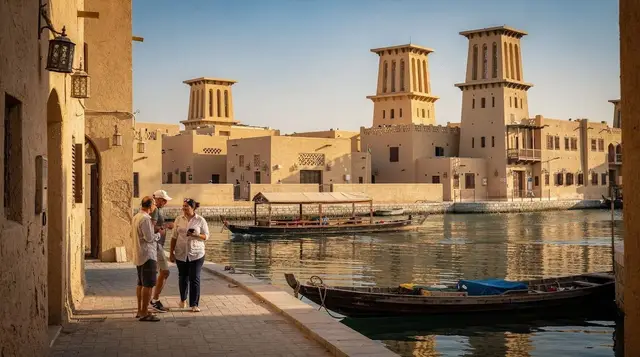
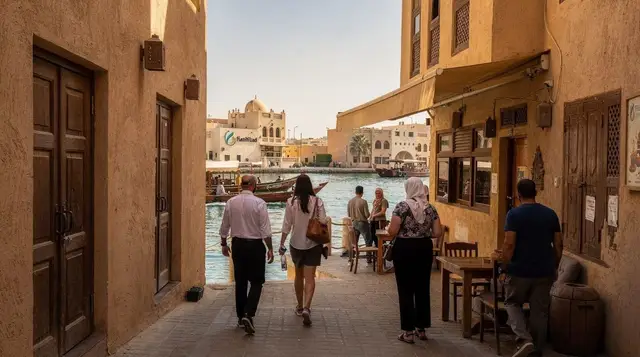
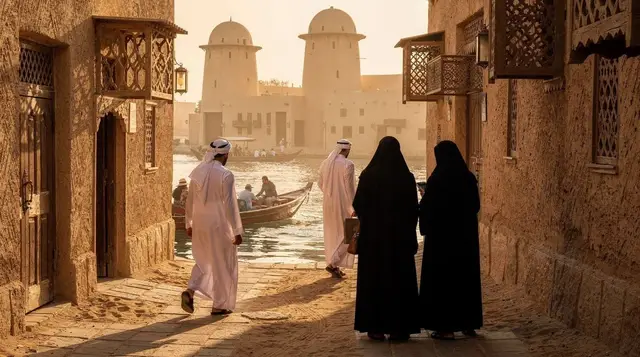
Al Fahidi Historical Neighbourhood sits in Bur Dubai, a few minutes’ walk from Dubai Creek, and is the single largest surviving cluster of Dubai’s pre-oil architecture — roughly 50 restored buildings across a compact grid of sandy lanes, most dating from the 1900s-1930s. It was known for decades as Bastakiya, after the Persian merchant families from the Bastak region who built much of it, and the older name is still used informally even though Al Fahidi (from the nearby Al Fahidi Fort) is now the official one.
Nothing here is reconstructed or staged for tourism the way some heritage villages elsewhere in the region are — these are genuine historic buildings, restored rather than rebuilt from scratch, which is part of why the area feels different from a manufactured attraction.
| Where | Bur Dubai, near Al Fahidi Metro (Green Line) |
| Cost | Free to walk; SMCCU sessions ~AED 65-95 |
| Time needed | 45-90 minutes; up to 2 hours with SMCCU or the Coffee Museum |
| Getting there | Metro (Al Fahidi station), taxi, or on foot from the Textile Souk |
| Best time | Early morning or late afternoon, outside the 10am-1pm tour-group window |
The wind towers, explained properly
The defining architectural feature is the barjeel, or wind tower — a square chimney-like structure rising above each house, open on all four sides to catch breeze from whatever direction it’s blowing and channel it down into the rooms below. This predates air conditioning by centuries and was, for its time, a genuinely effective passive cooling system; standing directly beneath one on a hot day, you can feel a noticeable draft even when the air outside feels still. Al Fahidi has the highest concentration of intact wind towers left in the city, since most of Dubai’s other historic buildings were demolished during the rapid development of the 1970s-1990s.
Look up as you walk rather than only at eye level — the towers are the whole point of the architecture, and it’s easy to miss them if you’re focused on shopfronts and gallery doors.
Galleries worth seeking out
Several of Al Fahidi’s restored courtyard houses now operate as art galleries, and XVA Gallery is the best established — a working contemporary art space (with an attached small boutique hotel and café) that’s hosted Middle Eastern and international artists for years inside a genuinely old building, which gives it a different atmosphere from a white-cube gallery elsewhere in the city. Smaller galleries rotate through the neighborhood more frequently, so it’s worth simply popping your head into open doorways as you walk rather than working from a fixed list — many operate on a browse-freely basis without an entry fee.
The Coffee Museum
A short walk from the main lanes, the Coffee Museum occupies a traditional house and covers the history and preparation of Arabic coffee (qahwa) — the cardamom-spiced, unsweetened coffee served in small handleless cups that’s central to Emirati hospitality. It’s a small, quick visit (20-30 minutes) with a modest entry fee, and it pairs well with actually being served a cup of traditional coffee on-site, which is arguably more instructive than the exhibits themselves about why the ritual matters culturally. The full museums guide covers this alongside Dubai’s other heritage museums for a fuller comparison.
Dubai Museum and Al Fahidi Fort: check before you go
Al Fahidi Fort, at the edge of the neighborhood, is Dubai’s oldest surviving building and historically housed Dubai Museum, covering the city’s pearling, Bedouin, and pre-oil history. It has faced extended renovation closures in recent years with repeatedly shifting reopening timelines, so treat any specific claim about its current status — including this one — as something to verify directly (via Dubai’s official tourism channels) rather than plan around sight unseen. This is a good general rule for smaller heritage sites across Old Dubai: opening hours and operating status change more often here than at major paid attractions with dedicated ticketing systems.
SMCCU: the cultural bridge organization based here
The Sheikh Mohammed Centre for Cultural Understanding operates out of a traditional house in Al Fahidi and exists specifically to give visitors direct, informal access to Emirati culture — its motto, roughly, is “open doors, open minds.” Its signature program is a cultural breakfast or lunch where a small group sits with an Emirati host, shares a traditional meal, and can ask genuinely any question about religion, customs, dress, or daily life without judgment; it’s consistently the most-praised structured cultural activity in Dubai precisely because it answers questions visitors often feel awkward asking a stranger. SMCCU also runs guided mosque visits and heritage walking tours through Al Fahidi itself.
Sessions typically run AED 65-95 (18-26 USD) and require advance booking, since group sizes are kept deliberately small. The Emirati culture and etiquette guide covers many of the same topics SMCCU addresses in session, for context before or instead of booking one.
The Sikka Art & Design Festival
Roughly once a year (historically in the cooler months, though exact dates shift), Al Fahidi hosts the Sikka Art & Design Festival, a multi-day event that opens up additional courtyards, installations, and pop-up craft stalls beyond the neighborhood’s usual permanent galleries. If your trip happens to overlap with it, it’s worth prioritizing — the neighborhood gets a genuinely different energy with live art-making, music, and a much higher density of things to see than on a normal day. Outside festival dates, Al Fahidi is quieter and more contemplative, which suits most visitors just as well but is a different experience worth knowing about in advance.
Shops and small purchases inside Al Fahidi
Unlike the Deira souks, Al Fahidi isn’t primarily a shopping destination, but a handful of small boutiques attached to galleries sell genuine local and regional crafts — textiles, ceramics, and small art pieces — at fixed (non-haggled) prices generally higher than souk equivalents but reflecting curated, often locally made goods rather than souk-standard imported souvenirs. If bargaining and volume shopping is what you want, save it for the Gold or Spice Souk instead; Al Fahidi’s retail is smaller-scale and more considered.
Common misconceptions about Al Fahidi
A frequent one is assuming the neighborhood is a reconstructed heritage village built for tourism, similar to attractions elsewhere in the Gulf — it isn’t. These are genuine early-1900s buildings, restored rather than rebuilt, and the distinction matters to anyone interested in authenticity over polish. A second misconception is that a quick 15-minute walk-through “does” the neighborhood; because so much of the value here is in noticing architectural detail and stepping into galleries rather than seeing a single headline sight, a rushed pass genuinely misses most of what makes it worthwhile.
A third is assuming it’s a large area requiring a half-day — it’s compact, and even a thorough visit rarely exceeds two hours unless you’re adding SMCCU programming.
Visiting with kids
Al Fahidi works reasonably well for families — it’s flat, safe, car-free within the lanes, and kids tend to enjoy the maze-like feel of the alleys along with spotting the wind towers once you explain what they do. The main limitations are that most galleries and the Coffee Museum are more engaging for adults, and there isn’t dedicated kid-focused programming the way some family attractions offer. A morning here pairs well with a more active kid-oriented stop later in the day, such as one of the family theme park guides, rather than being the sole activity of a day with young children.
Al Fahidi versus other heritage areas in the region
Compared to Sharjah’s Heritage Area, which is larger and more museum-dense with formal ticketing across multiple sites, Al Fahidi is smaller, more organic to wander, and leans more toward galleries and cafés than curated museum exhibits. Neither is strictly better — Al Fahidi suits a shorter, more relaxed visit within a broader Dubai day, while Sharjah’s heritage district (covered in the Sharjah culture guide) rewards a dedicated half-day trip on its own. Visitors doing both across a longer UAE trip generally find them complementary rather than redundant.
How Al Fahidi connects to the wider Old Dubai walk
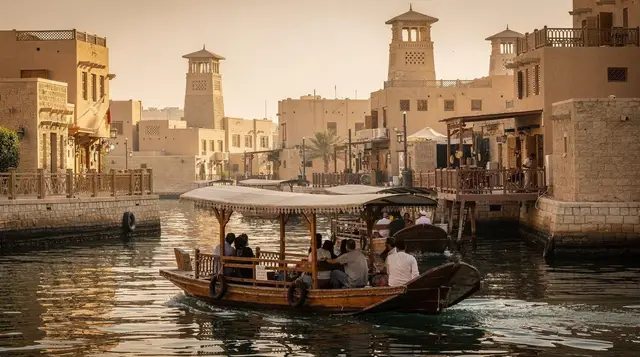
Al Fahidi is the western anchor of the broader Old Dubai walking route, which continues from here toward the Textile Souk, an abra crossing over Dubai Creek, and the Deira souks on the far bank. If you’re only interested in the historic neighborhood itself rather than the full loop, Al Fahidi works perfectly well as a standalone 45-90 minute visit — it doesn’t require continuing on to justify the trip out.
This guided walking tour of old Dubai, the souks, and an abra boat ride includes Al Fahidi as its starting point with a guide who can point out details — which houses belonged to which merchant families, which wind towers are original versus reconstructed — that aren’t obvious from a self-guided walk.
This old town, Creek, abra, and souks guided walking tour is another option covering the same neighborhood, structured slightly differently around the Creek crossing and souks for anyone wanting to extend beyond Al Fahidi itself on the same booking.
Timing and crowds
Al Fahidi is busiest in the mid-morning (10am-1pm) when tour groups and cruise-ship day visitors tend to pass through, though “busy” here is relative — it never feels genuinely crowded the way Dubai Mall or Burj Khalifa do. Early morning (before 9am) or late afternoon (after 4pm) gives the quietest, most atmospheric version of the neighborhood, and also avoids the worst of the heat, which matters more here than the crowd levels do. Shade is inconsistent across the lanes — narrower alleys between tall buildings stay cooler, while open courtyards get full sun by mid-morning.
Food and coffee stops
Several restored houses operate as cafés, ranging from simple Arabic coffee and dates to full restaurant menus in a courtyard setting. Arabian Tea House is a well-known example, serving Emirati dishes in a shaded courtyard that’s genuinely pleasant to sit in rather than just a photo backdrop. Prices run moderate by Dubai standards — a full meal for two might run AED 120-200 (33-54 USD) — reflecting the setting rather than being a tourist markup specifically. It’s a reasonable place to break up a longer Old Dubai walk rather than pushing straight through to the souks without a rest.
What SMCCU sessions actually cover
Beyond the headline cultural breakfast, SMCCU runs several distinct programs worth distinguishing between when booking. The mosque visit takes small groups into Jumeirah Mosque (covered in full in the Jumeirah Mosque guide) with a guided explanation of Islamic practice and mosque etiquette. The heritage tour walks Al Fahidi itself with commentary on specific buildings and the merchant families who built them. The cultural meal — breakfast, lunch, or in some cases dinner — is the most popular, structured around open Q&A with an Emirati host over a shared traditional spread that typically includes dishes like harees, luqaimat, and Arabic coffee.
Each runs as a separate bookable session rather than one combined tour, so decide in advance which specific experience you want rather than assuming one booking covers everything SMCCU offers.
Seasonal considerations beyond the summer heat
Outside the June-September heat window covered elsewhere in this guide, Ramadan is the other seasonal factor worth planning around specifically in Al Fahidi, given SMCCU’s cultural mission and the presence of a working mosque nearby. During Ramadan, some cafés adjust hours around fasting times, and SMCCU runs special Ramadan-specific programming (including Iftar experiences) that’s genuinely worth booking if your trip overlaps with the holy month — it’s one of the more meaningful ways to experience Ramadan as a visitor rather than simply working around its restrictions. The Ramadan guide covers how the month affects Dubai more broadly, including this neighborhood specifically.
Getting there
Al Fahidi sits a short walk from Al Fahidi Metro Station on the Green Line, making it one of the more transit-accessible historic sites in the city, and it’s equally reachable by taxi or Careem from Deira, Downtown Dubai, or Dubai Marina (15-30 minutes depending on traffic and starting point). There’s no dedicated parking within the neighborhood itself, so drivers typically park at the nearby Textile Souk car park and walk in.
Booking an SMCCU session in practice
SMCCU sessions fill up, particularly the cultural breakfast, and same-day walk-in availability isn’t reliable — book at least a few days ahead through SMCCU’s own website rather than assuming you can turn up and join. Sessions run in small groups (often under 20 people), seated together at long tables, which is deliberate: it keeps the Q&A conversational rather than lecture-style. Arrive on time, since latecomers can disrupt the seated, communal format, and dress modestly as you would anywhere else in Al Fahidi — SMCCU explicitly welcomes visitors regardless of dress mistakes made out of ignorance, but arriving already appropriately dressed makes the visit smoother for everyone.
Photography inside is generally welcome, though it’s good practice to ask your host before taking photos of them specifically, the same courtesy that applies throughout the souks and the wider neighborhood.
Accessibility notes
The lanes are narrow, with some uneven, sandy-textured paving that reflects the historic (rather than purpose-built-accessible) nature of the site, and several buildings have raised thresholds or a step or two at entrances rather than a level approach. It’s manageable for most visitors but not fully wheelchair-friendly, and anyone with significant mobility limitations should expect to see the neighborhood from its main through-lanes rather than every side alley and gallery interior.
Combining Al Fahidi with the rest of Old Dubai
Most visitors treat Al Fahidi as one stop within a longer morning covering the souks and an abra crossing on the Creek’s far bank — see the Old Dubai walking guide for the full route with realistic timing. If your schedule only allows for one stop in this part of the city, Al Fahidi is the strongest single choice, since it concentrates the neighborhood’s most photogenic architecture and its best cultural-context opportunities (via SMCCU) into the smallest single area.
Practical amenities
Public restrooms exist near the main courtyards and inside several cafés (generally for paying customers), though they’re not as densely available as in a mall, so plan around café stops rather than expecting facilities on every corner. Free drinking water isn’t broadly available, so carry a bottle, particularly outside the cooler months. Wi-Fi coverage is inconsistent across the lanes; don’t count on it for navigation and instead download an offline map or rely on the neighborhood’s small enough footprint to navigate by landmark.
Al Fahidi versus Al Seef: two waterfront heritage looks
Visitors sometimes confuse Al Fahidi with Al Seef, the newer waterfront heritage-style development along the Creek closer to Downtown. They’re genuinely different: Al Fahidi is original 1900s-1930s architecture, restored rather than rebuilt, with a quieter, more contemplative feel; Al Seef is a modern, purpose-built strip designed to evoke traditional style, with a more polished promenade, shops, and dining aimed squarely at a leisurely evening out. Neither replaces the other — Al Fahidi rewards visitors after authentic history, while Al Seef suits an easy waterfront stroll with food and photo spots built in.
A realistic one-hour route through the lanes
For visitors with exactly an hour, start at Al Fahidi Metro station and enter the lanes from the eastern edge, working west toward XVA Gallery and the Coffee Museum, looking up at wind towers as you go rather than only at shopfronts. Duck into two or three open gallery doorways along the way — there’s no fixed route, and the neighborhood’s compact grid means you genuinely can’t get lost. Finish at a courtyard café like Arabian Tea House for a short coffee break before continuing on to the Old Dubai walking guide’s next stop, the Textile Souk and Creek crossing, if time allows.
The bottom line
Al Fahidi rewards visitors who slow down rather than checklist through it — the wind towers, the galleries tucked into old courtyard houses, and SMCCU’s cultural sessions all work better with unhurried time than with a rushed 20-minute pass-through. It’s free to walk, cheap to add a museum or coffee stop to, and remains one of the few places in Dubai where the city’s pre-skyscraper history is genuinely tangible rather than something you read about on a plaque elsewhere.
Frequently asked questions about Al Fahidi historical district guide
Is Al Fahidi free to visit?
Walking the lanes is free. Individual galleries mostly don't charge entry, though a few small museums and SMCCU's guided programs (cultural breakfasts, mosque visits, heritage tours) charge a fee, typically AED 65-95 (18-26 USD) for a structured session.What's the difference between Al Fahidi and Bastakiya?
They're the same place. Bastakiya is the older name, referencing the Bastak-region Persian merchants who settled and built here in the early 1900s. Al Fahidi (named for the nearby fort) is the name Dubai's municipality formally adopted, and it's the name used on current signage and maps, though many longtime residents still say Bastakiya.How long should I spend in Al Fahidi?
45-60 minutes for a straightforward walk through the lanes and a gallery or two; 90 minutes to 2 hours if you add the Coffee Museum, a courtyard café stop, or an SMCCU program. It's small enough that you can't really get lost, which makes it easy to right-size the visit to however much time you have.What is SMCCU and should I book one of their tours?
The Sheikh Mohammed Centre for Cultural Understanding is based in Al Fahidi and runs structured sessions — including a cultural breakfast or lunch where you can ask an Emirati host anything about local customs, religion, and daily life — specifically designed for visitors. It's worth booking if you want direct, judgment-free answers to questions you might otherwise feel awkward asking; it's less essential if you're mainly here for the architecture and galleries.Is Dubai Museum at Al Fahidi Fort open?
Dubai Museum has faced extended renovation closures in recent years, and its status changes periodically — check current opening hours directly before planning a visit around it specifically, rather than assuming it's open based on older travel guides.What should I wear to Al Fahidi?
Shoulders and knees covered, for both men and women. This is a conservative, culturally significant area with a working mosque and SMCCU's cultural mission nearby, and modest dress is expected rather than optional.Is Al Fahidi worth visiting if I've already done the Old Dubai walking route?
Al Fahidi is the anchor stop of that broader route, so if you've done the full walk you've likely already covered it. This guide is for visitors who want to focus specifically on the neighborhood itself — its galleries, museums, and SMCCU programs — in more depth than a single pass-through allows.
Top experiences
Bookable activities with verified prices and instant confirmation on GetYourGuide.