Dubai Creek & Creek Harbour — abra crossings and dhow wharfage
Dubai Creek guide: the AED 1 abra crossing, dhow dinner cruises, Creek Harbour's new waterfront, and the Ras Al Khor flamingo hides.
Dubai: dhow dinner cruise along Dubai Creek
Quick facts
- What it is
- Natural saltwater inlet dividing Bur Dubai and Deira
- Abra crossing
- AED 1 (0.30 USD) shared, five-minute ride
- Creek Harbour
- Newer waterfront district further inland, Dubai Frame-era development
- Wildlife
- Ras Al Khor Sanctuary flamingos at the Creek's inland end
- Best time
- Early morning or after 4pm for the older stretches; year-round for Creek Harbour
What Dubai Creek actually is
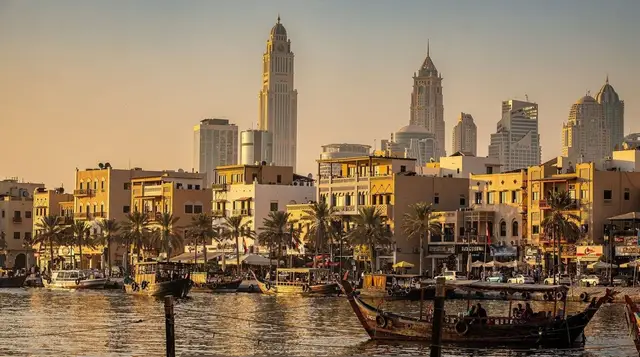
Dubai Creek is the natural saltwater inlet that gave the city its start, dividing Bur Dubai on the south bank from Deira on the north and functioning as the working port that built Dubai’s trading economy long before oil or tourism did. It stretches roughly 14 kilometers inland from the Gulf, and its character changes dramatically along that length — from the historic abra crossings and dhow wharfage near the mouth, to the newer, high-rise Dubai Creek Harbour development further inland, to the sail-shaped golf and yacht club midway along its length, to the quiet mangroves and flamingo flats of the Ras Al Khor Wildlife Sanctuary near its southern end.
Unlike a purely artificial waterway such as the Dubai Canal or the Marina, the Creek is a genuine natural feature that predates the city entirely and shaped its earliest settlement pattern, which is part of why its ecosystem — including the mangroves and wading birds further inland — has survived alongside decades of surrounding development rather than being engineered from scratch.
Most visitors experience the Creek through its historic stretch, covered in the old Dubai walking guide and the Deira destination page, but the full Creek corridor rewards a longer look if you’re interested in the wildlife sanctuary or the newer waterfront development at Creek Harbour. Few visitors realize just how far the Creek’s influence extends beyond the postcard abra shot, from working port infrastructure at one end to a genuine wildlife refuge at the other.
| Where | Natural saltwater inlet dividing Bur Dubai and Deira |
| Cost | Abra AED 1 (0.30 USD); dhow dinner cruises AED 150–350pp |
| Time needed | Half a day for the abra and old Creek; add hours for Creek Harbour or Ras Al Khor |
| Getting there | Green Line metro to either bank, or taxi to Ras Al Khor |
| Best time | November–March for daytime walks; year-round for evening cruises |
The abra crossing
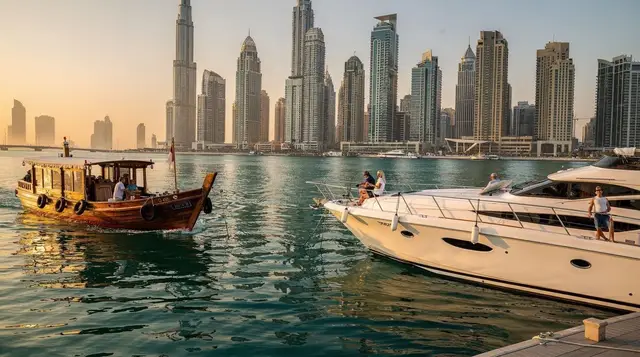
The abra — a small, open wooden motorboat, largely unchanged in design for generations — has crossed the Creek between Bur Dubai and Deira for longer than any bridge or tunnel has existed here, and it remains the fastest way across for foot traffic at AED 1 (about 0.30 USD) for a shared crossing, paid to the boatman once aboard. The ride takes roughly five minutes and gives a low, on-the-water view of the dhow wharfage — traditional cargo boats still loading goods bound for Iran and East Africa, genuinely functioning port infrastructure rather than a staged re-creation. A private abra, chartered for a longer loop, runs AED 20–30 (5–8 USD) for up to 20 minutes. Full detail in the abra Dubai Creek guide.
For a guided version that pairs the abra with the surrounding souks, old town, Creek, abra boat and souks guided walking tour covers the historic Creek corridor in a single session with context on the wharfage and trading history that’s easy to miss on a self-guided crossing.
Dhow dinner cruises
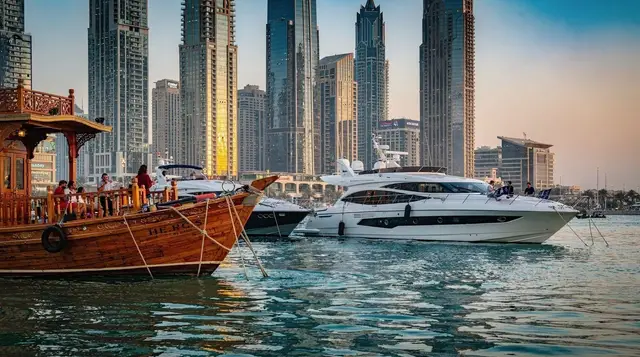
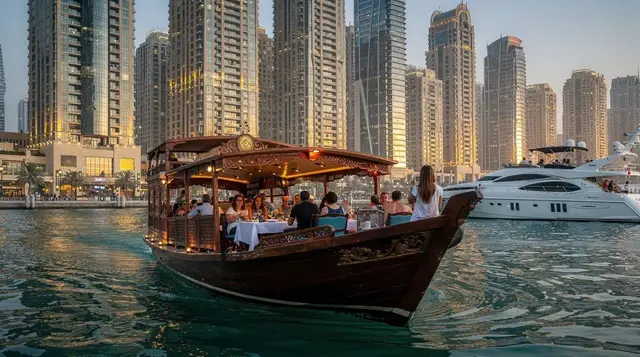
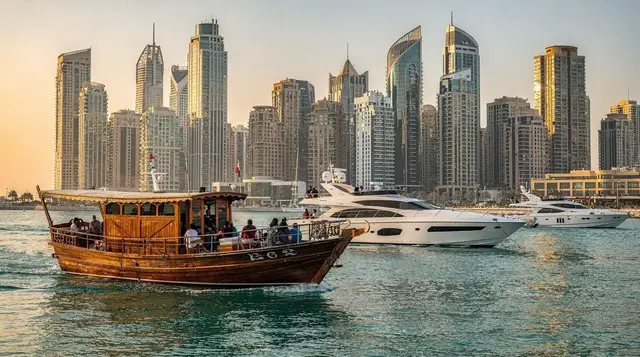
In the evening, traditional wooden dhows refitted with dining decks depart from docks along the Creek for dinner cruises that loop the historic waterfront rather than the Marina’s more modern skyline — a quieter, more atmospheric alternative for anyone who’s already done a Marina cruise or prefers the older part of the city as a backdrop. dhow dinner cruise along Dubai Creek and Al Seef Creek dhow dinner with live entertainment are both standard buffet-and-entertainment versions departing from the Al Seef waterfront promenade on the Bur Dubai side.
For a shorter, more casual option, Dubai Creek dhow cruise with unlimited pizza runs about an hour and suits families or anyone not wanting a full multi-course dinner. See the dhow cruise guide and the Creek vs Marina cruise comparison for how Creek cruises compare to Marina departures.
Dubai Creek Harbour
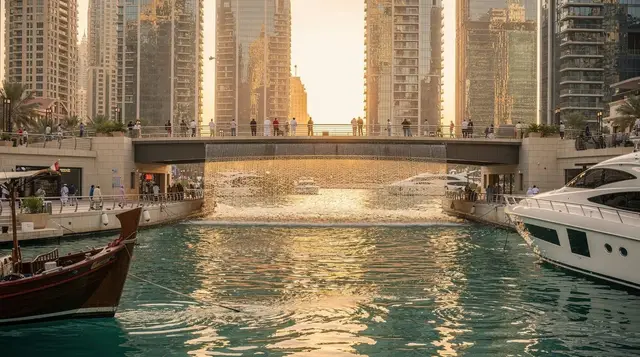
Further inland, Dubai Creek Harbour is a large-scale waterfront development built around the Creek’s newer stretch, with a landscaped promenade, marina, and a skyline of towers still under construction as of the mid-2020s. It’s positioned as a future landmark district — plans for a Creek Tower intended to surpass the Burj Khalifa’s height have been discussed for years but remain unbuilt, so don’t plan a visit around seeing that specific structure yet. What does exist today is a genuinely pleasant, much less crowded waterfront boardwalk with views back toward Downtown’s skyline across the water, plus a growing set of restaurants and cafes aimed at residents as much as visitors.
The development also includes a large public park and a planned wildlife-viewing area that ties directly into the neighboring Ras Al Khor sanctuary’s ecosystem, reflecting an intent to build the newer district around the same waterway’s natural features rather than displacing them entirely — a notably different approach from some of the city’s earlier, more purely commercial waterfront developments.
Creek Harbour is a reasonable stop if you’re interested in seeing how Dubai’s development continues to expand along the same waterway that started the city, though it doesn’t yet have the density of things to do that would justify a dedicated half-day for most first-time visitors.
Ras Al Khor Wildlife Sanctuary
Near the Creek’s inland end, the Ras Al Khor Wildlife Sanctuary is a genuinely surprising stretch of protected mangroves and mudflats that hosts flocks of Greater Flamingos year-round, along with herons, ospreys, and other migratory birds — a striking contrast against the high-rise skyline visible in the background from the hides. Entry is free, and three public hides along Ras Al Khor Road offer viewing without disturbing the birds; the flamingo hide is the most popular and typically has the best numbers in the cooler months from October through April. Bring your own binoculars, since the hides don’t rent equipment, and visit in the early morning or late afternoon when the flamingos are most active and the light is best for photos.
The sanctuary sits directly beneath the flight path of aircraft approaching Dubai International Airport, and the odd sight of flamingos wading in shallow mudflats with jets passing overhead is, in its own way, one of the more memorable juxtapositions the city offers — a reminder of how much of Dubai’s rapid development has grown up around, rather than replaced, its older natural and trading infrastructure.
Dubai Creek Golf & Yacht Club
Overlooking the Creek near its Downtown-facing stretch, the Dubai Creek Golf & Yacht Club is instantly recognizable for its sail-shaped clubhouse, one of the city’s earlier architectural landmarks and a deliberate visual echo of the traditional dhow sails that once filled the same waterway. Beyond the golf course itself, the club’s waterfront restaurants offer a quieter, marina-adjacent vantage on the Creek than the older wharfage further downstream, and it’s a reasonable stop for visitors specifically interested in Dubai’s golf scene or wanting a calmer waterside meal away from the souk crowds. It’s not a headline attraction for most first-time visitors, but it rounds out the Creek’s range from working port to leisure marina within a single waterway.
The Creek’s role in Dubai’s founding history
Dubai Creek is the single most important geographic feature in the city’s early history — the natural harbor it provided is the reason Dubai developed as a trading port at all, drawing merchants from Persia, India, and East Africa long before oil revenue transformed the economy in the latter half of the 20th century. The pearling and fishing trades that sustained the city before the discovery of oil centered directly on this waterway, and the wind-tower architecture still visible in Al Fahidi and parts of Deira was designed specifically to cool homes for a population whose livelihood depended on the Creek.
Understanding this history adds real context to what might otherwise look like a simple boat crossing — the abra route across the Creek is, in a real sense, the oldest continuously operating piece of transport infrastructure in the entire city. See the Al Shindagha Museum for a deeper look at this pearling and trading history, housed directly on the Creek’s banks near its mouth.
Al Seef: the Creek’s newer promenade
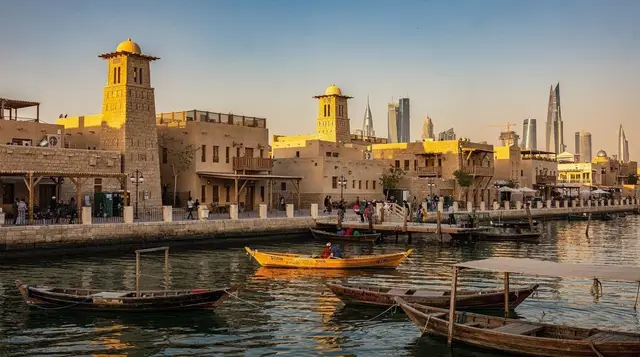
Al Seef, a redeveloped stretch of Creek-side promenade on the Bur Dubai side, blends a deliberately heritage-styled section of low-rise buildings echoing old Dubai’s architecture with a more contemporary strip of restaurants, cafes, and a small marina further along. It’s a popular departure point for several of the Creek’s dinner dhow cruises, including the Al Seef-specific cruise product, and makes a pleasant evening walk in its own right even without booking a cruise — the heritage-styled buildings house galleries and boutique shops that give a polished, tourist-friendly counterpoint to the working wharfage a short walk further along the same bank.
Al Seef is a useful stop for visitors who want a taste of “old Dubai” aesthetics without the crowds and bargaining culture of the actual working souks nearby.
Wildlife and nature beyond Ras Al Khor
Beyond the flamingo hides, the wider Ras Al Khor sanctuary and the mangrove stretches along the Creek’s inland reaches support a broader ecosystem than most visitors realize, including herons, ospreys, and a range of migratory shorebirds that pass through the UAE on routes between Africa, Asia, and Europe. The sanctuary’s continued existence in the middle of a rapidly developed city is itself notable — it survived surrounding development specifically because of a deliberate decision to preserve the wetland habitat, making it a rare example of urban conservation prioritized alongside rather than instead of commercial waterfront development.
Birdwatchers visiting outside the flamingo season (October to April) may find fewer flamingos but a wider variety of resident species worth spotting with patience.
Combining the Creek with a wider day
Because the Creek corridor spans from Deira’s old wharfage through Downtown-adjacent Business Bay and out to Creek Harbour and Ras Al Khor, it’s possible to trace the city’s growth in a single extended day — starting with the abra crossing and souks in the morning, moving to a Business Bay or Creek Harbour walk at midday, and finishing at Ras Al Khor for the flamingos in the late afternoon light. See the Business Bay guide and Dubai Canal guide for how that connecting stretch fits together.
Comparing the Creek’s dhow dinner cruise options
With several similarly named cruise products departing the Creek, it’s worth knowing what actually differs between them before booking:
| Cruise | Length | Style | Best for |
|---|---|---|---|
| Standard buffet dhow dinner | ~2 hours | Full multi-course buffet, live entertainment | A traditional, fuller evening |
| Al Seef Creek soiree | ~2 hours | Buffet dinner, departs from the heritage-styled Al Seef promenade | Combining with an Al Seef stroll beforehand |
| Unlimited pizza cruise | ~1 hour | Casual, shorter, family-friendly | Families or anyone not wanting a full dinner |
All three loop broadly the same historic stretch of the Creek, so the choice mostly comes down to how much time and how formal a dinner you want, not the view itself.
Practical tips for a Creek visit
Comfortable, closed shoes are worth wearing rather than sandals if you plan to walk the wharfage itself, since the quayside surfaces can be uneven and occasionally wet from loading activity. Sun protection matters more along the Creek than in most of the city’s air-conditioned attractions, since the abra crossings, wharfage walks, and Ras Al Khor hides are all fully outdoors with limited shade — a hat and water are worth carrying even for a short crossing, particularly outside the November-to-March cooler months. Photography is generally welcome along the wharfage and at the public hides, though as with the souks, ask before photographing dock workers or boat crews directly rather than assuming it’s fine.
Cash in small denominations is useful for the abra crossing itself, since boatmen collecting the AED 1 fare don’t always carry change for larger notes.
Seasonal variation along the Creek
The Creek’s character shifts noticeably with the seasons in ways that are worth planning around. Winter (November through March) brings the most comfortable conditions for the outdoor stretches — the wharfage walk, the abra crossing, and Ras Al Khor’s hides are all genuinely pleasant during these months, and flamingo numbers at the sanctuary are typically at their highest. Summer (June through September) makes the open-air sections of the historic Creek considerably less comfortable during the day, pushing most visits toward early morning or evening, when dhow cruises departing after sunset remain a viable option regardless of season since the boats themselves offer some relief from direct sun exposure once moving.
| Season | Months | Daytime temp | Creek visit comfort |
|---|---|---|---|
| Cool | November–March | 20–30°C | Best — abra, wharfage walk, and Ras Al Khor hides all pleasant |
| Shoulder | April, October | 30–36°C | Fine early morning or evening; midday less comfortable |
| Peak heat | June–September | 38–45°C+ | Early morning, or evening dhow cruises which offer some relief once moving |
Combining the Creek with Sharjah
For visitors with extra time, the Creek’s trading history connects naturally to Sharjah, Dubai’s northern neighbor emirate, which has its own historic creek (the Khalid Lagoon) and a stronger overall focus on museums and heritage preservation than Dubai itself. A day trip pairing Dubai Creek’s historic stretch with Sharjah’s heritage area gives a fuller regional picture of how trade and pearling shaped this entire coastline, not just Dubai specifically. See the Dubai to Sharjah day trip guide for how that combination works logistically.
Is Dubai Creek worth the time?
Yes, and it’s arguably the most historically layered single stretch of water in Dubai — few other spots let you cross a working 100-year-old trading route by boat, then drive twenty minutes to a wildlife sanctuary with wild flamingos against a skyline backdrop. The historic Deira-to-Bur Dubai stretch is the highest-value section for a first visit; Creek Harbour and Ras Al Khor are worthwhile add-ons for a second day or for visitors specifically interested in wildlife or urban development rather than history. The honest caveat is that Creek Harbour itself is still under construction in parts, so temper expectations if you’re expecting a finished landmark district.
See the 3-day Dubai itinerary for how a Creek day typically fits into a broader trip.
Frequently asked questions about Dubai Creek
How much does the abra cost?
AED 1 (about 0.30 USD) for a shared crossing, paid directly to the boatman. A private charter for a longer loop runs AED 20–30 (5–8 USD).
Is Dubai Creek the same as Dubai Creek Harbour?
No — Dubai Creek is the natural waterway itself; Dubai Creek Harbour is a specific newer development built along a stretch of it further inland from the historic Deira/Bur Dubai crossing.
Is the Ras Al Khor Wildlife Sanctuary free?
Yes, entry to the public hides is free, and no booking is required.
What’s the best time to see flamingos at Ras Al Khor?
Early morning or late afternoon, year-round, though numbers are typically highest from October through April.
Which dhow cruise is better: Creek or Marina?
Creek cruises pass historic wharfage and Old Dubai’s waterfront for a more traditional atmosphere; Marina cruises pass a denser modern skyline. Neither is objectively better — it depends on which backdrop you prefer.
Is the Creek Tower built yet?
No — plans for a tower intended to surpass the Burj Khalifa’s height have been discussed for years but remain unbuilt as of the mid-2020s.
Can I combine the abra crossing with the Gold and Spice Souks?
Yes, this is the standard route — cross by abra, then walk to either souk on the Deira side, or vice versa from Bur Dubai’s Al Fahidi district.
Is Dubai Creek Harbour worth visiting yet?
It’s a pleasant, quieter waterfront walk with skyline views, but much of the district is still under construction, so it doesn’t yet have the density of attractions that would justify a dedicated day for most first-time visitors.
What is Al Seef and how does it relate to the Creek?
Al Seef is a redeveloped Creek-side promenade on the Bur Dubai bank, blending heritage-styled architecture with modern restaurants and cafes, and it’s a common departure point for several Creek dinner dhow cruises.
Is it safe to drink tap water near the Creek area?
Bottled water is the standard recommendation throughout Dubai, including around the Creek, though the tap water itself meets safety standards; most visitors simply prefer bottled water for taste.
Is there an entry fee to walk along the Creek’s wharfage?
No, walking the public sections of the wharfage on either bank is free; only the dhow cruises and any organized tours attached to the area involve a cost.
What’s the best single photo spot along the Creek?
The abra crossing itself, taken from mid-crossing looking back toward the wharfage, captures the working boats, the water, and both banks in a single frame better than any fixed viewpoint on land.
Can I see the Creek’s wharfage without taking the abra?
Yes, both banks have public walkways along sections of the wharfage where you can view the dhows and loading activity without boarding a boat, particularly near the Deira side docks.
Is Ras Al Khor accessible by public transport?
Not directly — the sanctuary’s hides are best reached by taxi or car, since no metro station sits within comfortable walking distance of the viewing points along Ras Al Khor Road.
What is the Dubai Creek Golf & Yacht Club?
A golf course and marina club near the Creek’s Downtown-facing stretch, recognizable for its sail-shaped clubhouse; it’s a quieter waterside dining option rather than a headline visitor attraction.
How much does a Dubai Creek day cost overall?
Budget AED 1 for the abra crossing, AED 150–350 (41–95 USD) per person for a dhow dinner cruise if included, and little to nothing for the wharfage walk and Ras Al Khor hides, which are both free.
Which Dubai Creek dinner cruise should I book?
The standard buffet cruise suits a traditional full evening, the Al Seef soiree pairs naturally with a promenade stroll beforehand, and the unlimited pizza cruise is the shorter, more casual pick for families.
Can I do the Creek as a half-day if I only have a short window?
Yes — the abra crossing, a wharfage walk, and a stop at either souk fit comfortably into two to three hours, leaving Creek Harbour and Ras Al Khor for a longer visit.
Top experiences
Bookable activities with verified prices and instant confirmation on GetYourGuide.