Bur Dubai guide: Al Fahidi, Meena Bazaar and the Textile Souk
Dubai: old town, Creek, abra boat & souks guided walking tour
What is Bur Dubai known for and is it worth visiting?
Bur Dubai is the south-bank half of Old Dubai, home to the Al Fahidi Historical District's wind-tower architecture, the Dubai Museum, Meena Bazaar's textile and souvenir shops, and the Textile Souk along the Creek. It's worth a half-day to full-day visit for the history and cheap shopping, and a legitimate budget base with hotel prices well below Downtown or the Marina.
What Bur Dubai actually is
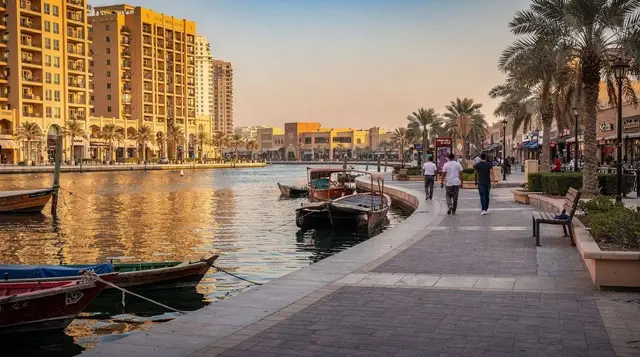
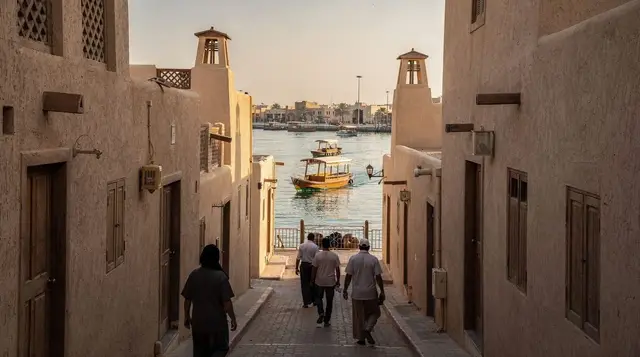
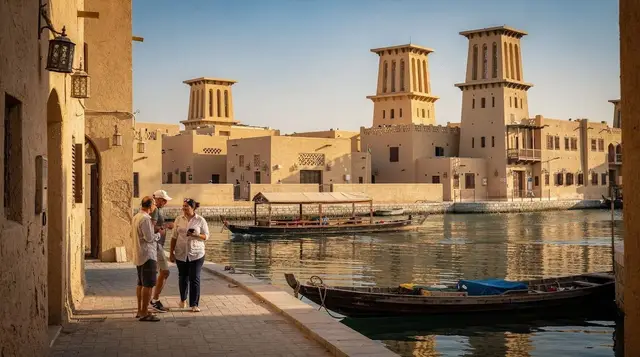
Bur Dubai sits on the south bank of Dubai Creek, facing Deira across the water, and it’s the half of Old Dubai most associated with the city’s best-preserved heritage architecture. Al Fahidi Historical District, a compact quarter of restored coral-and-gypsum buildings topped with wind towers — an ingenious pre-air-conditioning cooling system that channels breeze down into the rooms below — sits at its core. Beyond Al Fahidi, Bur Dubai extends into Meena Bazaar, a dense shopping district known for textiles and tailoring, and the Textile Souk running along the Creek’s edge. Together they give Bur Dubai a genuinely different character from Downtown or the Marina, closer in feel to Deira across the water than to any of Dubai’s newer districts.
| Where | South bank of Dubai Creek, Old Dubai |
| Cost to explore | Free; abra crossing around AED 1 (0.30 USD) |
| Time needed | Half-day minimum, full day paired with Deira |
| Getting there | Green Line metro: Al Fahidi, Al Ghubaiba, BurJuman |
| Best time | Early morning or after 4pm, cooler and quieter |
See the neighborhoods overview for how it fits alongside the rest of the city.
Al Fahidi Historical District
Al Fahidi is Dubai’s most complete surviving example of pre-oil architecture, its narrow lanes lined with restored buildings whose wind towers once served as the city’s only form of climate control. Several buildings now house small museums, art galleries, and cafés, making it one of the more pleasant areas in the city for an unhurried walk, particularly given its relative quiet compared to the souks nearby. The Dubai Museum, housed within Al Fahidi Fort at the district’s edge, traces the city’s history from a small pearling and fishing settlement through to its current scale, and it’s one of the better-value museum visits in the city given its modest entry price.
The Al Fahidi Historical District guide covers the quarter’s specific buildings and museums in more depth.
Meena Bazaar
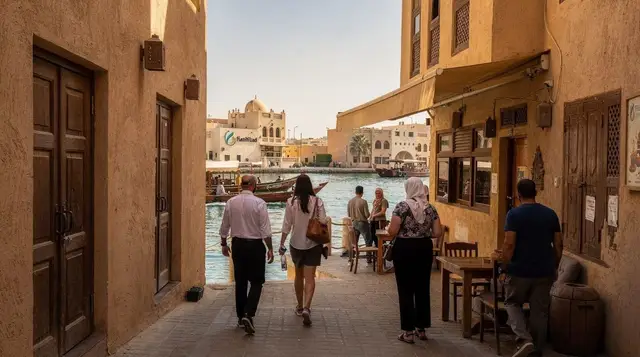
Meena Bazaar is Bur Dubai’s dense commercial heart, packed with textile shops, tailors who can turn around custom clothing within a day or two, and a wide range of souvenir and general goods stores. Prices here run consistently below equivalent items in Downtown or Marina malls, and bargaining, while less rigidly expected than in the Gold Souk, is still a normal part of many transactions. The area’s narrow streets and dense shopfronts give it an energetic, slightly chaotic atmosphere that’s part of its appeal for visitors wanting a break from Dubai’s more manicured retail spaces.
The Textile Souk and the Creek
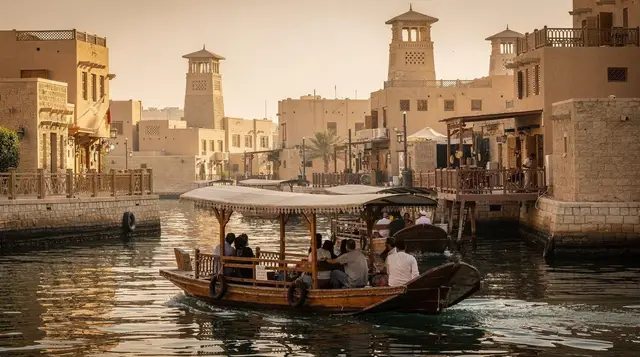
Running along Bur Dubai’s Creek-facing edge, the Textile Souk holds fabric shops selling everything from budget synthetics to higher-end silks and pashminas, with a covered walkway offering welcome shade during the hotter parts of the day. From here, the abra crossing to Deira departs regularly, costing around AED 1 (0.30 USD) shared, a short, cheap ride that’s genuinely one of the more memorable small experiences in the city. The abra crossing guide covers exact departure points and how the shared versus private options work.
Guided options for Bur Dubai
Visitors wanting context and easier navigation through the souks can book an old town, Creek, abra boat and souks guided walking tour, which typically covers both Bur Dubai and Deira across a single crossing. A similar walking tour of old Dubai’s souks and abra boat offers a comparable route for visitors wanting a guide-led alternative to navigating independently.
For a broader day combining Bur Dubai’s Creek-side sights with Jumeirah Mosque and the Dubai Frame, a half-day city tour with Blue Mosque, Creek, and souks bundles several districts into one guided outing.
Where the hotels sit and what they cost
Bur Dubai’s hotel stock runs AED 200-450/night (55-125 USD) in typical pricing, among the more affordable bands for a central Dubai location, though generally at a mid-range rather than luxury standard. Properties closer to Al Fahidi and the Creek tend to trade on their proximity to the historic quarter, while those further into the BurJuman area lean more toward business and long-stay travelers. For budget-conscious visitors wanting walking access to genuine heritage sites rather than just a cheap bed, Bur Dubai’s Al Fahidi-adjacent hotels offer good value relative to Deira’s slightly more utilitarian stock.
Getting around Bur Dubai
The Green Line metro serves Bur Dubai directly, with Al Fahidi, Al Ghubaiba, and BurJuman stations covering the district’s main areas. BurJuman station also connects to the Red Line, giving a direct one-transfer route to Downtown and onward toward the Marina. The abra crossing to Deira remains the most atmospheric — and often fastest — way to reach the opposite bank, avoiding Creek-crossing road traffic entirely. See getting around Dubai for the full network and the Nol card guide for fare details.
Is Bur Dubai worth a full day?
Yes, for visitors interested in heritage and culture — Al Fahidi alone justifies a half-day visit, and adding Meena Bazaar, the Textile Souk, and an abra crossing to Deira rounds it into a full day covering both banks of the Creek. As a base for an entire trip, Bur Dubai suits budget and culture-focused travelers well, similar to Deira, though visitors prioritizing beach access or proximity to the Burj Khalifa will find Downtown or the Marina more convenient despite the cost difference.
Bur Dubai food and dining
Bur Dubai’s food scene mirrors Deira’s in offering excellent, inexpensive South Asian and Middle Eastern food, with a particularly strong concentration of Indian and Pakistani restaurants around Meena Bazaar. Karama, a residential district just south of Bur Dubai proper, extends this further with its own dense strip of budget restaurants and a smaller souk of its own, worth the short walk or taxi for visitors wanting to go beyond the main tourist stretch. The Dubai cheap eats guide covers specific Bur Dubai recommendations in more detail.
Bur Dubai for photography and a quiet walk
Al Fahidi’s narrow, shaded lanes and restored wind-tower buildings offer some of the most photogenic street scenes in the city, particularly in the soft early morning light before crowds build. The district’s small courtyards and café corners, several tucked inside converted heritage buildings, make it one of the more pleasant places in Dubai for an unhurried coffee break between souk visits. Compared to Deira’s busier, more commercially driven atmosphere, Al Fahidi specifically offers a calmer, more contemplative pace.
Bur Dubai during summer and Friday
Al Fahidi’s shaded lanes offer somewhat more relief from summer heat than Deira’s more open souk stretches, though the Textile Souk and Meena Bazaar’s outdoor sections remain exposed between June and September. Early morning or after 4pm remains the more comfortable visiting window year-round. Fridays bring a shift in rhythm here too, with Jummah prayer drawing midday foot traffic and some shops opening later than on other days. See Dubai in summer for broader guidance on timing outdoor time around the heat.
Common mistakes in Bur Dubai
A frequent mistake is treating Al Fahidi and Meena Bazaar as the same place — they’re adjacent but distinct, with Al Fahidi being the quiet heritage quarter and Meena Bazaar the dense shopping district, and confusing the two leads to mismatched expectations about pace and atmosphere. Another is skipping the Dubai Museum inside Al Fahidi Fort, assuming it’s a minor stop, when it’s actually one of the better-value historical overviews of the city available anywhere. A third is not budgeting time for the abra crossing itself; it’s brief, but arriving at the wrong departure point or during a busy period can add unexpected waiting time.
The history behind Bur Dubai’s wind towers
Wind towers — barjeel in Arabic — are Bur Dubai’s most visually distinctive architectural feature, tall square structures rising above traditional buildings with internal vents designed to catch even light breezes and funnel them down into the rooms below, cooling interiors long before mechanical air conditioning existed. Al Fahidi holds the highest concentration of surviving examples in the city, many restored as part of a heritage preservation effort that began in earnest in the 1990s after decades of the area facing potential redevelopment.
Understanding this history adds context to what might otherwise look like simple decorative towers, and it’s a useful reminder of how Dubai’s pre-oil residents adapted to the same extreme heat that shapes so much of modern trip planning here. The old Dubai walking guide covers this architectural history in more depth alongside a suggested walking route.
Karama and the wider Bur Dubai area
South of the main Al Fahidi and Meena Bazaar cluster, the Karama district extends Bur Dubai’s budget-friendly, dense commercial character into a primarily residential area with its own smaller souk and a concentrated strip of inexpensive restaurants. It’s less visited by tourists than the Creek-side core, giving it a more everyday, local feel, and it’s worth the short walk or taxi for visitors wanting to see how the district functions beyond its most photographed streets. Karama also holds some of the more affordable long-stay accommodation options in the wider Bur Dubai area, a consideration for visitors planning an extended trip on a tight budget.
Bur Dubai’s galleries and small museums
Beyond the Dubai Museum’s broader historical overview, several smaller galleries and heritage houses within Al Fahidi focus on more specific themes — traditional Emirati dress, historic photography of the city, and rotating contemporary art exhibitions housed in converted courtyard buildings. Most charge modest or no entry fees, and together they add enough depth to Al Fahidi to comfortably fill a half-day for visitors with a genuine interest in local history and culture, rather than treating the district as a quick 30-minute photo stop. The Dubai museums guide lists these smaller Al Fahidi venues alongside the city’s larger museum options.
Bur Dubai for a longer, culture-focused stay
Visitors basing a full trip in Bur Dubai will find a genuinely different daily rhythm than a Downtown or Marina stay — mornings suited to a slow walk through Al Fahidi’s quiet lanes, afternoons for Meena Bazaar’s shopping and an abra crossing to Deira, and evenings for inexpensive, excellent food in Karama or along the Creek. It’s a strong fit for travelers prioritizing culture and value over resort amenities or beach access, and it pairs naturally with day trips to the Marina or Downtown for visitors who want both experiences without paying newer-district hotel prices for the whole trip.
Combining Bur Dubai with Deira in one day
Because the two districts sit directly across the Creek from each other, most visitors treat a Bur Dubai visit and a Deira visit as a single combined day rather than two separate trips. A practical route starts at Al Fahidi in the morning while the lanes are quiet and cool, moves through Meena Bazaar and the Textile Souk toward the Creek by early afternoon, crosses by abra to Deira, and finishes at the Gold and Spice Souks before an early dinner. This sequencing takes advantage of Al Fahidi’s shaded lanes during the hotter midday hours and saves the more open Deira souks for the cooler late afternoon.
The Deira neighborhood guide picks up the north-bank half of this route in the same depth as this guide covers Bur Dubai.
What to wear and bring to Bur Dubai
As with Deira, modest dress — shoulders and knees covered — is the practical norm throughout Al Fahidi and Meena Bazaar, both for local custom and comfort in the narrow, sometimes airless lanes. Comfortable, closed-toe walking shoes matter more here than in most other districts given Al Fahidi’s uneven, sand-colored paving and the crowded footing near the Textile Souk’s stalls. Carrying cash in smaller denominations helps with souk purchases and the abra crossing fare, since not every small vendor accepts cards for low-value transactions.
Bur Dubai during Ramadan
Al Fahidi’s cafés and Meena Bazaar’s shops generally adjust hours during Ramadan, with some closing during the earliest fasting hours and most extending into the evening after iftar at sunset, when the district’s food scene picks up noticeably. Museums and galleries within Al Fahidi typically continue operating on a close-to-normal schedule, making it one of the more reliable culture-focused visits to plan during the holy month even as other parts of the city shift their rhythm.
Bur Dubai vs Deira: which side of the Creek to base yourself
Both districts sit within the same budget-friendly, culture-focused bracket, but they suit slightly different priorities. Bur Dubai leans toward heritage and calm; Deira leans toward commerce and atmosphere.
| Bur Dubai | Deira | |
|---|---|---|
| Character | Quiet heritage quarter (Al Fahidi) plus dense shopping (Meena Bazaar) | Working souks (Gold, Spice) and Creek wharfage |
| Hotel prices | AED 200-450/night (55-125 USD) | AED 180-400/night (50-110 USD) |
| Best for | Museums, wind-tower architecture, tailoring | Bargaining, spices, dhow-loading photography |
| Shade during the day | Better — Al Fahidi’s narrow lanes | Less — Deira’s souks are more open |
| Airport distance | Roughly 20-25 minutes by taxi | Roughly 15-20 minutes by taxi |
Neither is a wrong choice, and most visitors end up doing both in a single combined day given the short abra crossing between them; see the Deira neighborhood guide for the north-bank half of this comparison in full.
A half-day walking route through Bur Dubai
For visitors with roughly four hours and no guide, a workable sequence starts at Al Fahidi Metro Station and moves through the district in the order that best matches the day’s heat. Begin in Al Fahidi’s shaded lanes while the morning is still cool, allowing 45-60 minutes for the Dubai Museum inside Al Fahidi Fort and a slow walk past the wind-tower buildings and small galleries. From there, cut through to Meena Bazaar for 30-45 minutes of browsing textile shops and tailors, before finishing at the Textile Souk along the Creek’s edge, timed to reach the abra crossing by early-to-mid afternoon if continuing on to Deira.
This sequencing keeps the more exposed, open-air stretches — the Textile Souk and the abra dock — for later in the walk, once the worst of the mid-morning heat has passed but before the afternoon peak sets in. Visitors with less time can compress this into Al Fahidi and Meena Bazaar alone and treat the Creek crossing as a separate, later outing.
Frequently asked questions about Bur Dubai
Is Bur Dubai the same as Al Fahidi?
No, Al Fahidi is a specific historic quarter within the broader Bur Dubai district, alongside Meena Bazaar and the Textile Souk.
Can I walk from Bur Dubai to Deira?
Not directly — there’s no pedestrian bridge across this stretch of the Creek — but the abra crossing takes only a few minutes and costs about AED 1 (0.30 USD).
Is the Dubai Museum in Bur Dubai worth visiting?
Yes, housed in Al Fahidi Fort, it offers a genuinely useful overview of Dubai’s pre-oil history at a modest entry price, making it one of the better-value museum stops in the city.
How do I get from Bur Dubai to the airport?
Expect roughly 20-25 minutes by taxi to Dubai International Airport outside peak traffic, slightly longer than from Deira but still one of the more central connections in the city.
Is Meena Bazaar good for buying souvenirs?
Yes, prices generally run below equivalent items in mall-based souvenir shops, though quality varies and bargaining is expected for most purchases.
Is Bur Dubai walkable?
Yes, within Al Fahidi and Meena Bazaar specifically — both are compact and pedestrian-friendly — though reaching Downtown or the Marina from Bur Dubai requires the metro or a taxi.
How does Bur Dubai compare to Deira for a first visit?
They’re complementary rather than competing — Bur Dubai offers the quieter heritage side (Al Fahidi, the Dubai Museum) while Deira offers the livelier commercial side (Gold and Spice Souks), and most visitors cover both in a single day via the short abra crossing.
Is one day enough to see all of Bur Dubai?
Yes, comfortably — a half-day covers Al Fahidi and Meena Bazaar at an unhurried pace, and a full day adds the Textile Souk and a Deira crossing without feeling rushed.
Top experiences
Bookable activities with verified prices and instant confirmation on GetYourGuide.