Dubai neighborhoods overview: which area is which
Dubai: city sightseeing HOHO bus tour + sunset & night tour
What are Dubai's main neighborhoods and how are they different?
Dubai's tourist-relevant core splits into a handful of distinct districts: Downtown Dubai (Burj Khalifa, Dubai Mall), Dubai Marina and JBR (waterfront, nightlife, beach), Palm Jumeirah (resorts, Atlantis), Old Dubai — Bur Dubai and Deira — (souks, heritage, the Creek), Jumeirah (mosque, open beaches, Burj Al Arab views), and Business Bay (canal, Museum of the Future). Each sits 15-40 minutes from the others by metro or taxi, so most visitors base in one or two and day-trip to the rest.
Why Dubai’s layout confuses first-time visitors
Dubai doesn’t have a single walkable center the way many older cities do — it’s a long, low-density strip of distinct districts running roughly parallel to the coast, connected by Sheikh Zayed Road, the Red Line metro, and a lot of taxi rides. Someone landing without a mental map of the city often assumes “Dubai” is one compact area, books a hotel, and then discovers the souks, the Marina, and the Burj Khalifa are each 20-40 minutes apart in different directions. This guide lays out the handful of neighborhoods that actually matter for a visit, what each one is built around, and how they connect, so the rest of this site’s area-specific guides make sense in context.
| Core districts | Downtown, Marina/JBR, Palm Jumeirah, Old Dubai, Jumeirah, Business Bay |
| Connections | Red Line (Downtown-Marina), Green Line (Old Dubai) |
| Hotel range | AED 180-1,200+/night depending on district |
| Between districts | 15-40 minutes by metro or taxi |
| Airport-closest | Deira and Business Bay (~15-20 min) |
Downtown Dubai — the skyline core
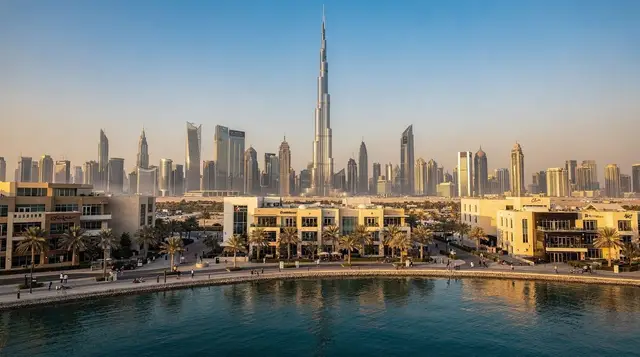
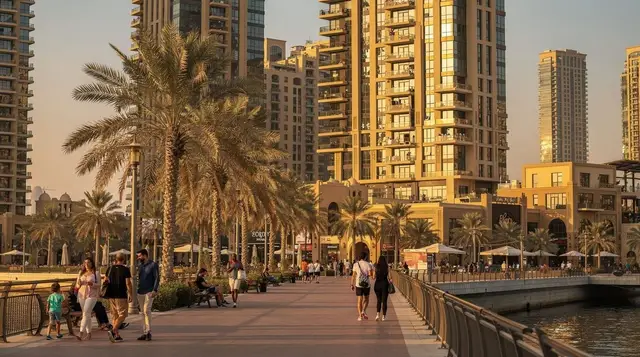
Downtown Dubai is the district built around the Burj Khalifa and Dubai Mall, and for most first-time visitors it’s the closest thing Dubai has to an obvious center. The Dubai Fountain performs every 30 minutes from 6pm to 11pm on the mall’s boardwalk, free to watch from ground level, and the surrounding streets hold some of the city’s densest concentration of hotels, restaurants, and observation decks. It sits on the Red Line at the Burj Khalifa/Dubai Mall station, making it one of the easier districts to reach without a car. The trade-off is crowding and higher hotel prices, particularly November through March.
The full breakdown of tickets, timing, and whether it’s worth basing yourself here is in the Downtown Dubai guide.
Dubai Marina and JBR — the waterfront
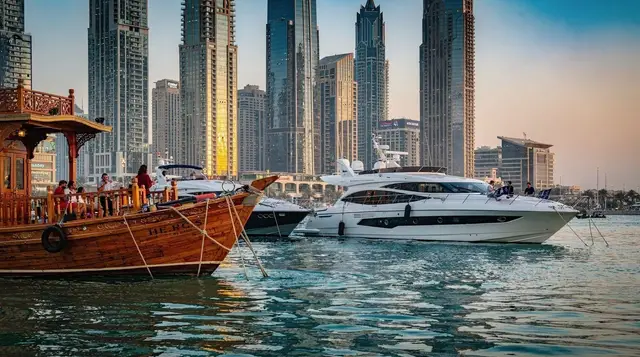
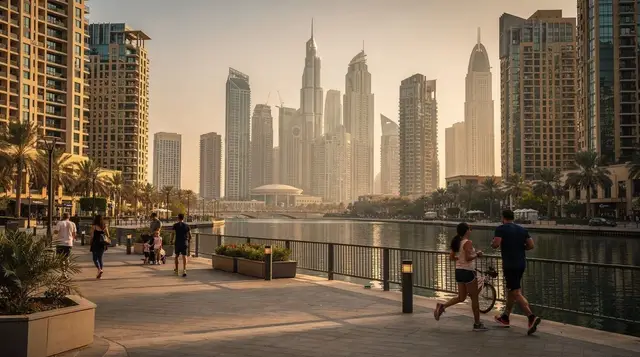
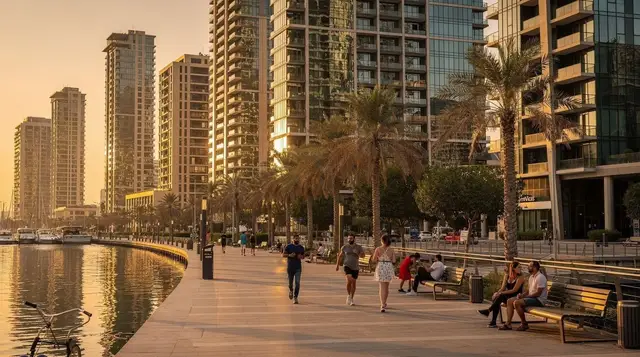
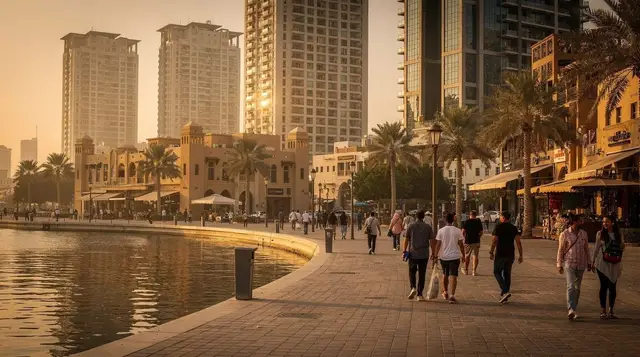
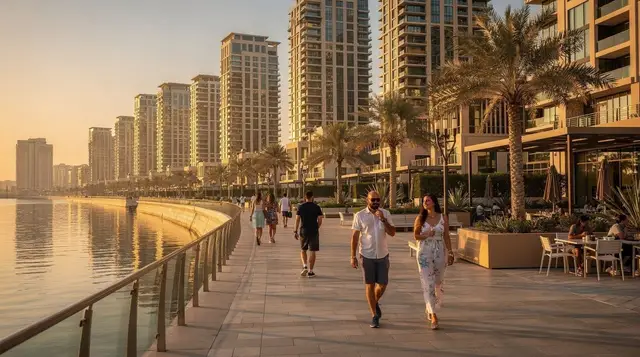
Dubai Marina is a manmade canal district lined with high-rise residential towers, restaurants, and a lively promenade called Marina Walk. Immediately adjacent sits Jumeirah Beach Residence — JBR — with its own beachfront promenade, The Walk, and a public beach, The Beach at JBR, that’s genuinely open and free to use rather than resort-gated. Together, Marina and JBR form Dubai’s most developed beach-plus-nightlife combination, reachable via the DMCC and Sobha Realty Red Line stations plus a tram along the waterfront.
Dhow dinner cruises and yacht trips depart from the Marina’s harbor most evenings, including a Dubai Marina luxury dhow dinner cruise. Separate guides cover Dubai Marina and JBR in more depth.
Palm Jumeirah — the resort island
Palm Jumeirah is the palm-shaped artificial island best known for Atlantis The Palm and The View at the Palm observation deck. It isn’t on the metro network, so getting there means a taxi, the Palm Monorail connection from the tram, or an organized tour transfer. Most of its beaches sit behind resort walls rather than being open public access, which makes Palm Jumeirah better suited to a day visit or a resort stay than a budget base. It pairs naturally with a Marina day given the short distance between the two.
Old Dubai — Bur Dubai and Deira
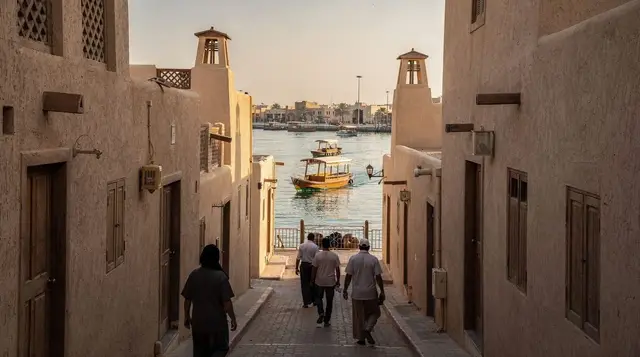
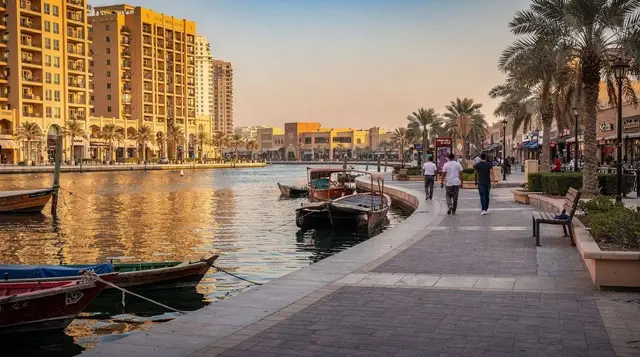
Old Dubai is the umbrella name for the historic core split across Dubai Creek: Bur Dubai on the south bank, home to the Al Fahidi Historical District, the Textile Souk, and Meena Bazaar, and Deira on the north bank, home to the Gold Souk and Spice Souk. An abra — a small traditional wooden boat — crosses the Creek between the two sides for around AED 1 (0.30 USD) per person, one of the cheapest and most memorable rides in the city. This is where Dubai’s pre-oil trading history is most visible, and it’s the district budget travelers gravitate toward for hotel prices roughly half those of Downtown or the Marina.
A guided Old Dubai souks, street food and abra crossing tour covers both banks with a guide who knows the bargaining norms, which some first-time visitors find easier than navigating the souks solo.
Jumeirah — mosque, open beaches, and the Burj Al Arab
Jumeirah is the coastal strip between Downtown and the Marina, quieter and less commercial than either. Jumeirah Mosque runs guided tours open to all faiths, with abayas provided free for visitors who need them, and it’s one of the few mosques in the city set up specifically for non-Muslim visitors. The area’s open public beaches — Jumeirah Beach Park, Kite Beach — offer some of the clearest free views of the Burj Al Arab without paying resort prices. It’s a natural stop for visitors who want a beach afternoon without the density of Marina or JBR. The Jumeirah neighborhood guide has the full breakdown.
Business Bay — the canal district
Business Bay sits just south of Downtown along the Dubai Canal, a landscaped waterway with a walkable boardwalk that’s noticeably calmer than Downtown’s crowds. The Museum of the Future sits on the district’s northern edge, and Bay Avenue holds a growing strip of high-rise dining with skyline views. It works well as a lower-cost, quieter alternative to a Downtown base, given its Red Line station and short taxi ride into Downtown proper. Details are in the Business Bay guide.
Other districts worth knowing
A handful of smaller areas round out the map without needing dedicated day trips for most visitors. Bluewaters Island, just off JBR, holds Ain Dubai, the giant observation wheel, plus its own dining strip. Dubai Creek Harbour — the newer development rather than the historic Deira/Bur Dubai stretch — adds dhow-building yards and waterside walks further inland. City Walk is a pedestrian retail district near Downtown built around open-air shopping and the Coca-Cola Arena. None of these typically justify a dedicated overnight stay, but they’re easy additions to a day built around a nearby core district.
Neighborhood snapshot: price and vibe
Hotel prices vary more by neighborhood than most first-time visitors expect, and it’s a useful shorthand for what each area is actually like day to day. Downtown runs roughly AED 500-1,200/night (135-325 USD) in high season, reflecting its landmark status and density of five-star properties. The Marina sits close behind at AED 450-1,000/night (125-270 USD), trading a little polish for beach access and a more residential, less touristy feel once you’re off the main promenade. Business Bay undercuts both at AED 400-850/night (110-230 USD) for a similar skyline outlook with a quieter, more corporate atmosphere.
Jumeirah runs AED 350-900/night (95-245 USD), reflecting its mix of mid-range hotels and a handful of standalone luxury resorts along the coast. Old Dubai is the clear budget outlier — Bur Dubai around AED 200-450/night (55-125 USD) and Deira closer to AED 180-400/night (50-110 USD) — a genuine two-to-three-times difference from Downtown for many properties, though with a correspondingly more basic hotel standard and a longer commute to the newer districts. None of this means cheaper is worse; it mostly reflects proximity to the skyline landmarks and how recently a district was built.
Weekends, Fridays, and neighborhood rhythm
Dubai’s weekend runs Saturday-Sunday, a shift made in 2022 to align more closely with global markets, but Friday retains its own distinct rhythm across most neighborhoods. Friday midday is Jummah prayer time, and traffic and foot patterns shift accordingly — some souk stalls in Old Dubai open later, while Downtown and Marina restaurants ramp up for the Friday brunch tradition that runs into the afternoon at many hotels. Saturday and Sunday see the busiest beach and promenade crowds at the Marina and JBR, while Old Dubai’s souks are typically calmer and more comfortable to browse midweek.
If a specific neighborhood experience matters to a trip — a quiet souk browse, a lively Marina evening — it’s worth checking which day of the week you’ll actually be there rather than assuming every day plays out the same.
Neighborhoods during Ramadan
Ramadan shifts daily rhythm across every district, though not identically. Malls and indoor venues in Downtown and the Marina generally stay closer to normal hours, with public eating and drinking restricted during fasting hours in non-licensed areas. Old Dubai’s souks often see reduced daytime footfall and busier evenings after iftar, when the fast breaks at sunset. Licensed hotel restaurants and bars continue serving alcohol to non-fasting guests in private settings throughout Ramadan, though public displays of eating, drinking, or smoking during daylight hours are discouraged citywide. See the Dubai Ramadan guide for how this affects each district in more detail if your trip overlaps with the holy month.
How the neighborhoods connect
The Red Line metro is the backbone for Downtown, Business Bay, and the Marina corridor, running roughly parallel to Sheikh Zayed Road. The Green Line serves Old Dubai’s stations — Al Fahidi, Al Ras, Baniyas Square — crossing the newer Red Line at Union station. Everywhere the metro doesn’t reach directly, including Palm Jumeirah and most of Jumeirah’s coastline, taxis and Careem fill the gap at reasonable cost. A Dubai hop-on hop-off bus route, including a Dubai hop-on hop-off sightseeing bus pass, links several of these districts on a single ticket for visitors who’d rather not plan transit themselves.
See getting around Dubai for the full transport picture and the Nol card guide for how metro and bus fares work.
Choosing where to base yourself
There’s no universally correct neighborhood — the right choice depends on trip priorities. Visitors focused on landmarks and shopping tend to prefer Downtown or Business Bay; visitors focused on beach time and nightlife tend to prefer the Marina or JBR; visitors on a tighter budget or prioritizing culture tend to prefer Old Dubai. The best areas to stay guide breaks this down by trip type in more detail, and where to stay in Dubai lists specific hotels by area and budget band.
| District | Best for | Trade-off |
|---|---|---|
| Downtown | Landmarks, walkability, first-timers | Highest prices, heaviest crowds |
| Marina/JBR | Beach, nightlife, waterfront dining | 20-40 min from Downtown landmarks |
| Palm Jumeirah | Resort stays, Atlantis | Not on the metro; mostly resort-gated beaches |
| Old Dubai | Budget, culture, heritage | Longer commute to newer districts |
| Jumeirah | Quiet beach, mosque visit | Fewer dining/nightlife options |
| Business Bay | Quieter, lower cost near Downtown | Less landmark density than Downtown itself |
Splitting a stay across two neighborhoods
For trips of five days or more, splitting a hotel booking across two neighborhoods — a few nights in Downtown for landmark sightseeing, followed by a few nights in the Marina for beach and nightlife — is a genuinely common and sensible strategy, avoiding the compromise of picking one district that serves only half your trip’s priorities. The trade-off is the hassle of checking out and moving mid-trip, including repacking and a taxi transfer between hotels, which is worth weighing against simply day-tripping from a single base using the metro or taxis instead. For shorter trips under four days, a single well-chosen base usually beats splitting, since the moving day eats into already limited time.
Getting from the airport to each neighborhood
Dubai International Airport sits closest to Deira and Business Bay, both reachable in around 15-20 minutes by taxi outside peak traffic, which makes either a practical first-night choice if you’re arriving late or on a tight layover. Downtown adds another 10 minutes or so given its slightly more inland position. The Marina and JBR run closer to 30-40 minutes by taxi, and Palm Jumeirah can push past 40 minutes depending on traffic on Sheikh Zayed Road. For visitors landing on a short layover, planning around which neighborhoods are realistically reachable within a few hours between flights matters more than distance on a map suggests.
The Red Line metro also connects directly from Terminal 1 and Terminal 3 stations toward Downtown and onward to the Marina corridor, a cheaper if slightly slower alternative to a taxi for travelers without heavy luggage.
How the neighborhoods have changed over time
Old Dubai — Bur Dubai and Deira — is genuinely old by the city’s standards, tracing back to the pearling and trading settlement that predates the oil-era construction boom entirely. Downtown, by contrast, is a 21st-century creation, built up almost entirely after the Burj Khalifa’s site was chosen in the early 2000s and opened in 2010. The Marina followed a similar trajectory through the mid-2000s onward, reclaiming land along an artificial canal where none existed before. Business Bay and Bluewaters Island are newer still, largely built out over the past decade.
Understanding this timeline helps explain why the districts look and feel so different from each other — Old Dubai has the organic, dense street pattern of a settlement that grew over generations, while Downtown and the Marina were master-planned from scratch with wide roads, tower setbacks, and metro stations built in from day one.
A note on distances and heat
Because Dubai spreads out rather than clustering, walking between neighborhoods generally isn’t practical — even relatively “close” districts like Downtown and Business Bay involve a 15-20 minute walk along roads not always built with pedestrians in mind, and that gets genuinely uncomfortable in summer heat between June and September, when daytime temperatures reach 40-48°C. Budget for metro or taxi transfers between districts rather than assuming you can walk it, and structure outdoor time around the cooler morning and evening hours if visiting during those months.
Neighborhoods for specific trip types
Families often do well split between Downtown, for the malls and indoor attractions, and the Marina or JBR, for beach time — both are covered further in the Dubai with kids guide. Budget travelers gravitate to Old Dubai for its lower accommodation costs and cheap, authentic food. Visitors prioritizing nightlife and beach clubs lean toward the Marina, JBR, or Palm Jumeirah’s resort scene. Couples and honeymooners often split time between Palm Jumeirah for the resort experience and Downtown or Jumeirah for sightseeing. None of these are rigid rules — plenty of trips mix and match — but they’re a reasonable starting filter when the number of districts feels overwhelming.
Mistakes to avoid when picking a base
The most common mistake is booking a hotel purely on price without checking its distance from the sights you actually want to see — a bargain rate in a residential pocket of Deira can end up costing more in cumulative taxi fares than a pricier room within walking distance of the metro. A second common mistake is assuming every neighborhood is walkable once you’ve arrived; Dubai’s block sizes and road widths are built for cars, and what looks like a short hop on a map can be a genuinely uncomfortable 25-minute walk with no shade, especially outside the cooler months. A third is under-budgeting transfer time to Palm Jumeirah, which isn’t on the metro network and can take longer to reach than its map position suggests.
Cross-checking a hotel’s actual metro or tram distance, not just its neighborhood name, avoids most of these issues before you book.
Frequently asked questions about Dubai’s neighborhoods
What’s the difference between Downtown Dubai and Dubai Marina as areas?
Downtown centers on the Burj Khalifa, Dubai Mall, and central sightseeing; the Marina centers on waterfront dining, beach access via JBR, and nightlife. Both sit on the Red Line and suit different trip priorities rather than one being objectively better.
Is Palm Jumeirah considered a neighborhood or just a resort area?
Functionally it’s mostly a resort area — most of its beaches and dining sit within hotel grounds rather than being open to casual walk-in visitors, though The Pointe and Nakheel Mall offer public dining and shopping.
Which area is closest to Dubai International Airport?
Deira and Business Bay sit closest to Dubai International Airport, typically 15-20 minutes by taxi outside peak traffic, while the Marina and Palm Jumeirah run closer to 30-40 minutes.
Can I see all of Dubai’s neighborhoods in a short trip?
A 3-4 day trip can reasonably cover Downtown, Old Dubai, and the Marina as day visits from a single base, though adding Palm Jumeirah, Jumeirah, and Business Bay comfortably needs 5-7 days without feeling rushed.
Are Dubai’s neighborhoods safe to walk around at night?
Yes, Dubai has a low crime rate and its main tourist districts — Downtown, the Marina, JBR — are well-lit and busy well into the evening, making evening walks generally comfortable.
Do taxi prices vary much between neighborhoods?
Not dramatically for typical cross-district trips — most rides between core neighborhoods run AED 25-60 (7-16 USD), though Palm Jumeirah and destinations further from central Dubai, such as Hatta or Jebel Jais, cost more given the distance.
Is it worth splitting a stay across two neighborhoods?
For trips of five days or more, yes — pairing Downtown with the Marina covers both landmark sightseeing and beach time. For shorter trips, a single well-chosen base is usually more efficient.
Which neighborhood is best for a first-time visitor with limited days?
Downtown, given its central position, metro access, and proximity to the Burj Khalifa and Dubai Mall — most other districts are a reasonable day-trip distance from there.
Top experiences
Bookable activities with verified prices and instant confirmation on GetYourGuide.