Jumeirah neighborhood guide: mosque, beaches and Burj Al Arab views
Dubai: half-day city tour with Blue Mosque, Creek, and souks
What is Jumeirah known for and is it worth visiting?
Jumeirah is the coastal strip between Downtown and Dubai Marina, known for Jumeirah Mosque's guided tours open to all faiths, open public beaches with clear Burj Al Arab views, and a quieter, more residential atmosphere than the Marina or JBR. It's worth a half-day visit for the mosque and beach, and a reasonable mid-range base for visitors wanting a calmer coastal stay.
What Jumeirah actually is
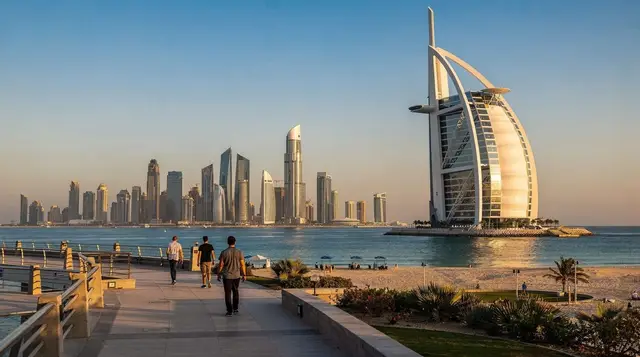
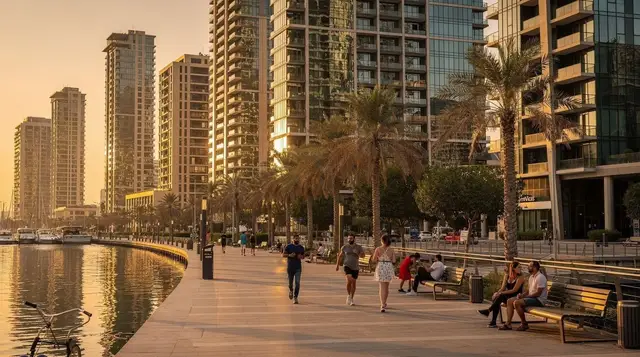
Jumeirah is the coastal strip running between Downtown and Dubai Marina, quieter and more residential than either, built up gradually over recent decades rather than as a single master-planned development. It’s best known for two things: Jumeirah Mosque, one of the few mosques in the city that welcomes non-Muslim visitors through structured guided tours, and a series of open public beaches offering some of the clearest free views of the Burj Al Arab anywhere in Dubai. Unlike the Marina’s dense tower cluster or Downtown’s landmark-driven layout, Jumeirah reads as a lower-rise, more spread-out district, which is part of its appeal for visitors wanting a calmer coastal base.
| Where | Coastal strip between Downtown and Dubai Marina |
| Cost | around AED 350-900/night for hotels; free public beaches |
| Getting there | Taxi or Careem; no direct metro access |
| Best for | Mosque visit, open Burj Al Arab views, quieter stay |
| Best time | Early morning or evening; midday summer heat is harsh |
See the neighborhoods overview for how it compares to the city’s other districts.
Jumeirah Mosque
Jumeirah Mosque, sometimes nicknamed the Blue Mosque for its stone coloring, is one of Dubai’s most photogenic religious buildings and one of the very few in the city offering dedicated guided tours for visitors of all faiths. Tours typically run for around 75 minutes, covering the mosque’s architecture, a Q&A session on Islamic practice and Emirati culture, and access to the prayer hall itself outside of prayer times. Abayas and modest coverings are provided free to anyone who needs them, removing any barrier to entry based on dress.
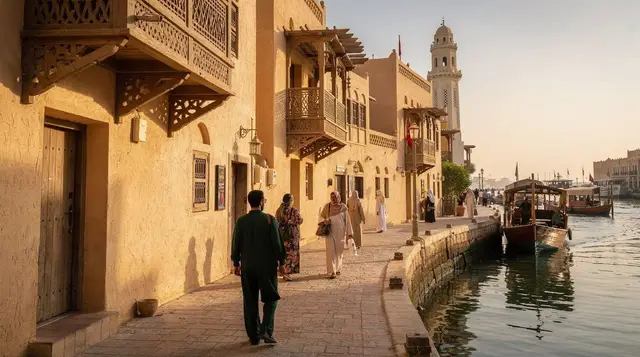
A combined half-day city tour with Blue Mosque, Creek, and souks pairs a Jumeirah Mosque visit with Old Dubai’s Creek and souks in a single guided outing. The Jumeirah Mosque visit guide covers tour timing and etiquette in more depth.
The beaches
Jumeirah Beach Park and Kite Beach are the district’s two main public beaches, both free to access and considerably less crowded than JBR’s beach most days of the week. Kite Beach in particular draws a mix of sunbathers, kitesurfers, and joggers along its dedicated running track, with food trucks and casual dining lining the beach’s landward edge. Both beaches offer some of the clearest unobstructed views of the Burj Al Arab in the city, a genuine advantage over trying to photograph it from the Marina or Palm Jumeirah at a greater distance. The Dubai beaches guide covers the full citywide beach comparison, including how Jumeirah’s options stack up against JBR and Palm Jumeirah.
Madinat Jumeirah and Burj Al Arab views
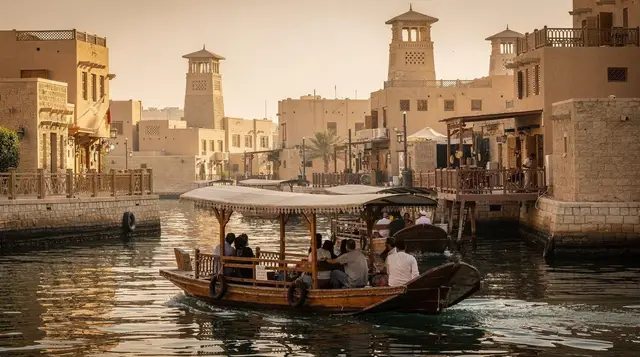
Madinat Jumeirah, a sprawling resort complex styled after a traditional Arabian citadel with its own network of canals and abra boats, sits along the Jumeirah coastline near the Burj Al Arab and is open to non-guests for dining and its Souk Madinat shopping arcade. It’s one of the more atmospheric places in the city for an evening stroll, particularly around sunset when the Burj Al Arab’s sail-shaped silhouette catches the light from across the water. The Burj Al Arab guide covers the hotel’s history and how to see or experience it, whether from a distance or with an interior visit.
Water activities near the Burj Al Arab
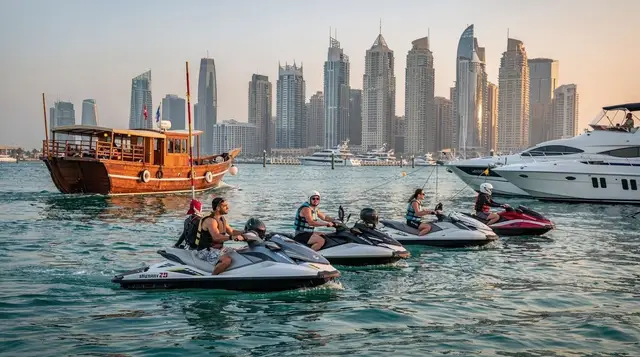
For a closer view of the Burj Al Arab from the water, a jet ski tour of the Burj Al Arab with photos departs from nearby and circles the hotel for photo opportunities not possible from the beach. A Marina, Atlantis, Palm and Burj Al Arab speedboat tour extends this into a broader coastal sightseeing route covering several of Dubai’s most photographed waterfront landmarks in one outing.
Where the hotels sit and what they cost
Jumeirah’s hotel stock runs AED 350-900/night (95-245 USD) in high season, a mid-range band sitting between Old Dubai’s budget pricing and the Marina or Downtown’s higher rates. The mix includes both standalone luxury resorts directly on the coast — some of the city’s most established five-star properties — and more modest mid-range hotels further inland, giving Jumeirah a wider price spread than most single-character districts. Choosing a beachfront property specifically, rather than one merely in the Jumeirah area, matters more here than in denser districts given how spread out the coastline is.
Getting around Jumeirah
Jumeirah isn’t served directly by the metro, so a taxi or Careem is the practical way to reach it and to move between its beaches, the mosque, and Madinat Jumeirah, which sit at some distance from each other along the coast. A taxi to Downtown runs roughly 15-20 minutes outside peak traffic, given Jumeirah’s position roughly midway along the coast between Downtown and the Marina. See getting around Dubai for the wider transport picture and how taxi-dependent districts like this one fit into a trip without a rental car.
Is Jumeirah worth basing yourself here?
Yes, for visitors wanting a quieter, more residential coastal stay without the density of the Marina or JBR, and who don’t mind relying on taxis rather than the metro. It’s a reasonable middle-ground choice between Downtown’s landmark focus and the Marina’s nightlife-heavy scene, particularly for couples, families, and visitors prioritizing a calmer beach experience over convenience to the metro network.
Jumeirah for families
Jumeirah’s open, less crowded beaches and generally calmer atmosphere make it one of the more comfortable family districts in Dubai, particularly for parents wanting beach time without navigating JBR’s or the Marina’s denser crowds. Kite Beach’s dedicated running track and food truck strip give families an easy half-day outing without much additional planning, and Jumeirah Mosque’s tours are family-friendly and genuinely educational for older children. See the Dubai with kids guide for how Jumeirah compares to other family-friendly districts.
Jumeirah during summer
Like Dubai’s other beach districts, Jumeirah’s outdoor appeal is significantly limited during the June-to-September heat, when daytime temperatures reach 40-48°C and beach visits become impractical outside the early morning or evening. Jumeirah Mosque’s tours, largely indoors, remain a viable option year-round regardless of the outdoor heat, making it a reasonable summer activity when beach time isn’t practical. See Dubai in summer for broader guidance on structuring a day around the heat.
Cultural etiquette specific to Jumeirah
Beyond the mosque’s specific dress requirements — covered fully, with abayas provided if needed — general modest dress is worth maintaining while walking through Jumeirah’s residential streets, distinct from the more tourist-oriented norms at JBR’s beach or the Marina’s promenade. On the beaches themselves, swimwear is entirely normal, but covering up when leaving the sand to walk through surrounding streets or into Madinat Jumeirah’s retail areas is the expected local norm. The emirati culture and etiquette guide covers this balance between beach norms and street norms across the city more broadly.
Jumeirah’s history and development
Jumeirah has a longer history as a residential area than most of Dubai’s newer coastal districts, having developed gradually as a preferred neighborhood for both Emirati families and expatriates well before the Marina or Business Bay existed in any form. This slower, organic growth is visible in its lower-rise villa-heavy streets away from the coast, a sharp contrast to the tower-dense skylines of the Marina or Downtown. Jumeirah Mosque itself, completed in 1979, predates most of the city’s now-iconic skyline by decades, and its stone construction and twin minarets remain one of the more traditional architectural landmarks in a city otherwise dominated by glass and steel.
This history is part of why Jumeirah feels distinctly different in character from Dubai’s newer purpose-built districts, even though it sits geographically between two of the busiest ones.
Dining in Jumeirah
Jumeirah’s dining scene splits between casual beachfront cafés and food trucks near Kite Beach, and more upscale options within Madinat Jumeirah and the district’s standalone resorts. Umm Suqeim Road and Jumeirah Beach Road hold a scattering of independent restaurants and cafés popular with residents rather than tourists, offering a lower-key dining experience than the Marina’s promenade or Downtown’s mall-based restaurants. For visitors wanting a fuller citywide dining picture, best restaurants in Dubai includes several Jumeirah entries alongside options across other districts.
Jumeirah for photography
Beyond the free Burj Al Arab views from Kite Beach and Jumeirah Beach Park, the mosque itself offers striking photography opportunities, particularly in the early morning or late afternoon light when its stone facade takes on a warmer tone. Madinat Jumeirah’s canal network and traditional wind-tower-style architecture provide another distinctive backdrop, especially around sunset when the resort’s lighting comes on and the Burj Al Arab catches the last of the daylight across the water. For visitors chasing skyline and landmark photography more broadly across the city, Dubai skyline photo spots covers other vantage points worth combining with a Jumeirah visit.
Common mistakes when visiting Jumeirah
A frequent mistake is assuming Jumeirah is walkable to Downtown or the Marina given its position between the two — in practice, the distances are too great to walk comfortably, and a taxi or Careem is the realistic way to move around. Another is visiting Jumeirah Mosque outside its tour hours or during a prayer time, only to find access to the prayer hall restricted; checking current tour schedules before heading over avoids this. A third is underestimating how spread out Jumeirah’s attractions are relative to a denser district like Downtown — the mosque, the beaches, and Madinat Jumeirah each require a separate taxi leg rather than being within a single walkable cluster.
Jumeirah versus Palm Jumeirah
Despite the similar name, Jumeirah and Palm Jumeirah are distinct districts with different characters — Jumeirah is the mainland coastal strip described throughout this guide, while Palm Jumeirah is the artificial palm-shaped island further along the coast, dominated by Atlantis and its resort ecosystem. Jumeirah’s beaches are genuinely open to the public; Palm Jumeirah’s are largely resort-gated. Visitors sometimes confuse the two when researching, so double-checking which district a hotel or attraction actually sits in avoids booking mismatches, particularly since both share the “Jumeirah” name in various property listings.
| Jumeirah | Dubai Marina/JBR | Palm Jumeirah | |
|---|---|---|---|
| Beach access | Open public sand | Open (JBR) / limited (Marina) | Mostly resort-gated |
| Metro | None (taxi/Careem only) | Red Line via tram | Monorail (separate) |
| Roughly | AED 350-900/night | Comparable | Higher, resort premium |
| Atmosphere | Quiet, residential | Denser, livelier | Self-contained resort |
Jumeirah for a longer, quieter stay
Visitors basing a full trip in Jumeirah, rather than treating it as a half-day stop from elsewhere, will find a distinctly slower, more residential rhythm than the Marina or Downtown — mornings for a mosque tour or a beach walk, afternoons for Madinat Jumeirah’s shops and canals, and evenings for a sunset view of the Burj Al Arab followed by dinner at one of the district’s independent restaurants. It suits couples and families prioritizing a calmer trip over dense sightseeing or nightlife, and it pairs well with day trips into Downtown or the Marina for visitors who want both experiences within a single stay.
Jumeirah during Ramadan and Friday
Jumeirah Mosque’s tour schedule typically adjusts during Ramadan, with some sessions shifting to accommodate fasting hours, so checking current times before visiting matters more here than during the rest of the year. The district’s beaches remain open throughout Ramadan, though public eating and drinking during daylight fasting hours is restricted, even outdoors on the sand. Friday follows its own separate rhythm, with Jummah prayer drawing worshippers to the mosque at midday and some beachfront cafés adjusting their opening hours around it. Visitors planning a Jumeirah Mosque visit specifically should avoid the Friday midday prayer window given the mosque’s active religious use at that time.
Jumeirah’s relationship to the wider coastline
Jumeirah technically stretches further than the mosque-and-beach cluster most visitors focus on, extending along Jumeirah Beach Road through several sub-areas sometimes marketed separately, including Umm Suqeim closer to the Burj Al Arab and Al Sufouh further toward the Marina. This wider stretch holds additional villa communities, smaller parks, and a handful of independent beach clubs that don’t see the same visitor traffic as Kite Beach or Jumeirah Beach Park, offering a genuinely quieter alternative for visitors who find even Jumeirah’s main beaches busier than expected on weekends.
Knowing this broader geography helps explain why address listings for “Jumeirah” hotels and attractions can span a fairly wide stretch of coastline rather than a single compact district.
Jumeirah’s independent cafés versus Madinat Jumeirah’s dining
Beyond the mosque and beaches, Jumeirah’s dining scene splits fairly cleanly along Umm Suqeim Road and Jumeirah Beach Road into two distinct experiences worth knowing apart. Independent, lower-key cafés and restaurants along these roads see mostly Dubai residents rather than tourists, offering a genuine break from the resort-priced dining found in Madinat Jumeirah or the district’s standalone hotels, with a casual meal typically running noticeably less than an equivalent spot along the Marina promenade or within a resort complex. Madinat Jumeirah’s own restaurants, by contrast, trade on the atmosphere of the canal-and-souk setting itself, priced accordingly for the setting rather than purely the food.
Neither is objectively better — a visitor prioritizing a genuinely local, lower-cost meal should head to the residential-facing cafés along Umm Suqeim Road, while anyone wanting the atmospheric canal-and-lantern setting as part of the experience should budget for Madinat Jumeirah’s premium instead, ideally timed around sunset when the setting is at its best.
Traveling to Jumeirah without a rental car
Since Jumeirah isn’t served directly by the metro, visitors relying on taxis or Careem should plan around the district’s spread-out layout — the mosque, the beaches, and Madinat Jumeirah each sit a short taxi ride apart rather than within a single walkable cluster, unlike a denser district like Downtown. Booking return rides through an app rather than expecting to hail a taxi on the street works more reliably here, particularly near the beaches and mosque where passing taxi density is lower than along the Marina promenade or Downtown’s hotel strip. For visitors basing a longer stay in Jumeirah specifically, budgeting slightly more for transport than a Marina- or Downtown-based trip is a reasonable expectation given how taxi-dependent the district is.
Ride-hailing apps generally show more accurate wait times than street hailing in this lower-density district, so building in a small buffer before any scheduled activity, particularly the mosque tour’s fixed start time, is worth doing rather than assuming a car will arrive as quickly as it would from a Downtown hotel.
Renting a car for a Jumeirah-based stay
Given the district’s lack of metro access, visitors basing a longer stay in Jumeirah sometimes find a rental car more practical than relying entirely on taxis, particularly for reaching Downtown, the Marina, or further destinations like Hatta on a self-driven day trip. Parking is generally straightforward at the district’s beaches, mosque, and Madinat Jumeirah, with dedicated lots at each rather than relying on street parking. The Dubai car rental guide covers the practical details of renting and driving in Dubai for visitors considering this option specifically for a Jumeirah base.
Frequently asked questions about Jumeirah
Do I need to book Jumeirah Mosque tours in advance?
It’s not strictly required, but arriving close to a tour’s scheduled start time is worth doing given group sizes are managed for the guided format; checking current tour times before visiting avoids a wasted trip.
Is Jumeirah more expensive than Old Dubai?
Yes, generally — Jumeirah’s hotel prices run AED 350-900/night (95-245 USD) against Old Dubai’s AED 180-450/night, reflecting its beachfront position and resort-grade properties.
Can you see the Burj Al Arab for free from Jumeirah?
Yes, both Jumeirah Beach Park and Kite Beach offer clear, unobstructed free views of the Burj Al Arab from public land.
Is Jumeirah safe for solo travelers?
Yes, it’s as safe as the rest of Dubai, with well-patrolled public beaches and a generally quiet, residential atmosphere.
How long should I spend in Jumeirah?
Half a day covers the mosque tour and a beach visit comfortably; a full day allows time to add Madinat Jumeirah and a sunset walk near the Burj Al Arab.
Is Jumeirah connected to the metro?
No, Jumeirah isn’t directly served by the metro network — a taxi or Careem is the practical way to reach and move around the district.
Is Jumeirah a good base for a first Dubai trip?
It works well paired with a day or two in Downtown for landmark sightseeing, though it’s less central for visitors wanting to minimize transit time given the lack of metro access.
How does Jumeirah compare to JBR for a beach stay?
Both offer genuinely open public beach access, but Jumeirah’s beaches are generally quieter than JBR’s, and Jumeirah’s atmosphere leans more residential than JBR’s denser promenade-and-tower setup.
Top experiences
Bookable activities with verified prices and instant confirmation on GetYourGuide.