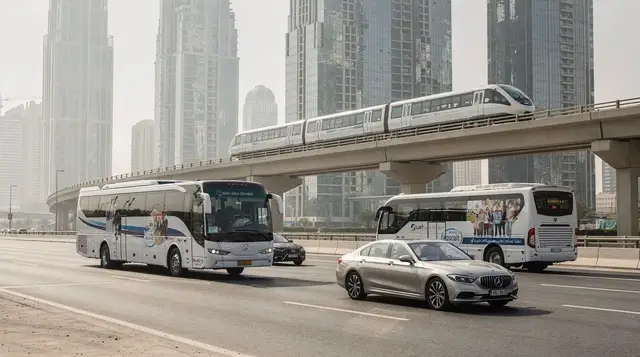
Getting around Dubai: every transport option compared
From Dubai: Abu Dhabi Sheikh Zayed Mosque guided tour
Duration: 5-7 hours
What's the best way to get around Dubai?
The metro is the cheapest and most predictable option for Downtown, the Marina, and Old Dubai's newer edge, with fares roughly AED 3-7.5 ($0.82-2) per trip on a Nol card. Taxis and Careem fill the gaps the metro doesn't reach — most of Old Dubai's interior, Jumeirah, and anywhere off the two lines — for roughly AED 15-50 ($4-14) per ride. A rental car only pays off if you're also doing day trips to Abu Dhabi, Hatta, or Ras al-Khaimah.
The short version
Dubai’s transport works well for the corridor it actually covers — Downtown, Business Bay, the Marina, and a slice of Deira and Bur Dubai along the Metro’s two lines — and requires taxis, Careem, or a rental car for everything outside that corridor. There’s no single “best” option: the metro is the cheapest and most reliable for point-to-point trips along its route, taxis and ride-hailing apps fill in the gaps at a reasonable cost, and a car only earns its keep if you’re leaving the city for Abu Dhabi, Hatta, or Ras al-Khaimah.
The honest starting point is that Dubai was built for cars, not pedestrians. Blocks are long, highways cut through the middle of the city, and few districts connect to their neighbors on foot. Once you accept that and plan transport as a deliberate part of each day rather than an afterthought, getting around stops being a source of friction.
| Cheapest | Metro, around AED 3-7.5 / 0.82-2 USD per trip |
| Most convenient | Careem/Uber, around AED 15-50 / 4-14 USD per ride |
| For day trips | Rental car, around AED 150-250 / 41-68 USD per day |
| Card needed | Nol card for metro, tram, and most buses |
| Cash needed for | Abra crossings (around AED 1, cash only) |
The Dubai Metro
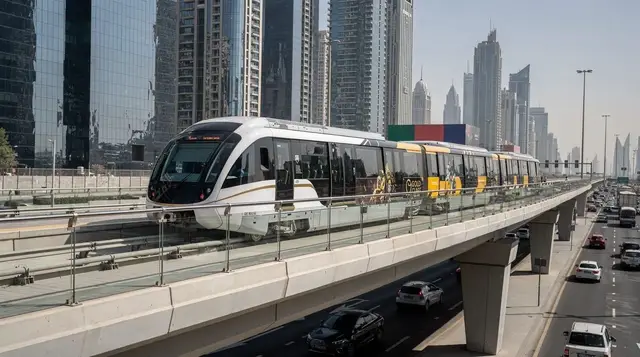
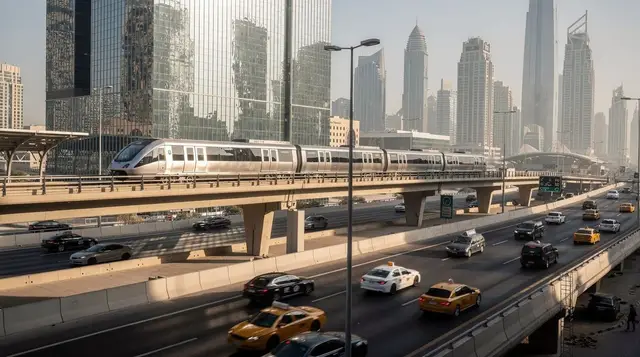
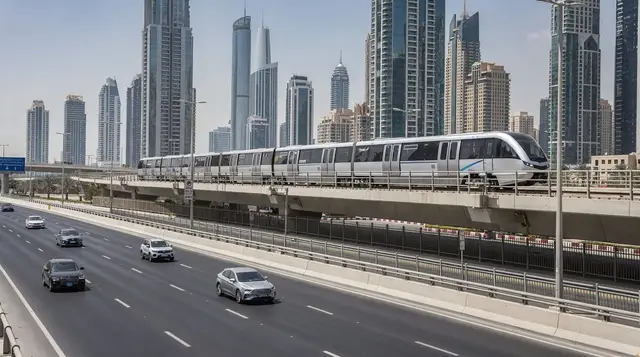
The Dubai Metro guide covers this in full, but the short version: two driverless lines, Red and Green, running mostly elevated above Sheikh Zayed Road and through Deira and Bur Dubai. The Red Line is the one most visitors use most, connecting the airport, Downtown, Business Bay, and the Marina in a single corridor. Fares run roughly AED 3-7.5 ($0.82-2) per trip depending on how many zones you cross, and trains run every 4-8 minutes during the day. The metro’s real limitation is coverage — it doesn’t reach Old Dubai’s interior streets, Jumeirah’s beach strip, or most residential neighborhoods, all of which need a taxi or bus for the final stretch.
Buses and the tram
Dubai’s bus network is far more extensive than the metro but slower and less intuitive for a short visit, mostly useful for reaching specific stops the metro doesn’t serve or for the cross-emirate E100/E101 routes to Abu Dhabi. The Dubai Tram runs a single line along Al Sufouh Road, connecting the Marina and JBR area to Dubai Media City and interchanging with the Red Line metro at two stations — genuinely useful if you’re staying in the Marina and want a low-effort way to move along that stretch without a taxi. The full picture of how these pieces interconnect, including the tram’s practical limits, sits in the Dubai public transport guide.
Taxis, Careem, and Uber
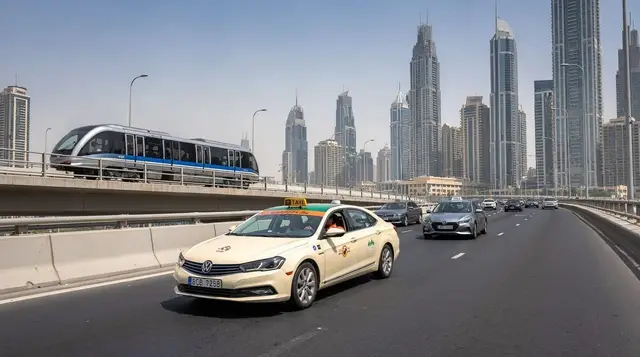
Cream-colored RTA taxis are everywhere in the tourist areas and can be hailed on the street, ordered by app, or picked up at ranks outside malls and hotels. Fares start with a flag fall of roughly AED 5 ($1.4), a minimum fare around AED 12 ($3.3), and a 25% surcharge between 10pm and 6am. Careem and Uber both operate citywide and are often marginally cheaper than a street-hailed taxi for a pre-booked economy ride, plus they let you see the price before confirming — genuinely useful in a city where meter surcharges (airport pickup, tolls, waiting time) can otherwise catch first-time visitors off guard. The full fare breakdown, including how Salik tolls get added to your ride, is in the Dubai taxi guide.
The Nol card system
Nol is the RTA’s rechargeable smart card, required (or at least strongly recommended) for the metro, tram, and most buses. There are several tiers — Silver for standard travel, Gold for the metro’s first-class-style carriage, Blue for registered residents, and a disposable Red paper ticket for occasional single trips — each with different fare caps and top-up rules. Buying the wrong one, or not realizing the daily spending cap exists, is one of the more common first-day mistakes visitors make. The full breakdown of card types, where to buy and top up, and which stations serve which lines is in the Nol card guide.
Abra, water bus, and ferry crossings
In Old Dubai, the cheapest and most memorable way to cross the Creek between Bur Dubai and Deira is the abra, a small wooden motorboat that’s run the same crossing for decades for roughly AED 1 per person, cash only. RTA also runs a more comfortable water bus version of the same route and scheduled Dubai Ferry services connecting further-flung stops along the coast, including a route out to the Marina. None of these substitute for the metro on a cross-city trip, but they’re a genuinely good way to see the Creek up close rather than just crossing a bridge — covered in more depth in the abra and Dubai Creek guide and the Old Dubai walking guide.
Getting in from the airport
Dubai International (DXB) sits close enough to Downtown that the Red Line metro runs directly into Terminals 1 and 3, making it one of the cheapest ways into the city if you’re traveling light and don’t mind a short walk with luggage through the station. Taxis are the more comfortable default, running roughly AED 50-70 ($14-19) to Downtown or the Marina with the airport pickup surcharge included, about 20-30 minutes outside peak traffic. Al Maktoum International (DWC), used by a smaller set of carriers, sits much further south near Dubai South and has no direct metro connection, making a taxi or pre-booked transfer the practical choice from there.
The full cost and time comparison for both airports is in the Dubai airport to city guide.
Renting a car and driving yourself
Self-driving makes sense mainly for reaching Abu Dhabi, Hatta, or Ras al-Khaimah on your own schedule, or if you’re staying somewhere the metro and buses don’t conveniently reach. Inside the city, a car adds parking costs, Salik toll gates (a flat AED 4 per gate crossing, billed automatically), and Dubai’s genuinely dense highway traffic during rush hour — for most visitors sticking to Downtown, the Marina, and Old Dubai, it’s an added cost without a real benefit over metro and taxi. Full details on rental costs, driving rules, and toll billing are in the Dubai car rental guide.
Getting to Abu Dhabi and other emirates
Abu Dhabi sits about 140 km southwest of Dubai along a single well-signed highway, reachable by intercity bus (roughly AED 25 / $7 one-way, about 2-2.5 hours), self-drive, or a guided tour that handles the driving for you. A half-day Sheikh Zayed Mosque tour from Dubai is a reasonable middle option if you’d rather not navigate mosque-area parking yourself.
Sharjah, Ras al-Khaimah, and Fujairah are all reachable by a mix of bus and taxi too, though each has its own logistics worth checking before you commit to a day trip — covered fully in the Dubai to Abu Dhabi transport guide and the best day trips from Dubai overview.
Hop-on hop-off buses and guided transport
For a first day or two, a hop-on hop-off bus removes the need to figure out routing entirely — you buy a ticket, board at any marked stop, and ride a fixed loop through Downtown, Old Dubai, and the Marina with recorded commentary included. A Big Bus hop-on hop-off ticket with an optional dhow cruise add-on covers the core sights without you having to plan a route. The hop-on hop-off guide has the honest comparison against metro plus taxi if you’re deciding which suits your trip better.
Cost comparison at a glance
For a typical day covering two or three areas, metro plus occasional taxi legs runs roughly AED 30-60 ($8-16) per person, a day of Careem rides runs roughly AED 80-150 ($22-41) depending on distances, and a rental car costs roughly AED 150-250 ($41-68) per day plus tolls and parking regardless of how much you actually drive it. None of these numbers make one option universally “best” — they make the case for combining metro for the corridor it covers with taxis for everything else, and reserving a car specifically for day trips outside the city.
Which option suits which visitor
First-time visitors on a short trip generally do best combining the metro for Downtown-to-Marina movement with taxis or Careem for Old Dubai and evening trips, without ever renting a car. Families with strollers and luggage often lean more heavily on taxis and pre-booked transfers simply for convenience, even though it costs more than the metro. Longer-stay visitors and anyone planning multiple day trips outside the city get real value from a rental car for a few specific days, without needing one for the whole trip. See the Dubai first-time guide and the Dubai with kids guide for itinerary-specific transport advice.
Common mistakes
The most common misstep is assuming the metro reaches everywhere — it doesn’t, and visitors who book a hotel expecting metro-adjacent everything sometimes end up relying on far more taxis than planned. The second is renting a car for a city-only trip and then paying for parking and tolls without ever really needing the flexibility. The third is not realizing Careem and Uber surcharge for demand spikes around major events or bad weather the same way they do elsewhere, so checking the fare estimate before confirming is worth the extra ten seconds.
Planning transport around the heat
From June to September, Dubai’s midday heat (routinely 40-48°C) makes walking even short distances between a taxi drop-off and an air-conditioned entrance genuinely uncomfortable, which shifts the calculus toward taxis and Careem over the metro’s walk-heavy interchange stations during those months. See Dubai in summer for how that affects daily planning beyond just transport, and best time to visit Dubai for the seasonal picture overall.
Paying for transport day to day
Cash is still accepted in taxis and at Nol top-up machines, but contactless cards and Apple Pay/Google Pay are widely accepted too, including directly at metro gates in some stations via open-loop payment, and inside Careem and Uber by default through the app. Carrying a small amount of AED cash is still worth it for the abra crossing in Old Dubai, which remains a cash-only ride, and for tipping drivers, which isn’t mandatory but is commonly rounded up to the nearest few dirhams. See the Dubai budget guide for how transport fits into a daily spending estimate alongside food and activities.
Accessibility and traveling with limited mobility
The metro is genuinely well set up for wheelchair users and anyone with mobility limitations — every station has lifts, and platform edges are level with train floors, unlike many bus stops which can involve a step up. Taxis and Careem don’t guarantee wheelchair-accessible vehicles by default, so requesting one in advance through the app or by calling ahead is worth doing if that’s a requirement rather than assuming any car that arrives will accommodate a wheelchair. Strollers are tolerated on the metro and buses without dedicated storage, so parents should expect to fold and hold rather than stow separately, a detail covered further in the Dubai with kids planning guide.
Booking ahead vs figuring it out on arrival
Nothing about Dubai’s transport requires advance booking except a rental car during peak season (November-March) when better vehicles and rates disappear first, and any private transfer or guided tour you want at a specific time slot. Metro, taxis, and Careem are all available on demand with essentially no planning needed, which is part of why many visitors skip renting a car entirely and just decide day to day how to get around. If you do want a private airport transfer arranged before you land rather than hailing a taxi on arrival, that’s covered in the Dubai airport to city guide.
Language and communicating with drivers
English is widely spoken by taxi and Careem drivers, and most drivers also use GPS navigation by default, so communicating a destination is rarely an issue — having the address or a saved pin in the Careem/Uber app or Google Maps avoids any ambiguity over pronunciation. Metro announcements and signage are in both Arabic and English throughout, and station staff at ticket counters generally speak enough English to help with a Nol card question or a lost fare card.
How this compares to other Gulf and Middle East cities
Compared to many regional capitals, Dubai’s public transport is unusually modern and well-maintained for a car-centric city, largely because the metro and tram were built recently rather than retrofitted onto an older network. The trade-off is coverage rather than quality — the system is excellent within its footprint but doesn’t yet reach anywhere near the whole of a sprawling, still-growing city, which is exactly why taxis and ride-hailing remain essential rather than a backup option for most visitors.
Rush hour and weekend patterns worth knowing
Dubai’s weekend runs Saturday-Sunday, so traffic and metro crowding follow a Sunday-through-Thursday work week, meaning Sunday mornings carry the heaviest commuter load rather than Monday. Friday afternoons empty out early as families head to brunch or the beach, then traffic builds again in the evening. If your itinerary is flexible, scheduling airport transfers and cross-city taxi rides outside the roughly 7-9am and 5-7pm windows on weekdays saves real time, particularly along Sheikh Zayed Road where congestion is most pronounced.
During Ramadan, traffic shifts further still, with a pronounced spike in the hour before sunset as people rush home for iftar — worth building extra buffer into any drive scheduled around that time, as covered in the Dubai Ramadan guide.
Combining modes across a single day
Most visitors end up mixing two or three transport modes within a single day rather than sticking to one, and planning for that upfront makes the day smoother than deciding mode by mode as you go. A typical pattern: metro from a Downtown or Marina hotel to a landmark, a short taxi or Careem hop to a specific restaurant or souk that sits off the metro corridor, and an abra crossing thrown in if the day includes Old Dubai. Keeping a Nol card topped up and a ride-hailing app installed with payment already added removes the friction of switching modes mid-day, which matters more in Dubai’s heat than it might in a more walkable city where switching costs little beyond a few extra minutes.
Transport options compared
| Option | Cost | Coverage | Best for |
|---|---|---|---|
| Metro | AED 3-7.5/trip | Downtown, Marina, Deira/Bur Dubai edge | Cheap, predictable point-to-point |
| Taxi/Careem/Uber | AED 15-50/ride | Citywide | Filling gaps, evenings, luggage |
| Tram | Included in Nol fare | Marina/JBR to Media City | Marina-area short hops |
| Bus | Included in Nol fare | Extensive but slow | Specific stops metro misses |
| Rental car | AED 150-250/day + tolls | Anywhere, including other emirates | Day trips outside the city |
| Abra/water bus | Around AED 1-5 | Dubai Creek crossings | Old Dubai sightseeing |
Frequently asked questions about getting around Dubai
Do I need to download an app before I arrive?
Careem and Uber both work well pre-installed with a payment method added, and the RTA’s own app (S’hail or the RTA Dubai app) is useful for checking bus routes and topping up a Nol card without visiting a machine.
Is it safe to use taxis and ride-hailing apps in Dubai?
Yes — both RTA taxis and Careem/Uber are widely used and considered reliable and safe, including for solo travelers and at night.
Can I pay for the metro with a credit card?
Not directly at the gate — you need a Nol card, which you can buy and top up with cash or card at any station’s ticket machine.
How early should I leave for the airport given traffic?
Budget at least 45-60 minutes for the drive during peak traffic (roughly 7-9am and 5-7pm), plus standard check-in time, even though the direct distance from Downtown is short.
Is Dubai walkable at all?
Within a single district like Downtown, the Marina, or Old Dubai, yes — each is reasonably walkable on its own. Between districts, distances and road design make walking impractical.
Does one ticket work across metro, tram, and bus?
Yes, a single Nol card works across all three modes, and RTA’s zone-based fare system treats a connected journey across modes within a set transfer window as one continuous trip rather than separate fares.
What’s the single biggest transport mistake first-time visitors make?
Booking a hotel purely on price without checking its distance from a metro station, then discovering every trip requires a taxi. A quick check of walking distance to the nearest Red or Green Line station before booking accommodation avoids most of this.
Is it worth renting a car just to get around the city?
Usually not — parking, Salik tolls, and traffic add cost without a real benefit over metro and taxi inside Dubai. A car earns its keep specifically for day trips to other emirates.
How do I pay for the abra crossing in Old Dubai?
Cash only, roughly AED 1 per person — it’s one of the few transport options in Dubai that doesn’t accept card or Nol payment.
Top experiences
Bookable activities with verified prices and instant confirmation on GetYourGuide.