Dubai public transport guide: metro, tram, bus, abra, and ferry
Dubai dhow cruise Marina dinner with transportation
How does Dubai's public transport system fit together?
Metro (Red and Green lines), the Dubai Tram, RTA buses, the abra creek crossing, and the RTA ferry all run under one authority, and all except the abra (cash-only, roughly AED 1) work on a single Nol card with zone-based fares from roughly AED 3-7.5 ($0.82-2). The system covers Downtown, the Marina, and the Creek well but leaves gaps — most of Jumeirah and Palm Jumeirah still need a taxi.
One authority, several modes
Dubai’s entire public transport network — metro, tram, bus, the abra creek crossing, and the RTA ferry — falls under a single authority, the Roads and Transport Authority (RTA), and most of it runs on one shared Nol card with zone-based fares. This integration is genuinely well designed for the corridor it covers, roughly Downtown, Business Bay, the Marina, and the Creek, but it’s worth being upfront that “integrated” doesn’t mean “everywhere” — large parts of the city, especially Jumeirah and Palm Jumeirah, still rely on taxis for most trips.
| Card needed | Nol card, around AED 25 incl. starting credit |
| Typical fare | Around AED 3-7.5 ($0.82-2) per zone-based trip |
| Cash-only leg | Abra crossing, around AED 1 per person |
| Coverage | Strong: Downtown, Marina, Creek. Weak: Jumeirah, Palm Jumeirah |
| Operating hours | Roughly 6am-midnight, later Thu/Fri-Sat |
For the fare mechanics and card types, see the Nol card guide; for the metro specifically, see the Dubai Metro guide.
The metro backbone
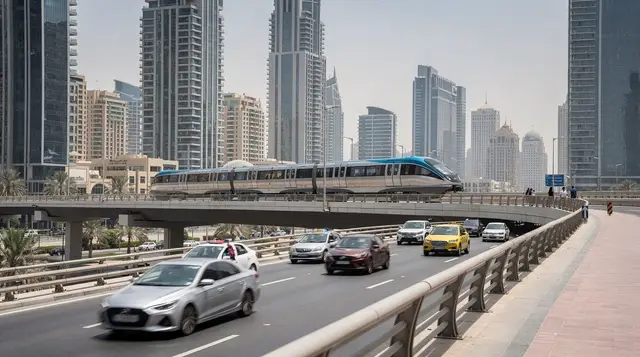
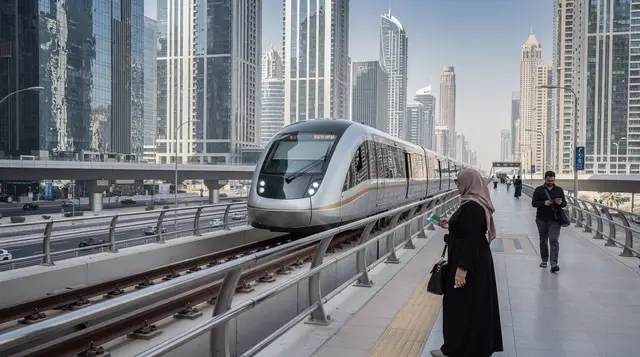
The Red and Green Line metro forms the backbone of the whole system, an elevated, driverless network running along Sheikh Zayed Road and through Deira and Bur Dubai, interchanging at BurJuman and Union stations. Everything else in this guide — tram, bus, ferry — essentially extends or fills gaps around this backbone rather than operating as a fully separate network, which is why understanding the two metro lines first makes the rest of the system click into place faster.
The Dubai Tram
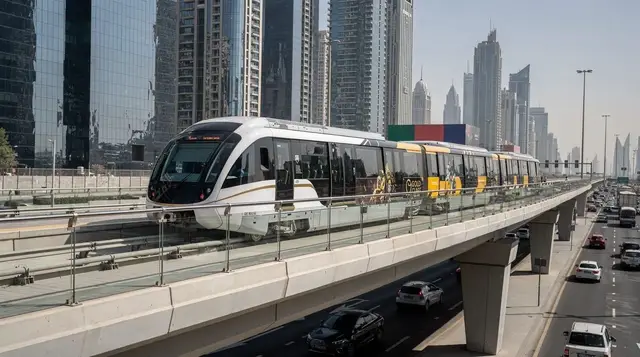
The Dubai Tram runs a single line along Al Sufouh Road, connecting Dubai Marina and JBR through Dubai Media City, and it interchanges with the Red Line metro at two stations, letting you move seamlessly between the tram and metro on the same Nol card without a separate fare. It’s a genuinely pleasant, low-effort way to move along the Marina/JBR waterfront strip without a taxi, running at street level with dedicated track rather than mixed into traffic, and it’s worth using specifically for that stretch rather than expecting it to extend much further into the city.
The bus network
RTA’s bus network is far larger than the metro or tram in terms of route coverage, reaching residential neighborhoods, older parts of the city, and connections the rail-based modes don’t touch, plus the E100/E101 intercity routes to Abu Dhabi. For a short visit, buses are less intuitive to use than the metro simply because routes and stop patterns take more research to figure out, so most tourists use buses selectively for a specific known route (like a museum or a market not near a metro station) rather than as a general-purpose exploration tool. Buses run on the same Nol card, tapped once on boarding without a separate tap-out.
Abra: the traditional Creek crossing
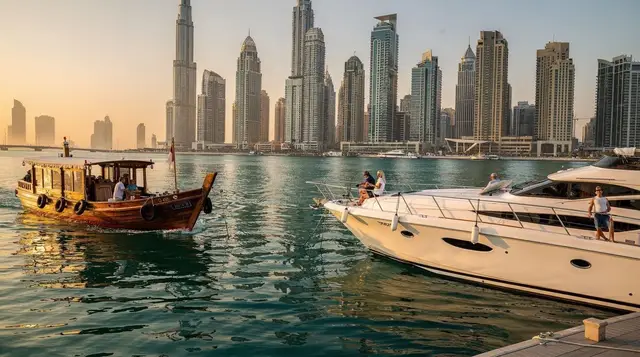
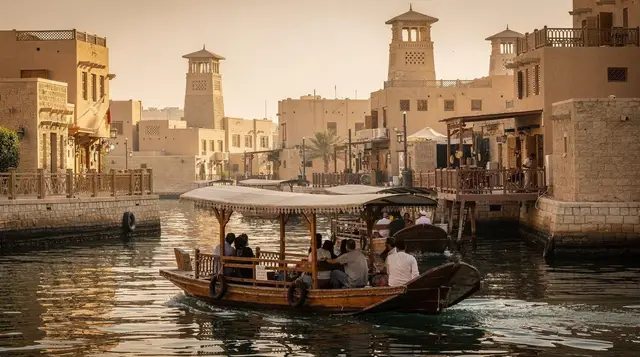
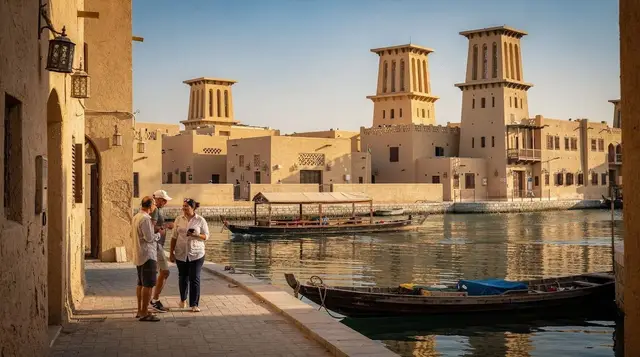
In Old Dubai, the abra — a small wooden motorboat that’s crossed Dubai Creek between Bur Dubai and Deira for generations — remains one of the cheapest and most memorable ways to move between the two historic districts, roughly AED 1 per person, cash only, with boats departing whenever they fill up rather than on a fixed schedule. It’s genuinely still used by locals for daily commuting, not just a tourist novelty, and pairs naturally with a walk through the gold souk or spice souk on either bank.
The full experience, including the more comfortable modern water bus version of the same crossing, is covered in the abra and Dubai Creek guide.
RTA Dubai Ferry and water bus
Beyond the abra, RTA runs a scheduled Dubai Ferry service along the coast, including a route connecting the Creek/Downtown area to Dubai Marina, priced and ticketed separately from the standard Nol zone fares, plus a modernized water bus version of the Creek crossing that does accept Nol. These are less about point-to-point commuting and more a scenic, relaxed alternative for a specific leg of a trip — worth building into an itinerary as an experience rather than relying on for tight scheduling, since departures are less frequent than the metro.
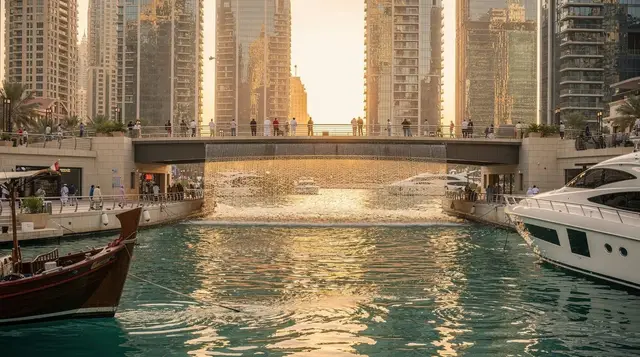
A dedicated dhow cruise with dinner and transportation included covers a similar stretch of water in the evening as a leisure experience rather than daytime transit.
How the modes connect in practice
A realistic cross-city trip might combine the metro from the Marina to Union station, a short walk or the Green Line to Al Fahidi, and then an abra crossing to reach the gold souk in Deira — three different modes on largely one continuous Nol-card journey (excluding the cash-only abra leg). This kind of multi-mode trip is exactly what the system is designed for, and it’s genuinely one of the more interesting ways to experience Old Dubai rather than just taking a taxi directly to a single stop.
A guided Old Town, Creek, and souks walking tour including an abra ride covers this same route with a guide explaining the history along the way, useful if you’d rather not self-navigate the older, less signposted parts of the crossing on your own.
Where the system genuinely falls short
Being honest about the gaps matters as much as explaining what works: Jumeirah’s beach strip, most of Palm Jumeirah, and the bulk of residential neighborhoods away from the Red and Green lines have no direct metro, tram, or meaningfully useful bus connection for a visitor’s typical itinerary. Taxis and Careem fill these gaps reliably, covered in the Dubai taxi guide, and accepting this rather than trying to force public transport into every leg of a trip makes for a much less frustrating visit.
Accessibility across the system
The metro and tram are both genuinely well designed for wheelchair users and anyone with mobility limitations, with lifts and level boarding throughout. Buses can require a step up depending on the specific vehicle and stop, and the abra, being an open wooden boat with no ramp, isn’t practically accessible for wheelchair users — the modern water bus version of the same crossing is a more accessible alternative for that specific route.
Payment across the whole system
A single Nol card covers metro, tram, bus, and the RTA water bus under one zone-based fare structure, while the traditional abra remains cash-only and the scheduled Dubai Ferry uses its own separate ticketing. Carrying a small amount of AED cash alongside a topped-up Nol card covers every mode in this guide without needing multiple separate payment methods for most of your trip — the Nol card guide has the full breakdown of card types and top-up logistics.
Using the system for a full day in Old Dubai
A full day exploring Old Dubai genuinely showcases how well this integrated system works when you stay within its coverage area: metro or Green Line to Al Fahidi or Al Ras station, a walk through the Al Fahidi historical district, an abra crossing to Deira for the gold and spice souks, and a return metro or bus leg back to your hotel — all for a few dirhams in fares plus the abra’s AED 1 crossing. This is one of the better arguments for learning the system rather than defaulting to taxis for every single leg of a trip focused on the older parts of the city.
Common mistakes
The most common mistake is assuming the tram extends further than it actually does, when it’s genuinely limited to the Al Sufouh Road corridor rather than a citywide network. The second is expecting the abra to run on a fixed timetable the way the metro does, when it actually departs once enough passengers board rather than on a schedule. The third is not realizing the Dubai Ferry is priced separately from the standard Nol zone fares, leading to confusion at the ticket counter if you’re expecting your metro balance to cover it directly.
Why Dubai’s system is shaped the way it is
Dubai’s public transport network was largely built in the last two decades, with the metro opening in 2009, well after the city’s road-centric, car-oriented urban layout was already established. This explains the coverage pattern better than anything else: rail lines follow the corridors that existed when the network was designed, mainly Sheikh Zayed Road and the older Creek-side districts, rather than retrofitting rail into every neighborhood built since. It’s a genuinely modern, well-run system for what it covers, and understanding that it was built onto an already car-centric city, rather than the other way around, explains why gaps exist rather than suggesting poor planning.
Comparing Dubai’s system to a genuinely rail-dense city
Visitors arriving from cities with dense, decades-old rail networks — London, Tokyo, Paris — sometimes expect a similar level of coverage and are surprised by the gaps. The fairer comparison is to other rapidly built car-first cities that added rail transit later, like parts of the US Sun Belt or Gulf neighbors, against which Dubai’s system is unusually good: clean, frequent, air-conditioned, and genuinely integrated across modes on one card, even if the physical footprint remains smaller than an older European or East Asian network. Recalibrating expectations this way avoids unnecessary frustration on a first visit.
Real-time information and trip planning
Google Maps integrates Dubai’s metro, tram, and much of the bus network directly into its public transport directions, making it a reliable primary tool for planning a multi-mode trip without needing to learn the system from scratch. The RTA’s own app (S’hail) offers similar route planning with the advantage of RTA’s live operational data, useful as a secondary check, particularly for bus timings which shift more than the metro’s fixed schedule. Neither tool currently integrates the abra’s on-demand departure pattern meaningfully, since it doesn’t run on a fixed timetable to begin with.
Traveling with luggage across multiple modes
If your day includes a multi-mode trip like the Old Dubai combination above, traveling light matters more than it would on a single metro ride — abra boats have limited deck space, and switching between modes with large suitcases adds friction at each transfer point. This kind of multi-mode day works best with a day bag rather than full luggage, which is better suited to a direct taxi transfer, covered in the airport to city guide for the specific arrival-day case.
Seasonal considerations for outdoor legs
The abra and any walking between transport modes involves brief outdoor exposure, which matters more than it sounds during Dubai’s summer months (June-September, routinely 40-48°C) — even a five-minute wait for an abra to fill up can feel uncomfortable at midday in that heat. Timing an Old Dubai multi-mode day for morning or early evening during summer, rather than midday, makes the experience meaningfully more pleasant, a pattern covered more broadly in Dubai in summer.
A practical three-day pattern using the full system
Day one, staying in Downtown or Business Bay: metro exclusively, covering the Burj Khalifa, Dubai Mall, and the Fountain without a single taxi needed. Day two, an Old Dubai day: Green Line metro plus an abra crossing, exactly as outlined above, again largely taxi-free. Day three, the Marina and JBR: Red Line metro connecting to the tram at the interchange station, covering Dubai Marina and the beach walk.
This three-day pattern demonstrates the system at its best — the moment your itinerary shifts to Jumeirah, Palm Jumeirah, or a day trip outside the city, taxis, Careem, or a rental car become necessary, as covered in getting around Dubai.
Night service and late-evening options
Metro and tram both run until around midnight most nights, extending later on Thursday and Friday/Saturday given the Saturday-Sunday weekend, while buses generally follow a similar but slightly earlier cutoff on most routes. The abra also winds down its frequency in the evening, though it doesn’t fully stop, and the RTA Dubai Ferry runs a more limited evening schedule than its daytime frequency. For anything after these services wind down, taxis and ride-hailing apps operate 24 hours and are the only reliable late-night option, covered in the night tour guide for evening-specific planning.
How the system handles large events and crowds
During major events — New Year’s Eve fireworks at Downtown or the Marina, or large exhibitions at Expo City Dubai — metro and bus services around the affected area often see temporary schedule adjustments and noticeably heavier crowding, sometimes with additional trains added on short notice. Planning to arrive well ahead of a major event and being prepared for a slower, more crowded return trip afterward is a realistic expectation rather than an exception, similar to how any major city’s transit system behaves around a large public gathering.
The system’s role in Dubai’s broader growth
As Dubai continues expanding southward toward Expo City and further developments, RTA’s public transport network is expected to extend accordingly, following the same pattern of rail following growth corridors rather than retrofitting into established areas. For now, though, treating the current Red and Green lines, the single tram route, and the bus network as the practical footprint for a visitor’s trip planning, rather than assuming future extensions, keeps expectations realistic for a trip happening today.
Choosing between the modes at a glance
| Mode | Best for | Cost | Coverage |
|---|---|---|---|
| Metro | Downtown, Marina, Deira, Bur Dubai | AED 3-7.5/trip | Excellent along Red/Green lines |
| Tram | Marina/JBR waterfront strip only | On Nol, same zone fares | Narrow, single corridor |
| Bus | Specific known routes, intercity to Abu Dhabi | On Nol, same zone fares | Widest but hardest to self-navigate |
| Abra | Bur Dubai-Deira, atmosphere over speed | Around AED 1, cash only | Single Creek crossing |
| Taxi/Careem | Jumeirah, Palm Jumeirah, late-night, luggage | Metered, higher than transit | Anywhere, anytime |
If your trip is mostly Downtown, Marina, and Old Dubai, budget for a Nol card and a little cash for the abra and expect to barely touch a taxi. If your hotel sits on Palm Jumeirah or along the Jumeirah beach strip, budget for taxis or Careem as your primary mode and treat public transport as a bonus for specific Downtown or Old Dubai days.
Traveling between airport and the network
Dubai International Airport connects directly to the Red Line metro, making it possible to reach Downtown or the Marina without a taxi if you’re travelling light, though the airport to city guide is worth reading first since luggage limits and rush-hour crowding change the calculation. Al Maktoum International (the newer, secondary airport further south) doesn’t have the same direct metro connection yet, so a taxi or pre-booked transfer is the realistic option from there for now.
Choosing between the modes at a glance
Can I use the Nol card on the Dubai Ferry?
Not for the scheduled Dubai Ferry service itself, which uses separate ticketing, though the modernized abra-route water bus does accept Nol.
Is the tram worth using if I’m not staying in the Marina?
Not especially — its route is limited to the Al Sufouh Road corridor, so it’s most useful specifically for visitors based in or near the Marina and JBR.
How often do abras depart?
They leave once enough passengers board rather than on a fixed schedule, typically every few minutes during busy daytime hours along the Bur Dubai-Deira crossing.
Is public transport enough to see all of Dubai without a taxi?
For Downtown, the Marina, and Old Dubai, largely yes; for Jumeirah, Palm Jumeirah, and most other neighborhoods, no — a taxi or Careem is genuinely necessary for those areas.
Does the bus network reach the desert or Hatta?
No, the standard city bus network doesn’t extend to desert conservation areas or Hatta; those require a car, tour, or the relevant intercity route covered in the Hatta day trip guide.
Is the abra safe?
Yes, it’s a routine, well-used local crossing with an excellent safety record, used daily by residents alongside tourists.
Can I plan a multi-mode trip using just my phone?
Yes, Google Maps handles metro, tram, and most bus routing directly, though it won’t schedule the abra’s on-demand departures, which you simply show up for at the dock.
Does the public transport system operate on public holidays?
Yes, generally with a modified schedule similar to a Friday or weekend timetable, so checking for holiday-specific hours before an early trip is worth doing around major UAE public holidays.
Is there a single app that shows abra, ferry, metro, and bus together?
Not fully — Google Maps and the RTA app cover metro, tram, and bus routing well, but the abra’s on-demand departures and the separately ticketed Dubai Ferry aren’t integrated into the same live journey planner.
Do I need a Nol card if I’m only in Dubai for a layover?
A short layover of a few hours is usually simpler by taxi directly to and from a single sight, but if you have a half-day or more and plan to combine two or three Downtown or Old Dubai stops, a Nol card pays for itself quickly — see the layover tour guide for a route that uses the metro efficiently.
Is it cheaper to use public transport than taxis for a whole trip?
For a Downtown, Marina, and Old Dubai-focused trip, yes, noticeably — a week of mostly-metro travel with occasional taxis typically costs a fraction of a taxi-only equivalent. If your hotel is in Jumeirah or Palm Jumeirah, the gap narrows considerably since taxis become the default rather than the exception.
Top experiences
Bookable activities with verified prices and instant confirmation on GetYourGuide.