Dubai Metro guide: lines, hours, fares, and Gold Class
Dubai: city sightseeing HOHO bus tour + sunset & night tour
How does the Dubai Metro work?
Two driverless lines, Red and Green, cover a corridor along Sheikh Zayed Road and through Deira/Bur Dubai. Buy or tap a Nol card at any station, fares run roughly AED 3-7.5 ($0.82-2) depending on zones crossed, and trains run from around 5am to midnight on weekdays with later hours Thursday-Saturday. The first carriage is paid Gold Class; one regular-fare carriage is reserved for women and children only.
What the Dubai Metro actually covers
The Dubai Metro is a driverless, elevated (mostly) rail system built around two lines, Red and Green, that together cover a corridor following Sheikh Zayed Road and looping through Deira and Bur Dubai near the Creek. It’s clean, air-conditioned, cheap, and runs frequently, which makes it the default choice for point-to-point trips along its route — the honest caveat is that “along its route” excludes a lot of the city, including most of Old Dubai’s interior streets, Jumeirah’s beach strip, and most residential neighborhoods away from the two lines. For the full picture of how metro fits alongside taxis, buses, and the tram, see getting around Dubai.
| Lines | Red (Sheikh Zayed Road) and Green (Deira/Bur Dubai) |
| Fares | AED 3-7.5 ($0.82-2) Silver; roughly double for Gold Class |
| Hours | ~5am-midnight weekdays, later Thu-Sat |
| Payment | Nol card, tap at any station |
| Interchange | BurJuman and Union stations |
The Red Line
The Red Line is the one most visitors use most, running roughly 52 km from the UAE Exchange area near Jebel Ali through Dubai Marina, Mall of the Emirates, Downtown Dubai (Burj Khalifa/Dubai Mall station), Business Bay, and both Dubai International Airport terminals, before continuing toward Rashidiya and the Route 2020 branch out to Expo City Dubai. This single line effectively connects most of the destinations a first-time visitor cares about — the Burj Khalifa, Dubai Mall, and the Marina — without needing to change lines.
The Green Line
The Green Line runs a shorter loop through Deira and Bur Dubai, closer to the older, denser parts of the city near Old Dubai and Deira’s gold and spice souks. It crosses the Red Line at two interchange stations, BurJuman and Union, so a trip from the Marina to the Gold Souk typically means one change at either interchange rather than a direct ride. The Green Line doesn’t reach the airport or the Marina directly, which is the main reason first-time visitors sometimes assume it’s less useful — in practice it’s the better line for anyone spending real time around the Creek and the older souks.
Fares and how the zone system works
Dubai is divided into travel zones, and your fare depends on how many zones your trip crosses rather than distance traveled within a single zone. On a Nol Silver card, a single-zone trip runs roughly AED 3 ($0.82), two zones roughly AED 5 ($1.4), and three or more zones roughly AED 7.5 ($2). Gold Class fares run roughly double those figures. There’s also a daily fare cap on Silver cards, meaning heavy same-day use doesn’t keep accumulating cost indefinitely — useful to know if you’re moving around a lot in one day. The Nol card guide covers card types, top-up methods, and where the fare caps kick in.
Gold Class: the paid upgrade
Every train’s first carriage is Gold Class, a paid upgrade with leather seating, roughly double the standard fare, and noticeably more legroom and quiet during busy commuting hours. It’s a genuinely nice option during the evening rush or if you’re carrying luggage and want guaranteed seating, but it’s not necessary for most sightseeing trips outside peak hours, when the regular carriages are comfortable enough. Riding in Gold Class with a Silver-fare Nol card, or vice versa, triggers a fine if checked, so make sure your card tier matches the carriage you board.
The women and children carriage
One regular-fare carriage on every train — usually the one adjacent to Gold Class, marked with pink signage at platform level and on the carriage itself — is reserved exclusively for women and children. Men traveling alone aren’t permitted to board it, and RTA does enforce this with fines for men who ignore the signage; the rule doesn’t apply to a mixed family group traveling together. This is a genuinely useful option for women traveling solo, particularly during crowded commuting hours, and it’s priced the same as the regular carriages, not a Gold Class-style upgrade.
Hours of operation
Trains generally run from around 5am to midnight Sunday through Wednesday, with an extended service to around 1am on Thursday nights and as late as 2am on Friday and Saturday nights, reflecting the Saturday-Sunday weekend. Friday mornings historically start later than other days since the weekend shifted from Friday-Saturday to Saturday-Sunday in 2022 — always worth double-checking the current RTA timetable before planning an early Friday trip, since exact hours have moved over the years. Trains run every 4-8 minutes during the day, stretching to a wider gap late at night.
Stations worth knowing for sightseeing
Burj Khalifa/Dubai Mall station on the Red Line is the main stop for Downtown Dubai, though it’s a longer walk than it looks on a map — an air-conditioned walkway connects the station to Dubai Mall, taking a genuine 10-15 minutes rather than a quick hop. Business Bay station serves the Museum of the Future area, and Mall of the Emirates station drops you at Ski Dubai and that mall’s entrance directly.
BurJuman and Al Fahidi stations are the practical entry points for Old Dubai’s souks and the Al Fahidi historical district, though from either station it’s still a 10-15 minute walk into the old quarter itself.
What the metro doesn’t reach
The metro’s biggest gap for visitors is Jumeirah’s beach strip, including the Jumeirah Mosque area and most of the public beaches, none of which sit near a station — a taxi or bus fills that gap. Palm Jumeirah also has no direct metro line onto the Palm itself; the nearest stations sit on the mainland, with a monorail or taxi covering the final stretch. Anyone planning to rely on the metro exclusively should check their hotel and planned attractions against the two lines before assuming everything connects.
Combining the metro with the tram
At two interchange points, the Dubai Tram connects to the Red Line, extending reach along Al Sufouh Road toward the Marina and JBR without a taxi. A single Nol card covers both modes under the same zone-based fare system, so this is a seamless combination rather than a separate purchase. The public transport guide covers the tram’s specific route and stops in more detail.
Comparing the metro to a hop-on hop-off bus
For a first day or two, some visitors prefer a fixed-route hop-on hop-off bus over figuring out metro stations and interchange logic, trading a higher price for recorded commentary and door-to-door coverage of the main sights. A hop-on hop-off sightseeing bus ticket with sunset and night tour is a reasonable alternative if you’d rather not learn the metro map on arrival day, though it costs meaningfully more than the metro for the same general route. The hop-on hop-off guide has the full honest comparison.
Practical tips for first-time riders
Trains stop precisely at marked doors, and platforms have screen doors that only open when a train is present, so there’s no risk of stepping onto the tracks. Priority seating near the doors is reserved for elderly, pregnant, and disabled passengers, and it’s generally respected. Eating, drinking, and chewing gum are not allowed on trains or platforms and are enforced with fines — a detail that surprises visitors used to more relaxed transit rules elsewhere. Luggage is fine on board outside the most crowded rush-hour windows, though very large suitcases can be awkward at busy interchange stations.
Common mistakes
The most frequent mistake is boarding Gold Class with a Silver-fare card, which triggers a fine if an inspector checks — always tap in and out at the correct gate for the carriage you’re riding. The second is underestimating walking time from station to destination, particularly at Burj Khalifa/Dubai Mall station, where the connecting walkway is longer than it appears. The third is assuming the metro reaches everywhere; checking your hotel and planned sights against the two lines before booking saves a lot of unplanned taxi spending, as covered more broadly in getting around Dubai.
Accessibility
Every station has lifts and level boarding, making the metro one of the most genuinely accessible transport options in the city for wheelchair users and anyone with mobility limitations, in contrast to buses which can require a step up. Staff are generally available at station gates to assist if needed.
Why the metro is elevated and driverless
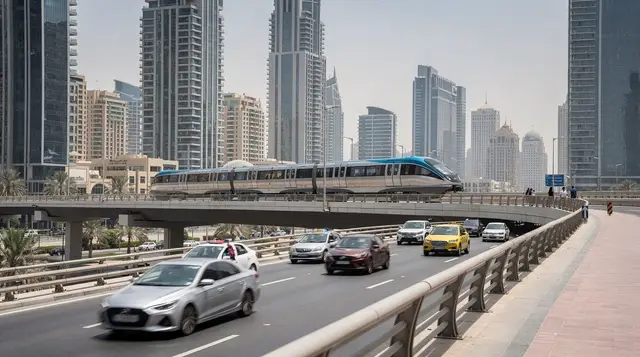
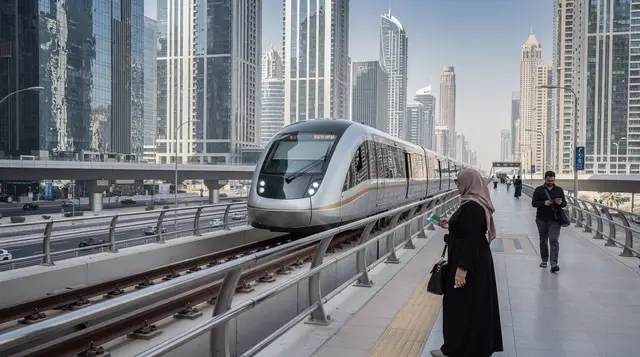
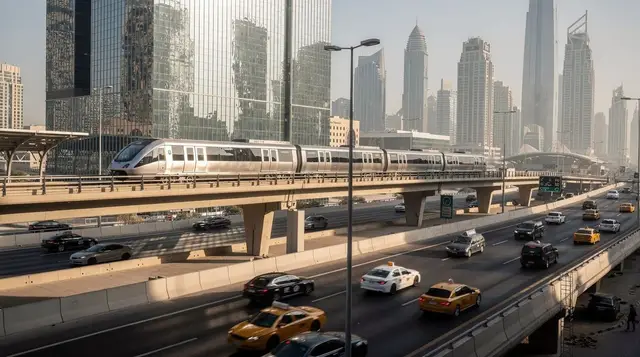
Most of the Dubai Metro runs on an elevated viaduct above Sheikh Zayed Road rather than underground, a design choice driven by the city’s high water table and the speed advantage of building above ground rather than tunneling through much of the route. The trains are fully driverless, controlled from a central operations center, which is part of why service is so consistent — there’s no variability from individual operators, just a fixed schedule the system either meets or doesn’t. This also means every carriage, including the very front, is just another passenger space rather than a driver’s cabin, which surprises some first-time riders expecting a view forward through a driver’s window.
Riding for the views, not just the commute
Because so much of the Red Line runs elevated above Sheikh Zayed Road, a normal metro ride doubles as a decent, free skyline viewpoint — the stretch between Financial Centre and Burj Khalifa/Dubai Mall stations gives an elevated, moving view of the tower cluster along the road that’s genuinely worth looking up from your phone for. It’s not a substitute for a dedicated viewpoint like the Dubai Frame or Ain Dubai, but it’s a pleasant bonus on a ride you’re already taking. Late afternoon light works best if you want photos through the window, since the elevated track faces largely west-to-east along that stretch.
Cost comparison: metro vs taxi for the same trip
A one-way Downtown-to-Marina metro trip crossing multiple zones runs roughly AED 7.5 ($2) on a Silver Nol card and takes about 30-35 minutes including the walk to and from stations. The same trip by taxi runs roughly AED 40-60 ($11-16) and takes 20-30 minutes depending on Sheikh Zayed Road traffic, without the walk. For a solo traveler or someone comfortable navigating stations, the metro is clearly cheaper; for a family with luggage or anyone short on time during rush hour, the taxi’s door-to-door convenience often justifies the extra cost. Neither is objectively wrong — see getting around Dubai for how this trade-off plays out across a full itinerary.
Crowding patterns to plan around
The metro gets genuinely crowded during the Sunday-Thursday commuting peaks, roughly 7-9am and 5-7pm, when standing room only is common on the Red Line’s central stretch through Downtown and Business Bay. Outside those windows, and on Fridays and Saturdays, trains are comfortably uncrowded even at popular tourist stations. If you’re traveling with a stroller, wheelchair, or a lot of luggage, timing trips outside the commuting peaks makes a noticeable difference to comfort, and it’s one of the few situations where checking the day of the week actually changes your transport plan meaningfully.
Future extensions worth knowing about
RTA has ongoing plans for further metro expansion beyond the current Red and Green lines, including a Blue Line intended to serve areas further from the current network — useful context if you’re researching long-term Dubai transport, though none of this affects a near-term visit since only the Red and Green lines are operational today. Route 2020, the existing Red Line branch extending to Expo City Dubai, is the most recent addition and already open, connecting that district for anyone visiting exhibitions or events there.
Metro during Ramadan
Operating hours and crowding patterns shift during Ramadan, with a pronounced quiet period during the day and a sharp crowding spike in the hour before iftar as commuters rush home, followed by lighter, later evening travel after sunset prayers. If your trip falls during Ramadan, the Dubai Ramadan guide has the fuller picture of how daily rhythms shift, including public dining rules that affect where you can eat near a station during daylight hours.
Buying a card at the station
Every station has ticket vending machines accepting cash and card, with an English-language interface that walks you through choosing a Nol card type and top-up amount step by step — no need to queue at a staffed counter unless you have a specific question. A basic Nol Silver card costs a small refundable-ish deposit plus whatever credit you load onto it, and it’s reusable for the rest of your trip and any future visit, so it’s worth keeping rather than discarding at the airport on departure. Staffed ticket counters exist at larger stations for anything the machine can’t handle, including replacing a lost registered card.
Etiquette on board
Beyond the no food, drink, or gum rule, Dubai’s metro etiquette leans toward the same norms as most modern metro systems — let passengers off before boarding, keep the priority seating area near the doors free for elderly, pregnant, or disabled riders, and keep noise reasonably low, particularly since many carriages carry a broad mix of commuters and tourists at once. Photography on board is fine and common; photographing other passengers without asking is best avoided as a matter of general courtesy rather than a specific rule.
Modest dress isn’t formally required on the metro the way it is at mosques, but Dubai’s general norm of covered shoulders and knees in public spaces applies here as much as anywhere else, detailed in the dress code guide.
Metro versus Dubai Taxi and Careem for tourists specifically
Beyond the general cost comparison covered above, the metro’s real advantage for tourists specifically is predictability — a metro trip takes roughly the same time regardless of traffic, while a taxi or Careem ride along Sheikh Zayed Road during rush hour can stretch well beyond its normal duration. The taxi guide covers Dubai’s metered taxi system and Careem’s app-based booking in detail, including when a taxi’s door-to-door convenience genuinely outweighs the metro’s lower cost — mainly late at night, with heavy luggage, or when your route falls outside the two lines entirely.
Using the metro for airport transfers specifically
The Red Line connects directly from Terminal 1 and Terminal 3 stations toward Downtown and the Marina corridor, making it one of the cheapest ways to reach the city on arrival — though it’s a less practical choice than a taxi for a very early or very late flight, when trains may not yet be running or luggage volume makes navigating stairs and platform transfers genuinely awkward. The airport to city guide covers the specific terminal walking distances and timing considerations that matter more for an arriving traveler than for someone already settled into a Dubai stay.
What a Nol Tourist Card adds over a standard card
Beyond the standard Silver and Gold cards covered in the Nol card guide, a Nol Tourist Card bundles a fixed number of trips or a time-based pass aimed specifically at short-stay visitors who know they’ll be using the metro heavily across a 1-3 day window — worth comparing against simply topping up a standard Silver card, since the tourist version isn’t automatically cheaper per trip for every travel pattern. Calculating your expected daily trip count against both options before committing to one avoids overpaying for a bundle you don’t fully use.
Frequently asked questions about the Dubai Metro
Can tourists use a regular Nol card, or is there a special tourist version?
Tourists can use the same Silver or Gold cards as residents; a “Nol Tourist Card” version also exists with slightly different top-up bundling aimed at short stays, covered in the Nol card guide.
Is the metro air-conditioned?
Yes, both trains and stations are fully air-conditioned, which matters given Dubai’s summer heat covered in the Dubai in summer guide.
Do the Red and Green lines connect directly?
Yes, at two interchange stations, BurJuman and Union, where you can change lines without leaving the paid zone.
Is there a metro station near the Burj Khalifa?
Yes, the Burj Khalifa/Dubai Mall station on the Red Line, connected by an air-conditioned walkway that takes roughly 10-15 minutes on foot.
Can I bring luggage on the metro?
Yes, luggage is permitted, though very full trains during rush hour make it awkward — the airport to city guide has specific advice for arrival-day timing.
Does the metro run on Fridays?
Yes, though historically with a later start in the morning than other days; check current RTA hours before an early Friday trip.
Is there Wi-Fi or phone signal in the metro stations and trains?
Yes, mobile signal is generally strong throughout stations and on board, and several stations and trains offer free Wi-Fi, though coverage quality varies slightly by carrier and location.
Can I bring a bicycle or scooter on the metro?
Folded bicycles and scooters are generally permitted outside rush-hour crowding, while full-size unfolded bikes are typically restricted during the busiest commuting windows — checking current RTA guidance before boarding with one avoids being turned away at the gate.
Is the metro cheaper than a taxi for tourists?
Yes, meaningfully — a cross-zone trip runs roughly AED 7.5 ($2) on the metro versus AED 40-60 ($11-16) by taxi, though taxis offer door-to-door convenience the metro can’t match at busy stations.
Does a Nol Tourist Card save money over a standard Silver card?
Not automatically — it bundles trips or a time-based pass, which only pays off if your expected daily trip count matches the bundle; compare both before committing.
Top experiences
Bookable activities with verified prices and instant confirmation on GetYourGuide.