Jumeirah — mosque, open beaches and Burj Al Arab views
Jumeirah guide: Jumeirah Mosque tours, open public beaches, Madinat Jumeirah's canals, and the best free spots to see the Burj Al Arab.
Dubai: half-day city tour with Blue Mosque, Creek, and souks
Quick facts
- Location
- Coastal strip between Downtown and Dubai Marina
- Best free view
- Burj Al Arab from Jumeirah Beach Park or Kite Beach
- Mosque visits
- Guided tours only, open to all faiths, abayas provided free
- Best for
- Beach days, cultural visits, mid-range hotel bases
- Typical hotel price
- AED 350–900/night (95–245 USD)
What Jumeirah covers
Jumeirah is the coastal strip running between Downtown and Dubai Marina, made up of low-rise villas, a string of public beaches, and two of the city’s more distinctive landmarks: Jumeirah Mosque, one of the only mosques in Dubai open to non-Muslim visitors, and Madinat Jumeirah, a sprawling resort complex built to resemble a traditional Arabian town, directly opposite the Burj Al Arab’s sail-shaped silhouette. The area takes its name from the Arabic word for “beautiful,” a fitting label for what remains one of the more visually appealing and least commercially aggressive coastal stretches in the city.
Unlike the Marina or Downtown, Jumeirah isn’t a single dense district so much as a corridor of specific stops connected by a coastal road, best visited by taxi or car rather than on foot between sights.
Most visitors treat Jumeirah as a half-day stop combining the mosque tour with a beach visit, though it also works as a quieter, mid-range hotel base for travelers who want beach access without the Marina’s density or the Palm’s isolation. See the Jumeirah neighborhood guide for area-specific hotel picks.
Jumeirah Mosque
Jumeirah Mosque, built in a Fatimid architectural style with twin minarets and pale stone that gives it a distinctive blue-grey cast at certain times of day, is one of the very few mosques in the UAE that welcomes non-Muslim visitors inside, and the standard way to see it is through a guided tour run by the Sheikh Mohammed Centre for Cultural Understanding. Tours run on a fixed schedule rather than open walk-in access, cover basic Islamic practice and etiquette, and include time for questions — genuinely one of the more worthwhile 75 minutes you can spend in the city if you’re interested in the culture beyond the malls and skyline.
Abayas and headscarves are provided free at the entrance for anyone not already dressed appropriately; shoulders and knees should be covered regardless.
See the Jumeirah Mosque visit guide for the current tour schedule and booking details, and the Emirati culture etiquette guide for broader context. A version that bundles a Jumeirah Mosque area visit with Old Dubai’s Creek and souks on the same half-day is available through Half-day city tour with Blue Mosque, Creek and souks, useful if you want the cultural and historic sides of the city covered in one guided outing rather than arranging transport between them yourself.
The beaches
Jumeirah’s public beaches are less commercial and generally quieter than JBR’s stretch by the Marina, with Jumeirah Beach Park (now Kite Beach in its northern section) offering a long, open stretch of sand popular with kitesurfers, joggers, and families, backed by food trucks rather than resort towers. It’s free, has decent facilities including showers and shaded seating, and gives one of the clearest unobstructed views back toward the Burj Al Arab of any public spot in the city — a genuinely good, free alternative to paying resort prices for the same silhouette. See the Dubai beaches guide for how Kite Beach compares to JBR and La Mer.
Further along, La Mer is a newer beachfront development with a boardwalk, restaurants, and a small water park, aimed more at a resort-style day out than Kite Beach’s sportier, more local feel. Both are reasonable half-day stops if you’re not staying at a beach resort but still want sand and a swim.
Jumeirah’s beaches compared
| Kite Beach | La Mer | JBR (for comparison) | |
|---|---|---|---|
| Vibe | Sporty, local, joggers and kitesurfers | Resort-style boardwalk | Busy, commercial, tower-lined |
| Burj Al Arab view | Clear, unobstructed | Partial, more distant | None |
| Amenities | Showers, shaded seating, food trucks | Restaurants, small water park | Full promenade, malls, hotels |
| Crowd level | Moderate | Moderate-busy on weekends | Busiest of the three |
Madinat Jumeirah and Burj Al Arab views
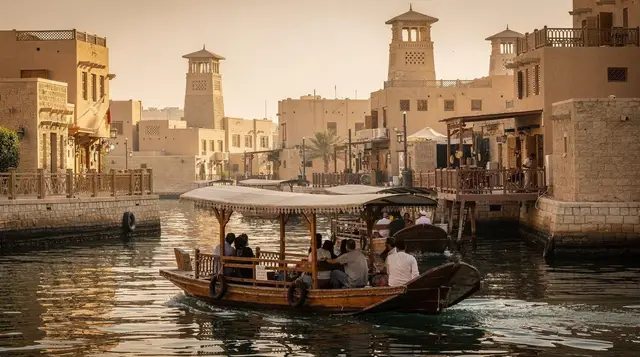
Madinat Jumeirah, built to resemble a traditional Arabian souk-and-waterway town, sits directly across a private lagoon from the Burj Al Arab and is one of the more atmospheric places in the city for an evening walk, with abra boats ferrying guests along its canals between restaurants and the souk-style shopping arcade. Non-hotel-guests can access parts of the complex, particularly the souk and several restaurants, without a room booking, though the best lagoon-facing terraces are generally reserved for hotel guests or diners with a confirmed reservation.
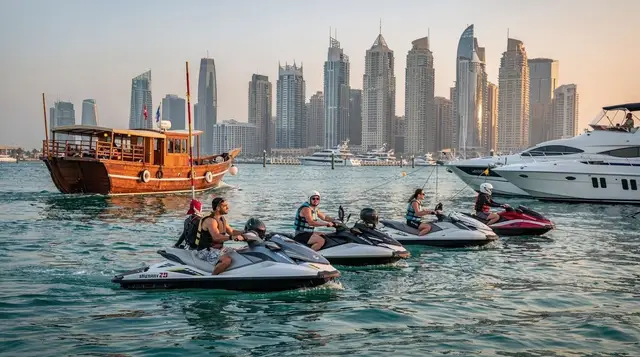
The Burj Al Arab itself isn’t open to non-guests without a dining or spa reservation, but its sail-shaped profile is visible, free, from several points along the Jumeirah coastline, including Kite Beach and the public areas around Madinat Jumeirah. For a closer look from the water, jet ski tour to Atlantis and Burj Al Arab and jet ski tour of Burj Al Arab with photos both loop close enough for genuinely dramatic photos without needing a hotel reservation.
A calmer alternative covering the same stretch of coast by speedboat is Marina, Atlantis, Palm and Burj Al Arab speedboat tour. See the Burj Al Arab guide for how to actually get inside if you want to try.
Jumeirah’s villa neighborhoods and Safa Park
Away from its coastal strip, Jumeirah is also one of Dubai’s older established residential areas, made up of low-rise villa neighborhoods that predate most of the city’s high-rise development — a genuinely different texture from the tower-lined Marina or Downtown, with tree-lined side streets and independent cafes tucked into converted villas rather than mall-based chains. Safa Park, a large green space on Jumeirah’s inland edge, is one of the better spots in the city for a walk or picnic away from the beach and traffic, with a lake, jogging track, and enough shade to make a midday visit tolerable outside the hottest summer months. It’s free to enter and a useful stop for travelers wanting a break from sightseeing-paced days.
Jumeirah’s mosques beyond the headline tour
While Jumeirah Mosque is the standard, guided-tour-only stop for visitors, the wider Jumeirah area has several smaller neighborhood mosques that punctuate the villa streets — not open to non-Muslim visitors for interior access, but worth noting for their varied architecture, from older, simpler coral-stone construction to newer, larger structures built in the past two decades. None of these substitute for the guided Jumeirah Mosque tour if genuine interior access and cultural context are what you’re after, but they add to the area’s overall texture on a slower walking visit.
Water sports and beach clubs along the Jumeirah coast
Beyond the free public beaches, several beach clubs along the Jumeirah coastline offer day passes that include pool access, loungers, and food and drink service for a flat daily fee — a reasonable middle ground between a fully public beach and a full resort stay for visitors not booked into a beachfront hotel. Kitesurfing and stand-up paddleboarding operators cluster around Kite Beach specifically, taking advantage of the consistent onshore winds that gave the beach its name; lessons and equipment rental are available on a walk-up basis most days outside the calmest summer stretches.
See the Dubai water sports guide and Dubai beach clubs guide for specific operator and day-pass recommendations.
Umm Suqeim: where the Burj Al Arab actually sits
The stretch of coastline where the Burj Al Arab, Madinat Jumeirah, and Wild Wadi Waterpark sit is technically Umm Suqeim, a sub-area at the southern end of the broader Jumeirah coastal corridor, though most visitors and even most maps refer to the whole stretch simply as “Jumeirah.” Knowing this distinction matters mainly for giving taxi drivers or delivery addresses — “Umm Suqeim” or a specific landmark name will get you there faster than “Jumeirah,” which covers a much longer stretch of coast.
Wild Wadi itself, a waterpark built beside the Burj Al Arab and operated in partnership with the neighboring Jumeirah Beach Hotel, is a genuine alternative to Aquaventure on Palm Jumeirah for visitors staying on this side of the city, with a more compact layout and a strong slide selection despite its smaller footprint. See the Wild Wadi guide for how it compares.
Getting there and where to stay
Jumeirah has no direct metro line, which is the district’s main practical drawback — taxis, Careem, or a rental car are the standard way to move between its stops, with a taxi from Downtown running roughly 15–25 minutes and AED 25–40 (7–11 USD) depending on which stretch of Jumeirah you’re headed to. A rental car makes more sense here than in most other Dubai districts precisely because of the lack of rail access and the spread-out nature of the coastline’s stops, though parking at the more popular beaches can fill up on weekend afternoons. See getting around Dubai for how that compares to metro-served districts.
Hotel prices sit in the mid-to-upper range, AED 350–900/night (95–245 USD), generally cheaper than Downtown’s landmark-adjacent properties but pricier than Old Dubai or Deira. Options here range from independent boutique hotels along Jumeirah Beach Road to larger beachfront resorts near Umm Suqeim, giving a wider spread of styles than the more uniform tower-hotel stock found in the Marina. The tradeoff for basing here is a quieter, more residential feel with direct beach access, at the cost of needing a taxi for most evening dining and nightlife rather than walking to it. See where to stay in Dubai for a full area comparison.
Jumeirah with kids
Jumeirah’s open beaches, particularly Kite Beach’s flat sand and shallow entry, work well for families, and La Mer’s small water play area adds an option for younger children who aren’t ready for open water. The area’s lower density compared to the Marina or Downtown also means less crowding at midday food stops, and Wild Wadi at the Umm Suqeim end of the coast gives families a waterpark option without needing to travel out to Palm Jumeirah. Lifeguards are present at the main public beaches during daylight hours, and shaded seating is more consistently available here than at some of the more built-up Marina stretches, which matters for managing younger children through the middle of the day.
See the Dubai with kids guide for how a Jumeirah beach day typically structures around the heat.
Jumeirah’s food scene
Jumeirah’s dining leans toward independent cafes and brunch spots housed in converted villas along Jumeirah Beach Road, a genuinely different atmosphere from the mall-based chains that dominate Downtown and the Marina — this is where a meaningful share of Dubai’s expat brunch culture actually plays out on weekends. Prices skew mid-to-upper range, comparable to the Marina, though the villa-cafe format means smaller, more intimate spaces than the large restaurant floors found in malls. The Dubai Friday brunch culture guide and Dubai coffee shops and cafes guide both draw heavily on this stretch of Jumeirah for recommendations.
Combining Jumeirah with a wider coastal day
Because Jumeirah sits directly between Downtown and the Marina along the coast road, it slots naturally into a day that touches both — a morning mosque tour, a midday stop at Kite Beach or La Mer, and an afternoon drive onward to the Marina for the evening covers a meaningful stretch of the city’s coastline without much backtracking. See the Dubai first-time guide for how a Jumeirah stop typically fits between the city’s two larger coastal districts on a first visit.
Is Jumeirah worth basing yourself here?
For travelers prioritizing beach access and a quieter, more residential feel over walkable nightlife and dense dining options, yes — Jumeirah offers genuinely good beaches and the mosque visit without the Marina’s crowds or the Palm’s isolation. The honest tradeoff is the lack of a metro line, which makes it more taxi-dependent than most other coastal bases, and the beaches, while pleasant, don’t have the promenade infrastructure of Marina Walk or JBR. Most visitors treat it as a half-day or day stop from a Downtown or Marina base rather than a full-trip base, and that’s a reasonable way to see it if you’re short on time. See the 3-day Dubai itinerary for where a Jumeirah half-day typically fits.
Jumeirah Beach Road and the villa cafe circuit
Jumeirah Beach Road, running roughly parallel to the coast between Downtown and the Marina, is the spine of Jumeirah’s independent cafe scene, lined with a mix of converted villas, small retail strips, and the occasional boutique hotel. It’s a genuinely pleasant stretch to explore by taxi with a few planned stops rather than on foot, given the distances between individual cafes and the lack of continuous shaded pavement in places. Weekend mornings see the road’s better-known brunch spots fill quickly, so arriving before 10am or booking ahead avoids the longest waits.
Compared to the mall-based cafe chains found in Downtown and the Marina, this stretch has a noticeably more local, less tourist-oriented feel — a reasonable stop for visitors wanting a slower, more residential slice of the city between beach time and the mosque tour, and a genuine contrast to the more manufactured “traditional” experiences found closer to the big hotel zones.
Booking a Jumeirah Mosque tour: what to expect
The Sheikh Mohammed Centre for Cultural Understanding runs guided tours from the mosque’s forecourt on a fixed daily schedule, generally starting mid-morning, with the exact time slot worth confirming ahead since it has shifted over the years. Tours are led by volunteer guides, often long-term UAE residents from a range of backgrounds, and structured around open questions — nothing is off-limits, and guides genuinely encourage direct questions about Islam, Emirati culture, and daily life that visitors might otherwise feel uncomfortable asking. A light meal or dates and coffee are sometimes served as part of the visit, in keeping with the cultural emphasis on hospitality that the Centre’s tours are built around.
Arrive with modest dress already in mind even though abayas are provided free, since the loaner garments queue can add a few minutes on busier days. Photography is generally permitted in the courtyard and prayer hall during the tour, though guides will indicate any areas or moments where it isn’t appropriate — a useful cue to follow rather than a hard rule stated upfront.
Frequently asked questions about Jumeirah
Can I go inside Jumeirah Mosque?
Yes, but only via the guided tour run by the Sheikh Mohammed Centre for Cultural Understanding, on a fixed schedule — there’s no open walk-in access.
Do I need to book the mosque tour in advance?
It’s recommended in peak season (November–March) since tours can fill, though walk-up spots are often available outside the busiest periods.
Is Jumeirah Beach free?
Yes, Kite Beach and the rest of the public Jumeirah coastline are free to access; sun loungers and umbrellas are available for rent from beachfront kiosks if you don’t bring your own.
Can I see the Burj Al Arab up close without staying there?
Not from the ground without a dining or spa reservation, but several public beaches and the Madinat Jumeirah’s public areas offer close, unobstructed views, and boat tours pass close enough for detailed photos.
Is there a metro station near Jumeirah?
No direct line serves the area — taxis, Careem, or a rental car are the standard way to reach Jumeirah’s beaches and the mosque.
What should I wear to visit Jumeirah Mosque?
Shoulders and knees covered at minimum; abayas and headscarves are provided free at the entrance for anyone not already appropriately dressed, regardless of faith.
How does Jumeirah compare to JBR beach at the Marina?
Jumeirah’s beaches, particularly Kite Beach, are generally less crowded and less commercial than JBR, with a clearer Burj Al Arab view, but JBR has a longer promenade with more restaurants and shops directly behind the sand.
Is Madinat Jumeirah open to non-hotel-guests?
Yes, the souk-style shopping arcade and several restaurants are accessible without a room booking, though the best lagoon-facing spots are generally reserved for hotel guests or confirmed diners.
Is Safa Park worth visiting?
Yes, if you want a break from beach and mall-paced sightseeing — it’s a large, free, well-shaded green space with a lake and jogging track, genuinely useful for a slower afternoon.
Can I do watersports at Jumeirah’s beaches?
Yes, particularly around Kite Beach, where kitesurfing and paddleboarding operators offer walk-up lessons and equipment rental most days outside the calmest summer conditions.
Is Jumeirah good for a beach club day pass?
Yes, several beach clubs along the coastline sell day passes covering pool access, loungers, and food and drink, a reasonable middle ground between a public beach and a full resort stay.
How does Jumeirah’s dining compare to Downtown or the Marina?
Jumeirah leans toward independent villa-converted cafes and brunch spots rather than mall-based chains, giving it a more residential, less commercial feel at a broadly similar price point.
What’s the difference between Jumeirah and Umm Suqeim?
Umm Suqeim is technically the specific sub-area where the Burj Al Arab, Madinat Jumeirah, and Wild Wadi sit, at the southern end of the wider coastal strip most people call Jumeirah — the distinction mainly matters for directions and addresses.
Is Wild Wadi worth it compared to Aquaventure?
Both are strong options; Wild Wadi is more compact with a dense slide selection and easy access from the Jumeirah coast, while Aquaventure on Palm Jumeirah is larger with more variety, including a marine-life component through Atlantis.
Is Jumeirah walkable between its main stops?
Not comfortably — the mosque, beaches, and Madinat Jumeirah are spread along several kilometers of coast road, so a taxi or car is the practical way to move between them rather than walking.
Top experiences
Bookable activities with verified prices and instant confirmation on GetYourGuide.