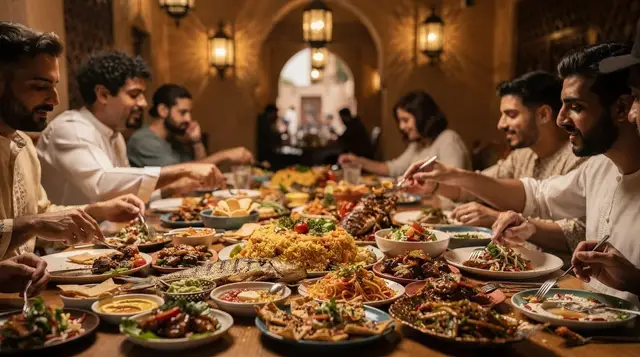
Dubai's Friday brunch culture: how a meal became an institution
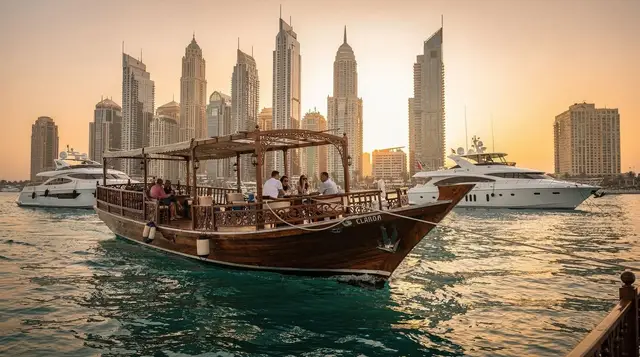
Dubai Marina: luxury yacht tour with breakfast or BBQ option
Duration: 1-3 hours
Why is Dubai brunch such a big cultural phenomenon?
Because it fills a specific social gap: a dry-ish, work-heavy expat city with limited casual daytime socializing options built an entire weekend ritual around long, multi-course hotel buffets with beverage packages, timed originally around Friday's status as the Islamic day of rest. It became the default way residents and visitors socialize on weekends, evolved alongside the 2022 shift to a Saturday-Sunday weekend, and now functions as much as a social institution as a meal.
| When | Friday, now often also Saturday |
| Format | multi-hour hotel buffet + tiered beverage packages |
| Cost | around AED 250-350 (68-95 USD) soft; 600+ (163+ USD) premium |
| Rooted in | Friday’s status as the pre-2022 UAE weekend’s first day |
| Best for | understanding Dubai’s expat social culture, not just eating |
A meal that became a cultural institution
Dubai’s Friday brunch isn’t just a long, boozy buffet — it’s arguably the single most distinctive piece of the city’s social culture, a weekly ritual that shapes how a huge share of residents structure their entire week around it. Understanding why this specific format took hold here, rather than treating it purely as a dining option, explains a good deal about how Dubai’s expat-majority population, its licensed-venue alcohol rules, and its hotel-centric social infrastructure fit together. For a practical rundown of venues, packages, and current prices, see the Dubai Friday brunch guide; this piece is about why the institution exists and what it reveals about the city.
Why Friday, originally
Before 2022, the UAE’s weekend ran Friday-Saturday rather than the globally standard Saturday-Sunday, a structure rooted in Friday’s status as Jummah, the Islamic day of congregational prayer. Friday was traditionally a slower, more communal day — businesses closed or ran reduced hours, families gathered, and a long midday meal fit naturally into that rhythm. Dubai’s hotels, competing for a captive, leisure-minded weekend audience with money to spend, built increasingly elaborate multi-hour buffet events around that Friday slot, and the format snowballed into the institution it is today.
The gap brunch fills in Dubai’s social life
Dubai lacks much of the organic, low-cost, street-level social infrastructure — neighborhood pubs, casual cafés doubling as social hubs, walkable social districts — that fills the same role in many cities with older, denser urban cores. Alcohol, where served, is confined to licensed hotels and venues rather than corner bars, and much of the city’s residential geography is car-dependent, discouraging the kind of spontaneous social dropping-in that other cities’ social lives run on. Brunch consolidates food, drink, and hours of unhurried socializing into a single bookable, contained event inside a licensed venue, filling a genuine structural gap rather than existing as pure indulgence.
Who brunch culture actually belongs to
While tourists absolutely attend and often build a Dubai weekend around booking a brunch, the institution’s deepest roots and its most consistent weekly participants are Dubai’s large expatriate population — professionals from the UK, India, the Philippines, South Africa, and dozens of other countries who’ve built their primary social lives in the city. For many expats, brunch functions less like an occasional indulgence and more like a genuine weekly social anchor, the equivalent of a regular pub night or Sunday family lunch back home, reconfigured into the specific shape Dubai’s licensing and hospitality landscape allows.
The 2022 weekend shift and what it changed
In January 2022, the UAE government shifted the national weekend from Friday-Saturday to Saturday-Sunday, explicitly to align working hours with global financial markets and international business partners. This directly affected brunch culture: with Friday no longer the first day of the weekend, many hotels expanded their brunch offerings to run on both Friday and Saturday, spreading what had been a single unmissable weekly event across two days. The change didn’t kill the tradition — if anything it expanded brunch’s calendar footprint — but it diluted the singular “everyone does the same thing on the same day” quality the institution had before the shift.
Escalating packages and competitive theater
Over roughly the past decade, competition among hotels for brunch business has pushed the format toward increasingly theatrical, expensive concepts: live entertainment, themed decor, celebrity chef partnerships, and tiered beverage packages running from soft (non-alcoholic) up through premium champagne options that can run several hundred dirhams above the base food price. This escalation reflects brunch’s shift from simple weekend dining into a genuine hospitality-industry battleground, where venues differentiate on spectacle and social-media-worthy presentation as much as on food quality itself.
Brunch as a status and social marker
Because premium brunch packages carry a real price tag — often equivalent to a proper multi-course dinner despite being a midday meal — where and how often someone brunches has become a subtle social signal within Dubai’s expat social scene, similar to how choice of gym, neighborhood, or car functions elsewhere. This isn’t universal or something every resident participates in, but it’s a genuine, observable dynamic within certain social circles, and it partly explains why brunch marketing leans so heavily on exclusivity and spectacle rather than simply advertising food quality.
The yacht and pool brunch variant
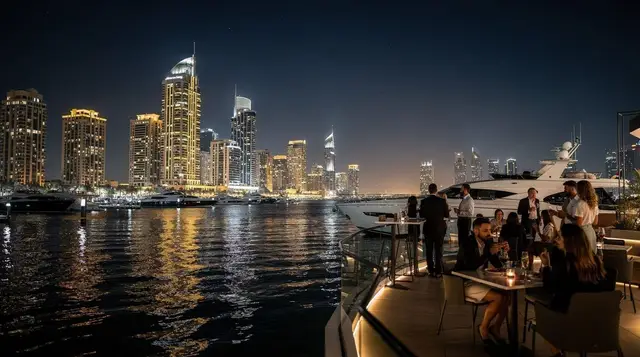
This Dubai Marina luxury yacht tour with a breakfast or BBQ option reflects a related, increasingly popular offshoot of brunch culture — moving the long, social, food-and-drink-centered gathering onto the water rather than a hotel ballroom. Pool and yacht brunches have grown alongside traditional hotel brunches as an alternative for groups wanting a similar social format with a different, more scenic setting, particularly popular for birthdays and special occasions.
Family brunch versus adults-only brunch
Brunch culture in Dubai splits into two fairly distinct tracks: family-oriented brunches at hotels with kids’ entertainment, dedicated children’s buffets, and a calmer atmosphere, and adults-only, higher-energy brunches built around DJ sets, premium beverage packages, and a nightlife-adjacent atmosphere that runs well past the meal itself. This bifurcation reflects Dubai’s broader dual identity as both a family destination and an adult entertainment and nightlife hub, with brunch culture flexible enough to serve both audiences on the same day at different venues.
What brunch reveals about Dubai more broadly
The brunch institution is a useful lens on Dubai’s contradictions: a city with genuinely conservative public norms around alcohol and public behavior that simultaneously hosts some of the world’s most elaborate, boozy weekend dining events — contained specifically within licensed hotel walls rather than public space. It reflects how Dubai manages the tension between its cultural and religious context and its ambitions as an international, expat-heavy business and tourism hub: not by eliminating either side, but by channeling potentially conflicting behaviors into clearly bounded, licensed spaces.
Ramadan and the brunch calendar
Brunch as normally understood largely pauses during Ramadan, when the emphasis shifts entirely to iftar and suhoor gatherings rather than long daytime buffet-and-drinks events — see the Ramadan guide for how the holy month reshapes Dubai’s dining and social calendar more broadly. Regular brunch programming typically resumes once Ramadan ends, often with a notable post-Ramadan surge in bookings as the city’s social calendar picks back up.
Criticism and honest pushback
Not everyone in Dubai buys into brunch culture uncritically — a recurring critique, including from longtime residents, is that the format has become excessive and price-inflated relative to food quality at many mid-tier venues, functioning more as a drinking occasion with food attached than a genuinely food-focused meal. There’s also a fair critique that the institution caters overwhelmingly to a specific, moneyed expat demographic rather than reflecting the city’s broader population, including its large lower-income migrant workforce who have no practical access to it. Both critiques are worth knowing before assuming brunch represents Dubai’s culture as a whole rather than one specific slice of it.
Comparing to other Gulf cities
Similar hotel-based brunch cultures exist in Abu Dhabi, Doha, and Manama, for broadly the same structural reasons — expat-heavy populations, alcohol confined to licensed venues, and hotel-centric social infrastructure — but Dubai’s scene is generally considered the largest and most developed, reflecting the sheer number and variety of hotels competing for the same weekend audience. Visitors doing a broader Gulf trip, including an Abu Dhabi day trip, will find a recognizably similar but smaller-scale version of the same institution there.
Should visitors experience it, or is it overhyped?
For visitors curious about a genuinely distinctive piece of contemporary Dubai social culture, yes, brunch is worth experiencing at least once — it’s a real, observable social institution rather than a manufactured tourist activity, even if its marketing leans heavily into spectacle. Visitors expecting food quality proportional to the (often high) price at every venue will sometimes be disappointed, which is why choosing carefully, rather than assuming any brunch delivers equal value, matters more than the decision to try it at all. The venue-and-pricing guide covers how to choose well.
A brief history: from colonial Sunday roast to Gulf institution
Brunch as a concept didn’t originate in Dubai — the word itself and the loose format (a late-morning meal blending breakfast and lunch) trace back to late-19th-century Britain, later popularized in the United States as a boozy weekend social occasion. What Dubai did was adapt an imported Western social format, strip it of its original Sunday timing, attach it to Friday’s local significance, and scale it dramatically through the city’s hotel-heavy hospitality infrastructure.
This layered history — a British-American social concept, reshaped by Gulf religious and social context, then amplified by a hospitality industry with few peers in scale — is part of why Dubai brunch feels distinct from either its Western origin or a purely local tradition; it’s genuinely a hybrid, and understanding that hybrid nature explains a lot about why the format looks the way it does.
The economics of brunch for hotels
For Dubai’s hotels, brunch functions as a significant, predictable weekend revenue stream, often outperforming a hotel’s standalone restaurant covers for the same day on a per-square-meter basis, given the volume of covers a well-run brunch service can turn through several hours. This economic incentive explains the format’s continued escalation — packages, entertainment, and marketing spend keep increasing because the revenue upside justifies it, particularly at hotels competing directly against several nearby options for the same finite pool of weekend diners in neighborhoods like Downtown Dubai and Dubai Marina.
Brunch and social media culture
Dubai brunch’s visual spectacle — elaborate spreads, themed decor, poolside or rooftop settings — has made it a genuinely significant driver of the city’s social media food content, with venues actively designing photogenic moments (dessert walls, live cooking stations, elaborate centerpieces) specifically for guests to photograph and share. This dynamic has become somewhat self-reinforcing: venues invest in photogenic elements because guests share them, and guests choose venues partly based on which spreads look best online, a feedback loop that’s pushed presentation standards up considerably over the past several years.
Brunch’s relationship to Dubai’s rooftop and beach club scene
Brunch culture doesn’t exist in isolation from Dubai’s broader licensed-venue social scene — many of the same hotels running elaborate weekend brunches also operate the city’s rooftop bars and beach clubs, and a single group of friends might move from a Friday brunch table straight into a rooftop or beach club session as the same event stretches into the evening. This blending of daytime dining and evening nightlife into one continuous social occasion is part of what distinguishes Dubai brunch culture from a standalone daytime meal elsewhere.
How brunch compares to Dubai’s fine dining scene
Where Dubai’s fine dining scene generally emphasizes a chef’s specific culinary vision through a tighter, curated menu, brunch inverts that logic entirely — volume, variety, and beverage inclusion take priority over precision, and the two scenes largely serve different occasions rather than competing directly for the same diners. Visitors chasing a genuinely excellent meal are often better served by a dedicated fine-dining reservation; visitors chasing a long, social, group occasion are better served by brunch.
Brunch culture and Dubai’s nightlife scene more broadly
Brunch sits at the daytime edge of a broader Dubai nightlife culture built around the same licensed-venue framework — hotels, clubs, and lounges operating within a legal structure that confines alcohol service to specific licensed spaces rather than public bars. Seen this way, brunch is less an isolated institution and more the daytime anchor of a wider hospitality-and-nightlife ecosystem that shapes how a large share of Dubai’s expat and visitor population socializes across an entire weekend, from Friday midday through Saturday night.
Where residents actually go for brunch
Certain neighborhoods have developed particular reputations within brunch culture — Dubai Marina and Downtown hotels lean toward larger-scale, higher-volume brunches with more elaborate entertainment, while smaller boutique hotels elsewhere in the city often run quieter, more food-focused versions of the same format. Where you brunch says almost as much about the experience you’re choosing as which specific package you book.
Sharjah’s dry contrast
The brunch institution described throughout this guide is specifically a Dubai (and broader licensed-emirate) phenomenon — it doesn’t exist in the same form in neighboring Sharjah, given that emirate’s total alcohol ban. Visitors doing a combined Dubai-Sharjah trip will notice the contrast sharply: the same weekend, two fundamentally different social cultures a 35-45 minute drive apart.
What first-time visitors misunderstand about brunch
The most common misunderstanding among first-time visitors is expecting a brunch price to roughly match a normal restaurant meal — premium packages, particularly bubbly and champagne tiers, run closer to a full night out than a midday lunch, and going in with that price expectation avoids sticker shock at checkout. A second common misread is assuming every brunch is a rowdy party atmosphere; plenty run as calmer, family-oriented, food-focused events, and choosing the wrong type for your group’s mood is a more common disappointment than any issue with the food or service itself.
Booking timing and practical advice
Popular brunches, particularly at well-known five-star hotels, fill up days or even weeks ahead during peak season (November-March), so booking well in advance rather than expecting same-day availability matters if a specific venue is the goal. Arriving close to the stated start time, rather than significantly late, also matters more than at a normal restaurant reservation, since live cooking stations and timed entertainment segments are often structured around the full seating window rather than a flexible walk-in service model.
The bottom line
Dubai’s Friday brunch culture is less about the food itself than about what the ritual reveals — a city working through the tension between conservative public norms and cosmopolitan, expat-driven social life by channeling both into a single, contained, licensed weekly (now often bi-weekly) event. Understanding that context turns brunch from a curious, expensive buffet into a genuinely useful window on how Dubai actually functions socially, beyond the skyline and the malls.
Brunch etiquette a first-timer should know
Beyond simply booking a table, a few unwritten norms shape a smooth brunch experience: arriving close to the stated start time rather than significantly late, pacing drinks across the full seating window rather than front-loading a premium package, and tipping on top only if service charge isn’t already listed on the bill. Dress codes vary by venue from smart casual to genuinely dressy, so checking a specific brunch’s stated dress expectations before booking avoids an awkward mismatch, particularly at the more theatrical, higher-end packages.
How long a typical brunch actually runs
Most brunch packages run a fixed three-to-four-hour seating window, though some premium packages extend longer or blend directly into a connected pool or evening event without a hard cutoff. This matters for planning the rest of a day around it — a Friday brunch booked from 1pm to 4pm, for instance, genuinely occupies the bulk of an afternoon, making it difficult to combine with a full sightseeing day on the same date without feeling rushed on one side or the other.
Choosing between a hotel brunch and a yacht or pool alternative
For visitors weighing a traditional hotel ballroom brunch against the water-based alternative, the choice mostly comes down to atmosphere and group size — hotel brunches suit larger groups wanting maximum variety and entertainment, while a smaller yacht or pool-based brunch suits a tighter group wanting a more scenic, intimate version of the same long, social format. Neither is objectively better; they’re different expressions of the same underlying institution, and the Friday brunch guide lists specific venues across both formats with current pricing.
Solo diners and small groups at brunch
Brunch is built around groups and long tables by default, but solo diners and pairs are increasingly common, particularly at hotel brunches with communal seating areas or bar-adjacent tables designed for smaller parties. It’s worth mentioning group size directly when booking, since some venues seat solo or two-person bookings differently from larger tables, and a smaller party at a highly social, entertainment-heavy brunch can feel different in energy than the same venue experienced with a bigger group.
Brunch culture beyond Dubai’s five-star hotels
While the institution’s most photographed, marketed examples sit at five-star hotels in Downtown and the Marina, a genuine mid-tier and boutique brunch scene exists too — smaller, quieter, more food-focused versions running at three- and four-star properties and independent restaurants across the city, generally at a noticeably lower price point than the flagship five-star packages. These rarely get the same social-media attention, but they represent a meaningful, if less visible, part of how a broader cross-section of Dubai’s population actually experiences the tradition without the premium price tag.
Frequently asked questions about Dubai’s brunch culture
Why is it called Friday brunch if it now happens on Saturday too?
The name predates the 2022 weekend shift, when Friday was the first day of the UAE’s weekend; many venues have since expanded to Saturday, but the traditional name stuck.
Is brunch mainly for tourists or residents?
Primarily a resident and expat social institution that tourists also participate in, rather than something invented for visitors.
Why did brunch become so central to social life in Dubai specifically?
It fills a structural gap left by limited casual, street-level social venues and alcohol being confined to licensed hotels, consolidating socializing into one bookable event.
Did the 2022 weekend change affect brunch culture?
Yes — it split brunch across both Friday and Saturday at many venues, expanding the format’s calendar footprint.
Does brunch pause during Ramadan?
Yes, largely — the social and dining focus shifts to iftar and suhoor gatherings for the month.
Is Dubai’s brunch scene the biggest in the Gulf?
Generally considered so, given the sheer number and variety of competing hotel venues, though similar cultures exist in Abu Dhabi, Doha, and Manama.
How long does a Dubai brunch typically last?
Most run a fixed three-to-four-hour seating window, though some premium packages extend longer or flow directly into a connected pool or evening event.
What should I wear to a Dubai brunch?
It varies by venue from smart casual to genuinely dressy — check the specific brunch’s stated dress code before booking, especially at higher-end, more theatrical packages.
Top experiences
Bookable activities with verified prices and instant confirmation on GetYourGuide.