Dubai food guide: how to eat well in a city of imported cuisine
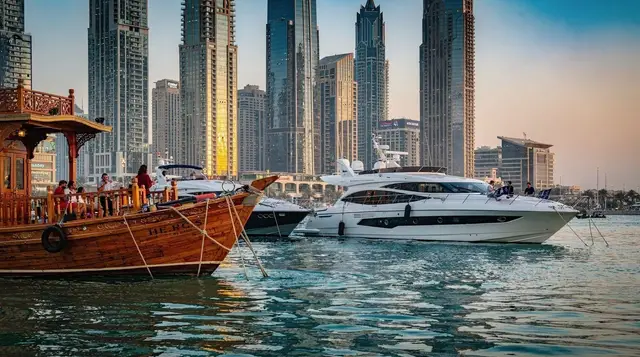
Dubai Marina dhow cruise: dinner buffet & live entertainment
Duration: 2 hours
What's the best way to eat well in Dubai?
Skip the attraction-adjacent restaurants and eat where the population actually eats: Indian, Pakistani, Filipino, Iranian and Lebanese kitchens in Deira, Karama, Satwa and Bur Dubai deliver better food for less money than almost anything near Downtown or the Marina. Layer in one Emirati meal, one Friday brunch, and one fine-dining night if budget allows, and you'll see the full range.
| Cheapest good meal | around AED 15-40 (4-11 USD), Deira/Karama/Satwa/Bur Dubai |
| Mid-range dinner | around AED 60-150 (16-41 USD) per person |
| Splurge (fine dining/brunch) | around AED 250-1,200+ (68-327+ USD) per person |
| Dietary defaults | halal is automatic; vegetarian well served; vegan growing |
| Alcohol | licensed hotels and venues only, not public spaces |
Why Dubai’s food scene doesn’t have one identity
Dubai is a city where roughly 90 percent of residents are foreign-born, and the restaurant scene reflects that ratio far more than it reflects Emirati heritage. What you’ll actually find is a layered stack of cuisines: Indian, Pakistani, Filipino, Iranian and Lebanese kitchens feeding the working population; imported global fine dining and celebrity-chef brands feeding tourists and residents with money to spend; and a small, deliberately preserved pocket of Emirati food that most visitors never encounter unless they seek it out.
None of these layers is more “real” Dubai than the others — they’re all real, they’re just not evenly distributed across the city, and most tourist itineraries only ever touch the most expensive and least distinctive one.
This matters practically because it means the usual travel-guide advice — “eat where the locals eat” — needs a specific answer in Dubai rather than a vague one. The population doing most of the everyday eating is South Asian, Filipino and Iranian, not Emirati, and their neighborhoods (not the postcard skyline districts) are where the food genuinely over-delivers relative to price. Visitors who only eat in Downtown, the Marina and JBR see a real but narrow slice of what’s on offer, and usually pay tourist-zone prices for it.
Emirati food exists, but you have to look for it
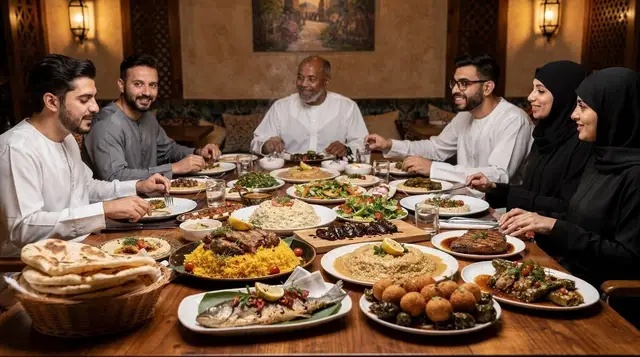
Genuine Emirati cuisine — machboos (spiced rice with meat or fish), harees (a slow-cooked wheat and meat porridge), luqaimat (fried dumplings in date syrup), chibab (sweet cardamom pancakes) — is not the default anywhere in the city. The reliable places to find it are the Al Fanar Restaurant & Cafe chain, styled like a 1960s Emirati household with staff in traditional dress, and the cultural meals run by the Sheikh Mohammed Centre for Cultural Understanding (SMCCU) in Al Fahidi, where an Emirati host serves a traditional meal alongside an open Q&A session about local culture and customs.
The full Emirati cuisine guide covers both in detail, including prices and what to expect at each.
A smaller number of newer, higher-end restaurants have started reworking Emirati ingredients and techniques into fine-dining formats rather than heritage-house settings, part of a broader regional trend of chefs reclaiming Gulf cuisine as something worth presenting seriously rather than only preserving nostalgically. These sit at the fine-dining end of the price scale, covered in the fine dining guide, and are worth the premium if an authentic but elevated take on local food matters more to you than the heritage-house atmosphere of Al Fanar.
The expat cuisines that actually define daily eating
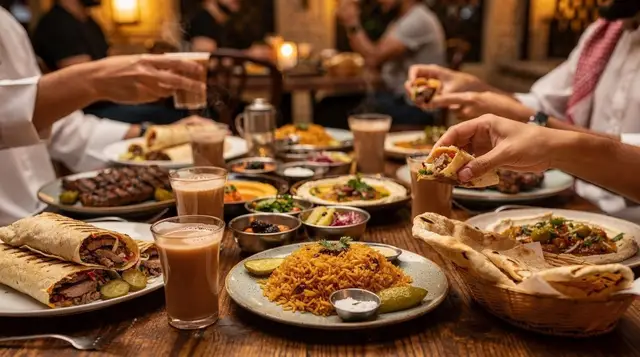
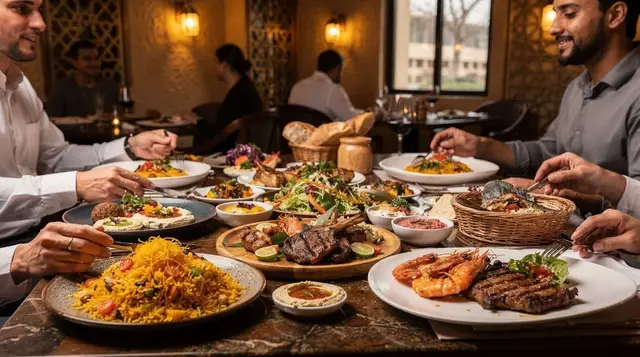
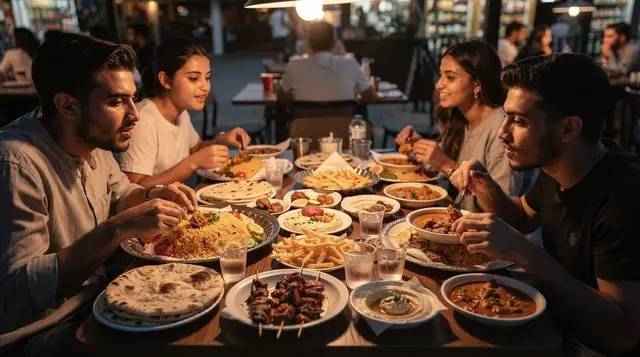
Walk into Deira, Karama, Satwa or Bur Dubai at lunchtime and the food on offer is overwhelmingly South Asian, Filipino, and Iranian — this is what most of Dubai’s population actually eats most days, and it’s consistently the best value food in the city. Karak chai stalls, biryani counters, Kerala-style thali houses, and Persian kebab spots serve full meals for AED 15-40 (4-11 USD) that outclass much of what’s served at triple the price in tourist zones. The street food guide and cheap eats guide map out the specific neighborhoods and stalls worth targeting.
Street food and where it clusters
Dubai doesn’t have a night-market street food culture in the Bangkok or Singapore sense — the climate and municipal regulation work against it most of the year. What it has instead is a dense scatter of hole-in-the-wall restaurants, roadside karak stalls, and shawarma counters concentrated in specific pockets: Al Rigga in Deira, Karama’s food streets, and Al Diyafah Street in Satwa. Global Village (seasonal, October-April) adds a different format entirely — dozens of country pavilions each serving their own street food, from Indian chaat to Turkish ice cream, in one walkable site. Full detail on both formats is in the street food guide.
Friday brunch: Dubai’s own institution
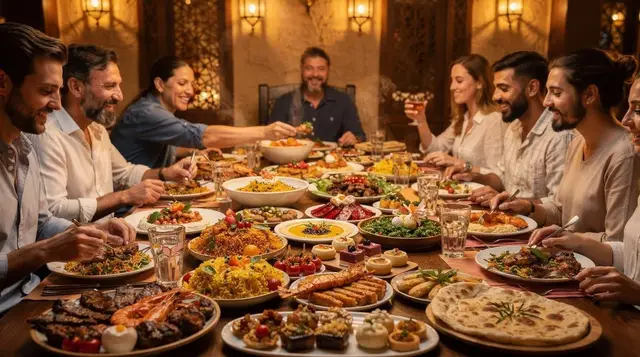
The Friday brunch is genuinely distinctive to Dubai and the wider Gulf — a multi-hour, multi-restaurant buffet event, historically tied to the Friday-Saturday weekend and now often running Friday and Saturday since the 2022 switch to a Saturday-Sunday weekend. Packages range from soft (non-alcoholic, from roughly AED 250-350 / 68-95 USD) through house beverage packages to bottomless bubbly tiers well over AED 600 (163 USD). The full Friday brunch guide names specific venues and prices, and explains how a religious observance day became a full-blown brunch institution across the city’s hotels.
This Marina dhow cruise with dinner buffet and live entertainment is a lower-key evening alternative if a full daytime brunch doesn’t fit your schedule.
Fine dining: a Michelin-listed city since 2022
The Michelin Guide launched its Dubai edition in 2022, and the city’s fine-dining scene has genuinely earned international attention since — chef-driven restaurants across French, Japanese, Indian, Levantine and pan-Asian cooking, several with waterfront or skyline settings that add to (and inflate) the price. Orfali Bros Bistro, a Levantine-Emirati fusion restaurant, has been named the best restaurant in the Middle East and North Africa by the World’s 50 Best organization — a genuine, independently judged accolade rather than a marketing claim. The fine dining guide covers the full landscape.
Alcohol and where it’s actually served
Alcohol in Dubai is legal only in licensed venues — almost exclusively hotels, plus a handful of standalone licensed restaurants and clubs. Public drinking, drinking in unlicensed restaurants, and visible intoxication outside licensed premises are against the law and enforced. Tourists don’t need a personal license to drink in a licensed venue, only to buy alcohol from a retail shop for personal consumption. This shapes where “going out for dinner and drinks” actually happens in practice, and why so much of the city’s nightlife sits inside hotel complexes rather than on independent high streets — see the rooftop bars guide for licensed venues with a view.
This same licensing pattern explains why bringing your own alcohol to a picnic on Kite Beach, or ordering a beer at a Karama curry house, isn’t an option regardless of how relaxed the surrounding city feels — the license sits with the specific venue, not with the neighborhood or the general mood of a tourist-friendly city.
Budget tiers: eating well from AED 15 to AED 1,500+
Dubai’s food scene spans a wider price range than most cities its size. At the bottom, a full meal in Karama or Deira runs AED 15-40 (4-11 USD). Mid-range casual dining — a Zaroob-style modern Lebanese spot, a decent Indian restaurant, a mall food court sit-down — runs AED 60-150 (16-41 USD) per person. Fine dining and brunches start around AED 250-350 (68-95 USD) and climb past AED 1,000 (272 USD) per person at the top tier without much ceiling. The cheap eats guide breaks this down further by neighborhood and daily spend.
Dietary restrictions: halal by default, vegetarian and vegan growing
Halal is the automatic default across essentially every restaurant, food truck and hotel kitchen — not something to request, just the baseline. Vegetarian food is genuinely well served thanks to the large South Asian population; look specifically toward Karama’s pure-vegetarian Indian restaurants for the strongest options. Vegan and specific allergy needs are more work but increasingly manageable — a small but growing cluster of dedicated vegan cafes has opened over the past several years. The vegetarian and vegan guide has the specifics.
Ramadan changes how the whole city eats
During Ramadan, eating, drinking and smoking in public during daylight hours is against local custom and, in some cases, regulation, even for non-Muslims — restaurants adjust by curtaining off dining areas or shifting to delivery-only during the day, then opening for iftar (sunset breaking of the fast) with special set menus, often buffet-style and heavily discounted relative to normal pricing. It’s a genuinely interesting time to visit for food specifically, if you plan around the daytime restrictions. See the Ramadan guide for what changes and when.
Tourist traps to skip near major attractions
Restaurants directly inside or immediately adjacent to major attractions — Dubai Mall’s waterfront strip, Marina Walk’s tourist-facing row, anywhere with a tout physically inviting you in — consistently charge a premium for mediocre, crowd-optimized food. This isn’t unique to Dubai, but the gap between attraction-adjacent pricing and quality is wider here than in most cities, because the customer base is transient and rarely returns. The honest tourist traps guide names specific examples worth skipping.
Coffee culture: gahwa and third-wave, side by side
Traditional Arabic coffee (gahwa) — pale, cardamom-spiced, served in small handleless cups alongside dates as a gesture of hospitality — sits alongside a genuinely strong specialty coffee scene built by a wave of independent roasters over the past decade. A dedicated Coffee Museum in Al Fahidi covers the traditional side in depth; the coffee shops and cafes guide covers where the specialty scene actually clusters and which neighborhoods reward a slow coffee crawl.
Delivery apps and hotel dining as fallback options
Talabat and Careem NOW cover virtually every restaurant in the city and are a genuinely useful fallback during the worst of summer heat (June-September) when walking anywhere for food is unpleasant. Hotel restaurants, while rarely the cheapest or most exciting option, are a reliable fallback for dietary needs, alcohol, and predictable quality — useful on nights when you don’t want to gamble on an unfamiliar spot.
Mall food courts: better than they sound
“Food court” undersells what Dubai malls actually offer. The Dubai Mall, Mall of the Emirates, and Ibn Battuta Mall all house sit-down restaurant clusters alongside the fast-food-style counters, including genuinely good regional options — a proper Lebanese grill, a Filipino carinderia-style counter, a decent ramen bar — at prices well below standalone restaurants in the same buildings. On a 45°C August afternoon, or with children who need air conditioning and options in one stop, a mall food hall is a legitimately good choice rather than a fallback, and it’s one of the few places where the full range of Dubai’s expat cuisines sits within a hundred meters of each other.
Reservations and how far ahead to book
Casual restaurants across the city rarely need reservations outside peak dinner hours. Fine dining, rooftop venues with a view, and anything branded around a celebrity chef are a different story — weekend evenings during the November-March peak season often book out a week or more ahead, and the most in-demand tasting-menu restaurants can require two to three weeks’ notice. Friday brunch tables at well-known hotel venues sell out even further ahead during winter, sometimes a month or more for the most popular packages. If a specific restaurant or brunch matters to your trip, book it before you book anything else time-sensitive.
Family dining and kid-friendly options
Most casual and mid-range restaurants in Dubai are comfortable with children, reflecting the large resident family population, and high chairs, kids’ menus, and a general tolerance for noise are standard rather than exceptional. Buffet-format dining — brunches, dhow dinner cruises, hotel breakfast spreads — tends to work best with picky eaters since everyone can select their own plate. Fine dining and the more design-forward rooftop venues are the exception, and several explicitly discourage or restrict young children in the evening; check before booking if you’re travelling with kids and want a specific upscale spot.
Seasonal eating: indoors in summer, outdoors in winter
Outdoor dining terraces, popular and pleasant from November through March, become genuinely unusable for anything but a few minutes in June through September, when daytime and even evening temperatures regularly sit at 38-45°C. Restaurants with strong outdoor seating in winter typically shift indoors or onto misted, air-conditioned terraces for summer, and it’s worth checking a restaurant’s summer setup before counting on the rooftop or waterfront view that drew you there in photos taken during peak season. Shoulder months — October and April — often deliver the best of both, warm enough for a pool day, cool enough by evening for an outdoor table without misting fans running at full blast.
Water and tap safety, briefly
Dubai’s tap water is treated to a high standard and technically safe to drink, but the taste (heavily desalinated, often stored in rooftop tanks that pick up heat and a faint mineral note) puts most residents and virtually all restaurants onto bottled water by default. Restaurants will serve bottled water, sometimes still on the table at no charge and sometimes chargeable, so it’s worth asking upfront if a free jug is what you want rather than a chargeable bottle appearing automatically.
Putting a food day together
A realistic food-focused day in Dubai might run: a karak chai and shawarma breakfast in Deira or Satwa, an Emirati lunch at Al Fanar or an SMCCU cultural meal in Old Dubai, an afternoon coffee at a specialty cafe in City Walk, and a fine-dining or dhow dinner in the evening. This spread costs more in logistics (taxis between neighborhoods) than in food itself, and shows a genuinely wider range than staying in one district all day. The 3-day itinerary has room to build a day like this into a longer trip.
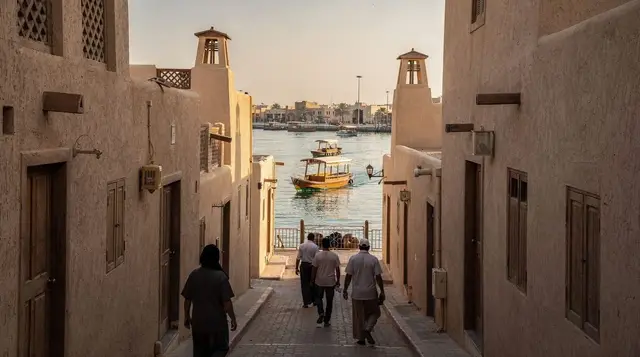
This Old Dubai souks and street food walking tour with abra crossing covers several of these stops in one guided outing if you’d rather not plan the route yourself.
What this guide doesn’t cover
This page is a map to the rest of the food-drink coverage on this site, not a substitute for it. It intentionally stays broad — for specific restaurant names and prices, see the best restaurants guide; for the Friday brunch venue list, the brunch guide; for a street-by-street street food breakdown, the street food guide. Each of those pages goes deeper than a single overview page reasonably can, and naming every specific venue here would duplicate content better placed in its own guide.
First-timer priorities if you only have one food-focused day
Given limited time, the highest-value single addition to a standard Dubai itinerary is one Emirati meal (Al Fanar or an SMCCU cultural session), because it’s the one cuisine you genuinely can’t easily find outside the Gulf. After that, prioritize by what you can’t replicate at home rather than by what photographs well — a Karama thali or a Deira karak stall beats a mediocre international brunch that exists in nearly identical form in a dozen other cities, even if the brunch is the one with better marketing.
A rough neighborhood cheat sheet
| Neighborhood | What to expect | Price level |
|---|---|---|
| Deira / Bur Dubai | South Asian, Iranian, Filipino, karak stalls | budget |
| Karama | pure-vegetarian Indian, thali houses | budget |
| Satwa | Al Diyafah Street shawarma and grills | budget-mid |
| Downtown / DIFC | fine dining, international brands | splurge |
| Marina / JBR | dhow dinners, resort-adjacent dining | mid-splurge |
Groceries and self-catering
Large supermarket chains (Carrefour, Spinneys, Waitrose) stock a genuinely wide international range, useful for visitors staying in serviced apartments or wanting to self-cater breakfasts and snacks rather than eating out for every meal. Spinneys and Waitrose skew pricier with a stronger imported and specialty selection, while Carrefour offers better value for everyday basics; smaller convenience stores (many open 24 hours) cover top-up shopping in most residential and tourist districts without needing a dedicated supermarket trip.
Eating solo in Dubai
Solo dining is entirely normal and unremarkable in Dubai given the huge single-resident expat population — food courts, casual restaurants and even mid-range sit-down spots see solo diners constantly, with no awkwardness attached. Fine dining counter seats (covered in the fine dining guide) work well for a solo splurge, and Karama or Deira’s small, quick-turnover restaurants are especially solo-friendly since tables turn over fast and nobody expects you to linger for company.
Breakfast: an overlooked strong point
Breakfast in Dubai spans a genuine range worth planning around rather than defaulting to the hotel buffet every morning: a karak chai and paratha stall in Deira or Satwa costs a few dirhams and delivers a genuinely good start to the day, while City Walk and Jumeirah’s specialty cafes cover a Western-style flat white and pastry crowd well. Hotel breakfast buffets are convenient but rarely the most interesting option — worth skipping at least once or twice on a longer trip in favor of a local stall, especially if an early desert safari or Old Dubai walk means you’re out the door before the hotel buffet even opens.
Late-night eating options
Dubai’s food scene runs later than many visitors expect, particularly in Deira, Karama and Satwa where South Asian and Iranian restaurants commonly serve until midnight or later, and 24-hour karak and shawarma stalls exist in several neighborhoods. Downtown and the Marina’s more polished restaurants tend to wind down earlier, closer to 11pm-midnight, so a genuine late-night craving after an evening desert safari or dhow cruise is often better served by heading toward Deira or Satwa than staying near the tourist core.
Allergies and communicating dietary needs
Restaurant staff across most price tiers are generally accustomed to allergy and dietary questions given the international customer base, but English-language allergen labeling on menus varies, and it’s worth stating a serious allergy (shellfish, nuts) clearly and directly to a server rather than assuming a menu note covers it. Hotel and fine-dining kitchens handle this most reliably with advance notice at booking; smaller independent restaurants in Deira or Karama are usually accommodating too, just with less formal allergen documentation, so a direct conversation with staff matters more there.
Frequently asked questions about eating in Dubai
Is Emirati food easy to find in Dubai?
Not without looking. Al Fanar’s chain restaurants and SMCCU’s cultural meals in Al Fahidi are the two reliable, dedicated sources — you won’t stumble into it by accident.
Is all the food in Dubai halal?
Yes, by default, across nearly every restaurant and hotel kitchen. Alcohol and pork exist only in clearly separated licensed venues.
What’s the cheapest way to eat well in Dubai?
Deira, Karama, Satwa and Bur Dubai — full meals AED 15-40 (4-11 USD) — consistently outperform tourist-zone pricing.
Do I need to worry about food safety in Dubai?
Dubai Municipality grades food venues with a visible letter sticker, and standards are generally high even at cheap stalls.
Is Dubai a good destination for foodies?
Yes, mainly for the range of authentic expat cuisines rather than the more generic international luxury dining scene.
How much should I budget for food per day?
AED 150-300 (41-82 USD) per person covers a realistic mid-range day; budget travelers can manage AED 60-100 (16-27 USD).
Is it easy to eat well as a solo traveler in Dubai?
Yes — solo dining is entirely normal given the huge single-resident expat population, and quick-turnover restaurants in Karama and Deira are especially solo-friendly.
Can I buy groceries and self-cater?
Yes, Carrefour, Spinneys and Waitrose all stock a wide international range, useful for serviced-apartment stays or self-catering breakfasts.
Top experiences
Bookable activities with verified prices and instant confirmation on GetYourGuide.