Dubai fine dining guide: Michelin, celebrity chefs and real prices
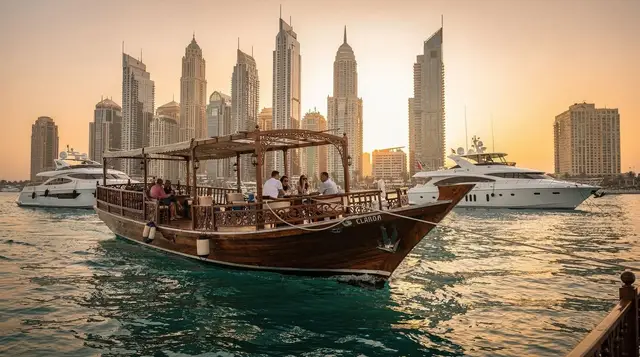
Dubai: private VIP luxury yacht tour with BBQ & drinks
Does Dubai have Michelin-starred restaurants?
Yes. The Michelin Guide launched its Dubai edition in 2022, and the city's fine-dining scene has drawn genuine international recognition since — Orfali Bros Bistro, a Levantine-Emirati fusion restaurant, was named the best restaurant in the Middle East and North Africa by the World's 50 Best organization, and Trèsind Studio, an ambitious Indian tasting-menu restaurant, has also drawn strong Michelin recognition. Expect AED 400-1,200+ (109-327+ USD) per person at this tier.
This guide covers where Dubai’s fine-dining scene genuinely earns its reputation since the 2022 Michelin Guide launch — which restaurants carry real independent credentials, what a splurge dinner actually costs, and how to book, dress and budget for it without overpaying for hype.
| Where | DIFC & Downtown Dubai (densest cluster), plus Palm Jumeirah, Business Bay, Marina |
| Cost | around AED 400-1,200+ (109-327+ USD) per person, drinks excluded |
| Booking | 1-3 weeks ahead for the top names; longer around holidays |
| Dress code | smart or elegant casual minimum, strictly enforced at several venues |
| Best for | one deliberate splurge dinner, not a nightly habit |
Dubai has earned genuine fine-dining credibility since 2022
The Michelin Guide launched its Dubai edition in 2022, a meaningful marker for a city whose restaurant scene had, until then, been judged mostly on luxury branding and celebrity-chef imports rather than independent culinary criticism. In the years since, Dubai’s fine-dining scene has drawn real, independently earned recognition beyond just Michelin’s own list — most notably Orfali Bros Bistro’s Middle East and North Africa’s Best Restaurant title from the World’s 50 Best organization, a genuinely competitive, internationally judged accolade rather than a marketing claim.
Orfali Bros Bistro: the standout
Orfali Bros Bistro, run by three Syrian-Emirati brothers reworking Levantine and Emirati ingredients into a modern, ambitious tasting format, has been named the best restaurant in the Middle East and North Africa by the World’s 50 Best organization in consecutive years. It’s the single strongest independently earned credential of any restaurant on this list, and worth prioritizing as the one splurge meal if your trip has room for only one. Expect to book well ahead and to pay AED 600-1,000+ (163-272+ USD) per person for the full tasting experience.
Trèsind Studio: Indian cuisine taken seriously
Trèsind Studio, an ambitious Indian tasting-menu restaurant that has drawn strong Michelin recognition, reworks Indian regional cooking into a fine-dining format with the same seriousness typically reserved for French or Japanese tasting menus elsewhere in the world — a genuinely interesting proposition given how rarely Indian cuisine gets this treatment internationally. It’s a strong pick specifically for visitors who’ve had plenty of French or Japanese fine dining elsewhere and want something the format doesn’t usually apply to.
Zuma, Nobu and the international heavy-hitters
Zuma (DIFC), a globally recognized modern Japanese izakaya brand, and Nobu (Atlantis The Palm), the Nobu Matsuhisa-founded sushi and Japanese-Peruvian fusion brand with locations worldwide, both deliver a reliably excellent, internationally consistent meal — a safer, if less surprising, choice than a purely local discovery. La Petite Maison (DIFC), a French Mediterranean restaurant with a strong original Nice-based pedigree, rounds out this internationally branded tier. Expect AED 400-800 (109-218 USD) per person across these three, drinks excluded.
Pierchic: overwater seafood at the top end
Pierchic, an overwater fine-dining restaurant at Madinat Jumeirah with a direct view of the Burj Al Arab, pairs genuinely excellent seafood with one of the most striking settings in the city — worth the premium for a special-occasion dinner specifically because the combination of food quality and setting rarely lines up this well elsewhere. It’s considerably more expensive than Bu Qtair’s seafood shack, covered in the best restaurants guide, but the two aren’t really competing for the same evening.
At.mosphere: the view premium, named honestly
At.mosphere, on the Burj Khalifa’s 122nd floor and among the world’s highest restaurants, charges a price that reflects the setting considerably more than the cooking — worth booking specifically for the view and the novelty of dining that high above the city, not for a meal that competes with Orfali Bros or Trèsind Studio on pure culinary merit. This isn’t a knock on At.mosphere specifically; nearly every restaurant with a comparable signature view in Dubai carries the same tradeoff, and it’s worth going in with accurate expectations rather than disappointment.
Emirati fine dining: a newer, smaller category
A small but growing number of restaurants have begun reworking Emirati ingredients and techniques into serious fine-dining formats rather than heritage-house settings, part of Orfali Bros’ broader significance as proof that Gulf cuisine can compete internationally on its own terms rather than only through imported formats. The Emirati cuisine guide covers this newer category alongside the more traditional Al Fanar and SMCCU options.
Where Dubai’s fine-dining scene actually clusters
DIFC and Downtown Dubai together host the densest concentration of fine-dining restaurants in the city, a natural fit given the affluent resident and business population both districts draw. Palm Jumeirah and Madinat Jumeirah in Jumeirah add a resort-adjacent cluster with a stronger view-driven angle, Pierchic and Atlantis’s Nobu among them. Business Bay has grown its own smaller cluster in recent years alongside the wider development of the Dubai Canal waterfront. Geography matters less here than at the budget end of the scale — most visitors will taxi across districts for a specific fine-dining reservation regardless of where they’re staying.
Fine dining with a skyline or waterfront view, beyond At.mosphere
Beyond At.mosphere’s tower-top format, several restaurants across Business Bay’s canal and the Marina waterfront combine a genuinely serious kitchen with a strong view without charging quite the same premium purely for elevation — worth considering as a middle path between a purely view-driven restaurant and one with no view at all. This category has grown considerably as Dubai Canal’s restaurant scene has matured, giving fine dining a genuine alternative to the Downtown and DIFC cluster.
Group dining and private rooms
Several of the restaurants named in this guide, particularly the larger hotel-based venues rather than the more intimate tasting-menu formats, offer private dining rooms or semi-private sections for group celebrations — worth inquiring about directly if you’re booking for a birthday, anniversary or business dinner with a party larger than four or five people, since standard table reservations at the smaller tasting-menu restaurants often can’t accommodate larger groups without weeks of advance notice.
Most of Dubai’s top-tier fine-dining restaurants, including Orfali Bros and Trèsind Studio, operate primarily or exclusively on a fixed tasting-menu format rather than a full a la carte selection — a format choice that suits the ambitious, chef-driven positioning of these restaurants but means less flexibility for picky eaters or those with multiple dietary restrictions within one party. Restaurants like Zuma and Nobu retain a fuller a la carte menu alongside tasting options, worth considering if your group needs more individual choice.
Wine, cocktail pairings and alcohol licensing
Every restaurant in this guide operates under a hotel or standalone liquor license, and wine and cocktail pairings are offered at the top tier exactly as they would be at an equivalent restaurant in London or New York — the licensing structure is the only meaningful difference. Pairing menus at the tasting-menu restaurants typically add AED 300-600+ (82-163+ USD) per person on top of the food, a substantial but expected addition at this tier.
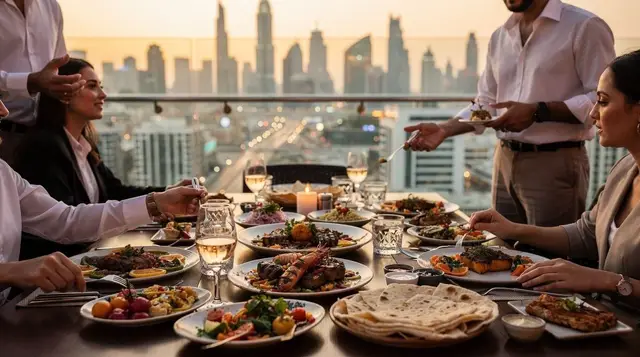
This private VIP luxury yacht tour with BBQ and drinks offers a genuinely different format for a special-occasion evening — a chef-prepared spread for your group alone on the water, worth weighing against a traditional fine-dining reservation for a milestone celebration.
Booking strategy: how far ahead, really
Orfali Bros and Trèsind Studio, given their international reputations, routinely book out one to three weeks ahead during the November-March peak season, and considerably further ahead around major holidays. Zuma, Nobu and Pierchic are marginally easier to book but still merit at least a week’s notice for a weekend evening. If a specific fine-dining restaurant matters to your trip, book it as soon as your travel dates are confirmed rather than waiting until arrival.
Dress code across fine-dining venues
Smart or elegant casual is the standard minimum, and several venues, particularly the tasting-menu restaurants and hotel fine dining, enforce it strictly in the evening — closed shoes required, no shorts, sandals or sportswear, and a jacket occasionally required for men at the most formal tables. Checking a specific restaurant’s stated dress code before a reservation avoids an awkward turn-away, which does happen at the stricter venues.
Dietary restrictions and tasting menus
Tasting-menu restaurants generally handle dietary restrictions and allergies well, given the smaller, more controlled kitchen operation compared to a large buffet format, but this requires advance notice — flagging allergies or restrictions at the time of booking, not on arrival, gives the kitchen time to adapt the set menu properly. Vegetarian and vegan tasting alternatives exist at most of the restaurants named here, though they’re worth confirming specifically rather than assuming automatic availability. The vegetarian and vegan guide covers standalone plant-based options if a tasting-menu adaptation doesn’t fully meet your needs.
Fine dining versus Friday brunch: different formats
Fine dining and the city’s famous Friday brunch scene, covered in the brunch guide, serve genuinely different purposes despite both sitting at the premium end of Dubai’s food scene — brunch is a long, social, buffet-format event, while fine dining is a focused, courses-paced evening built around a specific chef’s vision. Neither substitutes for the other, and a trip with room for both experiences shows a genuinely wider range of what premium dining in Dubai actually offers.
Rooftop and view-driven fine dining
Several fine-dining restaurants combine a serious kitchen with an elevated or waterfront setting rather than treating the view as the sole draw — worth distinguishing from purely view-driven venues like At.mosphere where the setting carries more of the price than the cooking does. The rooftop bars guide covers which elevated venues pair a proper kitchen with their view and which are primarily about the drinks and the skyline.
Sommelier programs and the wine list gap
Given Dubai’s licensing structure, wine lists at the top fine-dining restaurants are almost entirely built and curated in-house by hotel or restaurant-employed sommeliers rather than drawing on an independent wine bar or retail scene the way a city like Paris or London might — worth knowing if you’re specifically interested in wine pairing, since the selection, while often genuinely strong at the top venues, reflects a single curator’s program rather than a broader competitive market.
Asking your sommelier directly about lesser-known regional options, particularly Lebanese and other Eastern Mediterranean wines given the concentration of Levantine fine dining in the city, often turns up more interesting choices than the default recommendation.
What “Michelin-recognized” actually means in Dubai
It’s worth being precise about terminology here: the Michelin Guide Dubai includes starred restaurants, Bib Gourmand picks (a separate, lower-price-point recognition for excellent value dining), and a broader “selected” list without a star — not every restaurant mentioned by Michelin in Dubai holds an actual star. Marketing materials sometimes blur this distinction, so it’s worth checking specifically what category a restaurant’s Michelin recognition falls into before assuming “Michelin” automatically means starred.
How fine dining compares to Dubai’s overall food reputation
It’s worth stepping back on this point: Dubai’s fine-dining scene, while genuinely strong and improving, is not what makes the city distinctive from a food perspective — that distinction belongs more to the range of authentic expat cuisines covered in the street food guide and cheap eats guide. Fine dining here competes on the same terms as fine dining in any major global city, importing techniques and often literal restaurant brands from elsewhere, while the street-level food scene reflects something genuinely specific to Dubai’s population makeup that you won’t find replicated in Paris or New York.
A realistic one-splurge strategy
For most visitors, a single fine-dining dinner, chosen deliberately rather than as a default assumption that “Dubai means fine dining,” delivers the most value relative to cost — pick either Orfali Bros for the strongest independent culinary credential, or a view-driven venue like Pierchic or At.mosphere if the setting matters as much as the food. Trying to fit multiple fine-dining dinners into a single trip quickly becomes one of the most expensive ways to spend a Dubai food budget, without necessarily improving the overall experience proportionally.
A more balanced approach for a longer trip pairs one genuine splurge dinner with several strong mid-range and budget meals covered elsewhere in this guide series, spreading the food budget across a wider range of experiences rather than concentrating it entirely at the top of the price scale. That balance, more than the specific restaurant chosen, is usually what separates a food-focused trip that felt genuinely varied from one that simply felt expensive — and it’s a distinction worth planning for deliberately, ideally before departure, rather than discovering by accident partway through a trip once the budget has already tilted heavily toward one extreme.
Building fine dining into a trip
One fine-dining dinner, treated as a dedicated evening rather than squeezed between other activities, fits naturally into most multi-day Dubai itineraries — the 5-day itinerary and luxury itinerary both have room for this without disrupting the rest of the trip’s pacing, and booking the restaurant before finalizing evening plans around it avoids the disappointment of missing out on a fully booked table.
Chef’s table and kitchen-side experiences
A handful of the most ambitious restaurants, Orfali Bros among them, offer a limited chef’s table or kitchen-counter format alongside standard seating, putting diners closer to the actual cooking process for an additional premium and, typically, an extended tasting format compared to the regular dining room. These seats are limited (often just a handful per service) and book out even further ahead than standard tables, so it’s worth asking specifically about this option at the time of booking rather than assuming it’s automatically offered.
Seasonal menus and how often they change
Dubai’s top fine-dining kitchens generally rotate their tasting menus seasonally, sometimes more frequently, reflecting both ingredient availability and a chef-driven restaurant’s need to keep repeat local diners interested across a resident population that eats out often. This means a specific dish praised in an older review may no longer be on the current menu by the time you visit — worth checking a restaurant’s current offering directly rather than booking based on a specific dish you read about months earlier.
Corkage and bringing your own wine
A small number of restaurants, mostly independent rather than hotel-based, permit corkage — bringing your own bottle of wine for a service fee — though this remains uncommon in Dubai relative to markets with a more developed retail wine culture. Most fine-dining venues expect guests to order from their own curated list rather than bring outside alcohol, and it’s worth confirming a restaurant’s specific corkage policy directly rather than assuming it’s available, since the default assumption in Dubai should be that it isn’t.
Comparing the top names at a glance
| Restaurant | Cuisine | Price per person (around) | Standout for |
|---|---|---|---|
| Orfali Bros Bistro | Levantine-Emirati fusion | AED 600-1,000+ (163-272+ USD) | strongest independent culinary credential |
| Trèsind Studio | Indian tasting menu | AED 600-1,200+ (163-327+ USD) | Indian cuisine treated as serious fine dining |
| Zuma / Nobu | Japanese / Japanese-Peruvian | AED 400-800 (109-218 USD) | reliable, internationally consistent quality |
| Pierchic | Seafood, overwater | AED 500-900 (136-245+ USD) | setting paired with genuinely strong food |
| At.mosphere | International, tower-top | AED 500-900 (136-245+ USD) | the view, honestly, more than the cooking |
Solo diners at fine-dining restaurants
Solo diners are welcome at every restaurant named in this guide, and the counter or chef’s-table seats at Orfali Bros and Trèsind Studio in particular suit a solo booking well, putting you close to the kitchen rather than at a table built for conversation across a large party. Staff at this tier are generally used to solo diners travelling for business or on a deliberate food-focused trip, so there’s no need to feel self-conscious about a single-cover reservation at even the most formal tables.
Tipping and the service charge
Most Dubai fine-dining bills already include a service charge, typically listed separately on the check, so an additional cash tip is appreciated rather than expected — around 5-10% on top for exceptional service is generous by local standards. It’s worth glancing at the bill specifically to check whether service is already included before adding a tip on top, since double-tipping is a common visitor mistake at this price tier.
Business dinners and networking meals
DIFC’s cluster of fine-dining restaurants, Zuma among them, sees a genuine amount of business dining given the district’s role as Dubai’s financial hub, and several venues there are set up with this in mind — quieter tables, efficient service paced for a working dinner, and private or semi-private rooms bookable directly for client entertaining. If you’re booking a business dinner rather than a purely social one, mentioning this when reserving usually gets you a more appropriate table.
Are these restaurants suitable for children?
Most tasting-menu restaurants named here, Orfali Bros and Trèsind Studio in particular, are not really built for young children — the format runs long, courses arrive at a chef-driven pace, and the atmosphere is quiet and adult-focused rather than family-friendly. Hotel-based venues like Zuma, Nobu and Pierchic are generally more accommodating of older, well-behaved children, but it’s worth calling ahead to check a specific restaurant’s stance rather than assuming. For a genuinely family-friendly premium meal, the Friday brunch guide covers a format built around groups and children far better than a tasting menu does.
Frequently asked questions about Dubai fine dining
What is Dubai’s best fine-dining restaurant?
Orfali Bros Bistro, named the Middle East and North Africa’s best restaurant by the World’s 50 Best organization. Trèsind Studio is a close second.
How much does fine dining cost in Dubai?
Tasting menus run AED 600-1,200+ (163-327+ USD) per person; a la carte fine dining runs AED 400-700 (109-191 USD), drinks excluded.
Do I need to book far ahead?
Yes — a week or more ahead in peak season, and two to three weeks for the most in-demand tasting-menu restaurants.
Is there a dress code?
Smart or elegant casual at minimum, strictly enforced at several venues — closed shoes, no shorts or sportswear.
Are celebrity chef restaurants worth the premium?
Generally yes for reliable, internationally consistent quality, though they rarely surprise the way a genuinely original restaurant does.
Does alcohol pairing work the same as elsewhere?
Yes, at licensed venues, which covers virtually every fine-dining restaurant in the city through hotel or standalone liquor licenses.
Is service charge already included in the bill?
Usually yes, listed separately on the check — check before adding an extra tip, though 5-10% more for exceptional service is generous and appreciated.
Can solo travelers book a fine-dining table?
Yes, and counter or chef’s-table seats at Orfali Bros and Trèsind Studio suit a solo booking particularly well, putting you close to the kitchen rather than a table built for a group.
Top experiences
Bookable activities with verified prices and instant confirmation on GetYourGuide.