Dubai cheap eats: eating well on a real budget
Dubai: old town, souks, street food, guided tour & abra ride
Duration: 3-4 hours
Can you eat well in Dubai on a tight budget?
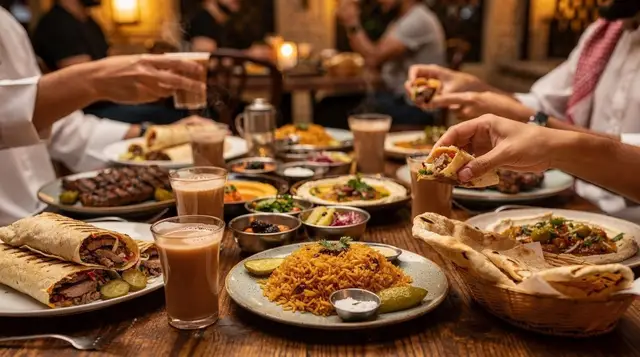
Yes, genuinely well. Ravi Restaurant, Al Ustad Special Kabab and Al Mallah, all long-running institutions rather than compromises, serve full meals for AED 15-45 (4-12 USD). A realistic budget eater can cover AED 60-100 (16-27 USD) of food per day in Deira, Karama, Satwa or Bur Dubai without sacrificing quality — the cheap option and the good option are frequently the same restaurant in Dubai.
Cheap in Dubai doesn’t mean compromised
Dubai has an unusually wide gap between its cheapest and most expensive food, wider than most cities of comparable size, and — unlike in many destinations — the cheap end isn’t simply a lesser version of the expensive end. Ravi Restaurant and Al Ustad Special Kabab, two of the most consistently recommended restaurants in the entire city regardless of budget, both charge under AED 50 (14 USD) per person. Eating cheaply in Dubai, done in the right neighborhoods, is a genuine strategy rather than a fallback, and this guide names the specific restaurants, streets and neighborhoods worth targeting rather than vague general advice about “eating like a local.”
| Daily budget | Around AED 60-100 (16-27 USD) for food |
| Where | Deira, Karama, Satwa, Bur Dubai, Al Rigga |
| Cheapest meal | Karak chai + egg paratha, around AED 15 (4 USD) |
| Cash needed | Yes, small AED notes for stalls and karak |
| Best value sit-down | Ravi Restaurant, Al Ustad Special Kabab |
Why this matters more in Dubai than most destinations
Dubai’s reputation as an expensive, luxury-first destination is genuinely earned at the top of the market, but it creates a skewed impression for visitors planning a budget trip who assume the whole city prices accordingly. In practice, the gap between what a five-star hotel restaurant charges and what a genuinely excellent Satwa institution charges is larger here than in almost any other major city, which means budget planning in Dubai rewards specific neighborhood knowledge far more than it does in a city with a more evenly distributed price range.
The core budget neighborhoods
Deira, Karama, Satwa and Bur Dubai carry the densest concentration of genuinely good, cheap food in the city, reflecting the large South Asian, Filipino and Iranian population that lives and eats there daily rather than a curated tourist offering. Full meals in these areas typically run AED 15-40 (4-11 USD) per person, and the street food guide maps the specific stalls and streets worth targeting within each neighborhood.
Ravi Restaurant and the AED 30 meal
Ravi Restaurant, on Al Diyafah Street in Satwa and open since 1978, remains the benchmark for what a great cheap meal in Dubai looks like — Pakistani curries, grilled meats and fresh naan served to a genuine cross-section of the city for AED 25-45 (7-12 USD) per person. Al Ustad Special Kabab in Bur Dubai, also operating since 1978, delivers the same standard for Iranian kebabs. Neither restaurant has changed its formula to chase a higher price point despite decades of popularity, which is itself part of why they’re still recommended.
Karama: the pure-vegetarian advantage
Karama hosts a genuinely strong cluster of pure-vegetarian South Indian restaurants serving thali-style meals — a full plate of rice, dal, vegetables and bread for AED 15-25 (4-7 USD) — that consistently outperform much of what’s marketed to tourists at higher prices elsewhere in the city. It’s also one of the more reliable areas for very cheap, filling meals generally, and pairs naturally with a stop at Karama’s market for a half-day out combining food and shopping.
Karak chai and the AED 3 caffeine fix
Karak — strong, sweet, cardamom-spiced tea — sold at roadside stalls for AED 2-4 (0.50-1 USD) a cup, is the cheapest genuine Dubai food experience available, and stalls in Al Rigga and Karama in particular reward seeking out a specific, busy stall over a random nearby one, since freshness varies more than the low price suggests. A karak and a simple egg paratha, together often under AED 15 (4 USD), remains one of the best-value breakfasts available in the city.
Mall food courts: genuinely worth it, not just a fallback
Dubai’s larger malls — The Dubai Mall, Mall of the Emirates, Ibn Battuta Mall — house proper restaurant clusters alongside fast-food counters, including solid regional options (a decent Lebanese grill, a Filipino counter, a reasonable ramen bar) at prices well below standalone restaurants in the same buildings, roughly AED 30-60 (8-16 USD) per person. On a 45°C August afternoon, this isn’t a compromise choice — it’s a legitimately good one, with reliable air conditioning as a genuine bonus rather than an afterthought.
Al Rigga and Deira: Dubai’s other budget core
Deira’s Al Rigga strip carries a similarly dense cluster of cheap, good food to Satwa and Karama — Filipino carinderia-style counters, Indian and Pakistani grills, Iranian kebab spots and karak stalls within a few blocks of each other, feeding a resident population rather than a curated tourist offering. It’s arguably the single most convenient budget-food neighborhood for visitors thanks to its own Dubai Metro Red Line station, removing the taxi cost that eats into savings elsewhere.
Iranian and Persian budget food beyond Al Ustad
Beyond Al Ustad Special Kabab, Bur Dubai and parts of Karama host a wider cluster of Iranian and Persian grill houses serving skewered kebabs, grilled chicken and saffron rice for AED 20-40 (5-11 USD) per person — a small step up from the very cheapest stalls while remaining firmly in budget territory, and a useful category to explore if you want more variety than repeat visits to the same one or two famous names.
Old Dubai’s abra crossing: sightseeing for AED 1
The wooden abra boats crossing Dubai Creek between Deira and Bur Dubai cost a single dirham (about 0.30 USD) per crossing, making it not just Dubai’s cheapest form of transport but arguably its cheapest sightseeing activity — a genuine city landmark experience that costs less than a bottle of water. Pairing an abra crossing with a cheap meal on either bank is one of the best-value half-days available anywhere in the city.
This Old Dubai souks, street food and abra guided tour covers several of the neighborhoods in this guide in a single half-day with a local guide pointing out the specific stalls worth stopping at, useful if navigating Deira’s food streets alone feels daunting on a first visit.
Cheap eats near the Marina and JBR, if you’re staying that side
The Dubai Marina and JBR area sits well away from Deira, Karama and Satwa, and taxi fares there eat into savings fast, so visitors based in that neighborhood need a different budget strategy. Marina Walk and JBR’s back streets carry a smaller but real cluster of casual, reasonably priced options — shawarma counters, fast-casual Lebanese and South Asian spots — running roughly AED 25-45 (7-12 USD) per person, noticeably higher than Deira or Karama but still well below the area’s resort-style restaurants. Supermarket delis inside the Dubai Marina neighborhood’s residential towers are also worth checking for a genuinely cheap grab-and-go lunch between beach and boardwalk time.
Ordering etiquette at budget spots
Most budget restaurants and stalls in Deira, Karama and Satwa move fast and expect the same from customers — deciding quickly, paying at the counter or on delivery rather than expecting table service, and not lingering over a single small order during a busy lunch rush. Pointing at a photo menu or a neighboring table’s dish is completely normal if you’re unsure of the name, and staff at these high-turnover spots are generally used to visitors who don’t speak the language well. Tipping isn’t expected at this tier the way it is at a mid-range restaurant, though rounding up a bill by a few dirhams is a welcome, low-cost gesture.
Bu Qtair: proof that cheap and excellent can coexist
Bu Qtair, a no-frills seafood shack near Jumeirah, sits slightly above the very cheapest tier but remains remarkable value — pick your fish, it’s fried or grilled to order, plastic chairs and cash-friendly pricing throughout, with a meal for two rarely exceeding AED 150-200 (41-54 USD) even ordering generously. The full best restaurants guide covers it alongside the city’s pricier options for context.
Global Village: cheap food with variety
Global Village, open seasonally from October through April, mixes genuinely affordable street-food-style pricing at most of its country pavilions with the convenience of trying a wide range of cuisines in one visit — worth the entry ticket if variety matters as much as absolute lowest price, since a single visit can cover Indian, Turkish, Emirati and dozens of other cuisines’ cheap-eats equivalents in one site.
This Global Village entry ticket is the standard way in, and the food pavilions alone can justify the visit on a tight budget if timed to a meal.
Delivery apps as a genuine budget tool
Talabat and Careem NOW extend the reach of the budget restaurants named throughout this guide to hotel rooms and apartments across the city, useful specifically during the worst of summer heat (June-September) when walking to Deira or Karama is genuinely unpleasant. Delivery fees add a real cost on top of already-cheap food, so this works best as an occasional convenience rather than the default way to access budget dining.
Free water, free wifi and other small savings
Most casual restaurants and cafes in Dubai provide free wifi as a matter of course, and tap water, while less commonly free than in some countries, is worth explicitly asking for if a chargeable bottled water appears automatically at a budget restaurant — the savings are small individually but add up across a longer trip. Public spaces with free amenities, such as JBR beach and Al Seef’s waterfront promenade, are also worth combining with a nearby cheap meal to stretch a budget day further without feeling like every hour costs money.
Combining cheap eats with free attractions
Several of Dubai’s genuinely free attractions sit close to the budget-food neighborhoods described in this guide — the Dubai Fountain show is free to watch, and Old Dubai’s souks cost nothing to wander even without buying anything. Structuring a day around a free sightseeing stop plus a cheap meal nearby, rather than paying for a ticketed attraction and a mid-range restaurant, is one of the more effective ways to stretch a tight Dubai budget across a longer stay.
Street vendors versus sit-down cheap restaurants
The distinction between a street stall and a genuinely cheap sit-down restaurant matters less in Dubai than the underlying neighborhood — both Ravi Restaurant (a proper sit-down restaurant) and an anonymous Al Rigga karak stall deliver comparable value at a similar price point, and it’s worth not assuming a seated restaurant with a proper menu is automatically pricier than a stall. Checking a specific restaurant’s menu pricing before assuming its format dictates its cost avoids missing genuinely good, cheap sit-down options in favor of a stall purely out of habit.
Grocery stores and self-catering
For longer stays, particularly in serviced apartments or Airbnb-style accommodation, self-catering from a supermarket (Carrefour, Spinneys, Lulu among the larger chains) can meaningfully reduce food spend below even the cheapest restaurant options, especially for breakfast and simple lunches. This isn’t necessary for a short trip but worth considering for stays of a week or longer where restaurant costs compound noticeably even at budget prices.
What to avoid at the cheap end
Not every low price in Dubai reflects the same value — restaurants and stalls directly inside or immediately adjacent to major attractions sometimes advertise a “cheap” menu item as a loss-leader while padding the bill elsewhere, or simply serve lower-quality food to a transient customer base with little incentive to return. The genuinely good cheap food described throughout this guide sits in residential and working neighborhoods, not tourist zones, and that distinction matters more than the specific price on a menu board. The honest tourist traps guide names specific examples worth being wary of.
Building a full cheap-eats day
A realistic full day on a tight budget: karak and egg paratha breakfast in Karama (AED 15/4 USD), a thali lunch at a Karama vegetarian restaurant (AED 20/5 USD), an afternoon snack from a Global Village or Al Rigga stall, and a Ravi Restaurant dinner in Satwa (AED 35/10 USD) — a genuinely varied, satisfying day of eating for around AED 80-100 (22-27 USD) total including transport between neighborhoods by taxi. The dubai budget guide fits this into a wider daily spending plan covering accommodation and activities too.
Ramadan and cheap eats: cheaper still, with a caveat
During Ramadan, many budget restaurants offer discounted or set iftar (sunset fast-breaking) meals, often significantly below their normal pricing, since the format is built around volume rather than margin on a night when the whole neighborhood eats at roughly the same time. The caveat is timing — most budget restaurants either close or operate reduced hours during daylight, since eating and drinking in public during Ramadan daylight hours is against local custom and, in places, regulation. Plan a Ramadan visit to these neighborhoods around the evening rather than assuming normal daytime hours apply. See the Ramadan guide for the practical specifics.
Vegetarian budget options beyond Karama
Beyond Karama’s dedicated pure-vegetarian restaurants, most budget stalls and restaurants across Deira and Satwa carry at least a few vegetarian dishes — vegetable samosas, dal, paneer preparations, falafel — even at meat-forward establishments, generally at the same low price point as the rest of the menu. The vegetarian and vegan guide covers dedicated venues if plant-based eating is more than an occasional need, but budget vegetarian eating specifically is rarely difficult to find across any of the neighborhoods in this guide.
A note on portion sizes at budget restaurants
Portions at Ravi, Al Ustad and similar long-running budget institutions tend to be generous relative to price, reflecting a business model built on volume and repeat local custom rather than a tourist-facing markup — it’s common for two people to comfortably split what looks like a single-person portion on the menu, worth knowing before over-ordering out of habit from pricier restaurants elsewhere. Asking staff directly whether a dish is meant to be shared, especially with rice or bread-based mains, is a normal question and avoids unnecessary extra spend.
Allergies and dietary restrictions beyond vegetarian
All food sold in Dubai is halal by default, so pork and pork-derived products are essentially absent from budget menus without needing to ask. Gluten-free options are much rarer at the cheap end than at mid-range restaurants — most curries, thalis and grills are naturally free of obvious gluten, but flatbreads, naan and fried items are not, so flag a specific restriction directly with staff rather than assuming a menu item is safe by default. Nut allergies deserve particular caution at stalls using shared frying oil or communal serving spoons, since cross-contamination controls are inconsistent at this price tier; asking directly and, if in doubt, choosing a freshly cooked-to-order dish over a pre-prepared one is the safer approach.
Why budget eating in Dubai rewards curiosity
Unlike some destinations where the cheapest food is simply a lesser version of what’s available elsewhere, Dubai’s budget-food scene reflects the genuine, distinct cuisines of the population that actually lives and works in the city — trying it isn’t just a cost-saving measure but a legitimately different, arguably more interesting way to experience Dubai’s food culture than staying within Downtown, the Marina and JBR’s more homogenous, internationally generic restaurant scene. Visitors who treat a Deira or Karama food crawl as a highlight rather than a compromise consistently report it as one of the more memorable parts of a Dubai trip.
Getting between the budget neighborhoods
Al Rigga has its own Dubai Metro Red Line station, the most convenient of the budget-food neighborhoods to reach without a taxi. Satwa and Karama require a short taxi or Careem ride from most parts of the city, adding a real but modest cost on top of the food itself — worth factoring into a genuinely tight daily budget rather than assuming transport is free. The getting around Dubai guide covers the wider transport picture.
Peak hours and avoiding the rush
Budget restaurants in Deira, Karama and Satwa see their busiest windows around 1-2pm for lunch and 8-9pm for dinner, when service slows and seating can run short at the most popular spots like Ravi Restaurant. Arriving slightly earlier or later than these peaks, roughly 12-12:30pm or after 9:30pm, generally means faster service and an easier time finding a table without needing a reservation, since these places rarely take one at the cheap end. Weekday lunches also tend to move faster than Friday or Saturday, when a larger share of the resident population who eat there daily are off work and dining out themselves.
Frequently asked questions about Dubai cheap eats
What’s the cheapest way to eat in Dubai?
Karak and a shawarma or biryani from a stall in Deira, Karama or Satwa — AED 15-30 (4-8 USD) for a full meal.
Is cheap food lower quality than expensive food?
Not necessarily — some of the most highly regarded food in the city (Ravi, Al Ustad, Bu Qtair) costs a fraction of tourist-zone pricing.
How much should I budget per day?
AED 60-100 (16-27 USD) sticking mainly to Karama, Deira and Satwa. Add one mid-range meal for AED 120-180 (33-49 USD).
Are mall food courts a good option?
Yes — proper restaurant clusters at prices well below standalone restaurants nearby, plus reliable air conditioning.
Is it safe to eat at cheap stalls?
Generally yes. Dubai Municipality grades food establishments with a visible sticker; busy, high-turnover spots are the safer choice.
Do budget restaurants take cards?
Many do, but not all, especially the smallest stalls — carry small cash denominations to be safe.
Cheap eats as part of a longer trip strategy
For a longer stay, alternating budget-neighborhood meals with the occasional mid-range or splurge meal, rather than picking one tier and sticking to it for the whole trip, tends to produce the most satisfying overall food experience without blowing a budget. A visitor spending most meals in Deira, Karama or Satwa and reserving one or two nicer dinners elsewhere sees a genuinely wider range of Dubai’s food scene than either extreme alone, while still keeping total spend well below what a trip built entirely around mid-range and upscale restaurants would cost.
This approach also tends to age better across a multi-day trip than eating exclusively at either extreme, since even the best budget restaurant loses some of its charm on the fifth consecutive visit, and even a fine-dining habit becomes financially unsustainable well before a typical trip ends. The on a budget guide covers how food spending fits into a wider daily budget alongside accommodation, transport and activities.
Top experiences
Bookable activities with verified prices and instant confirmation on GetYourGuide.