Dubai to Abu Dhabi transport: bus, car, and tour options
From Dubai: Abu Dhabi Sheikh Zayed Mosque guided tour
Duration: 5-7 hours
What's the best way to get from Dubai to Abu Dhabi?
Self-driving along Sheikh Zayed Road (E11) is the fastest and most flexible option at 1.5-2 hours, best for groups of three or more given rental and toll costs. The E100/E101 intercity bus is cheapest at a flat roughly AED 25 ($7), taking 2-2.5 hours, ideal for budget solo travelers with flexible plans. A guided tour handles pickup, driving, and mosque-area logistics for a fixed price, the easiest option for couples and solo travelers.
Three real ways to get there
Abu Dhabi sits about 140 km southwest of Dubai along Sheikh Zayed Road (E11), and there are three genuinely practical ways to make the trip: the E100/E101 intercity bus (cheapest, least flexible), self-driving (fastest and most flexible, best value for groups), or a guided tour (most convenient, no driving or parking logistics to figure out). None is universally best — the right choice depends on group size, budget, and how many stops you want to fit into a single day. This guide covers all three honestly; for what to actually do once you’re there, see the Dubai to Abu Dhabi day trip guide.
| Cheapest | E100/E101 bus, ~AED 25 ($7) one-way |
| Fastest/most flexible | Self-drive, ~1.5-2 hours |
| Easiest | Guided tour, hotel pickup included |
| Time needed | Full day round trip |
| Best time | Year-round; avoid Dubai rush hours (7-9am, 5-7pm) |
The E100 and E101 intercity bus
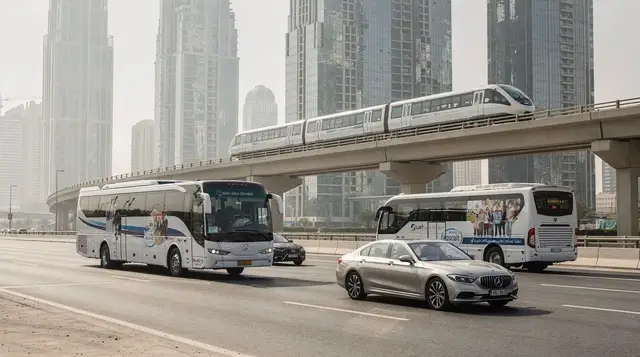
RTA operates the E100 and E101 routes connecting Dubai and Abu Dhabi, both running roughly every 30-40 minutes throughout the day, taking about 2-2.5 hours depending on traffic and the specific route’s stop pattern, for a flat fare of roughly AED 25 ($7) one-way. The two routes differ slightly in departure points and stops along the way — check the current RTA timetable for which one departs nearest to your accommodation, since Dubai’s main departure point is Ibn Battuta Bus Station, reachable by metro on the Red Line before transferring to the bus platform.
This is by far the cheapest way to make the trip, but it drops you at Abu Dhabi’s Central Bus Station rather than directly at the Sheikh Zayed Grand Mosque or Saadiyat Island, meaning a taxi or Careem for the final leg to each attraction once you arrive.
Who the bus suits
The bus is the right call for budget-conscious solo travelers or backpackers with a flexible schedule who don’t mind arranging their own onward transport once they arrive in Abu Dhabi, or for anyone commuting between the two cities regularly rather than doing a single tightly-scheduled day trip. It’s a weaker fit for families trying to hit both the mosque and Louvre Abu Dhabi in a single day, since the fixed departure schedule and the need for taxis at both ends adds friction to a day already tight on time.
Self-driving the E11
Sheikh Zayed Road runs directly out of Dubai and becomes the E11 continuing straight into Abu Dhabi, a single, well-maintained highway with no turns to navigate the entire way — genuinely one of the easiest self-drive routes in the region even for a first-time visitor unfamiliar with UAE roads. A rental car for the day runs roughly AED 150-250 ($41-68) plus fuel and Salik toll gates, a handful of roughly AED 4-6 ($1.1-1.6) charges each way, making self-drive the cheaper option once you’re splitting the cost across three or more people. The Dubai car rental guide covers booking specifics, insurance, and how Salik billing works for a rental.
Timing the drive around traffic
Expect roughly 1.5 hours in light traffic, closer to 2 hours if you leave during Dubai’s morning rush (roughly 7-9am) or return during the evening peak (5-7pm). Leaving Dubai by 8-8:30am and starting the return drive by 4-5pm avoids both congestion windows and leaves a full day in Abu Dhabi in between — the exact schedule laid out in the Dubai to Abu Dhabi day trip guide.
Guided tours: the middle option
For travelers who’d rather not navigate mosque-area drop-off and parking restrictions themselves, a guided tour handles pickup from your Dubai hotel, the drive, and a structured itinerary in one fixed price. This half-day Sheikh Zayed Mosque tour from Dubai covers hotel pickup, transport, and a guided mosque visit in about 4-5 hours, a solid option if the mosque is your main goal. For a fuller day including the palace interior, this Grand Mosque and Qasr Al Watan heritage tour adds Qasr Al Watan’s library and dome to the same itinerary.
If you’d rather keep your afternoon flexible, this Abu Dhabi day tour with optional lunch lets you choose the second half of the day rather than following a fixed script.
Cost comparison across all three options
For a solo traveler, the bus at roughly AED 25 ($7) each way is unbeatable on price, though it adds taxi costs at the Abu Dhabi end. A shared guided tour runs roughly AED 150-300 ($41-82) per person including transport and often a guide, with mosque entry free regardless. Self-driving costs roughly AED 200-350 ($54-95) total for the day across rental, fuel, and tolls, which becomes cost-competitive with a tour once split across three or four people, and includes full flexibility over the day’s schedule that neither the bus nor a fixed-departure tour offers.
Private transfers as a fourth option
Beyond the three main options, a private car and driver booked for the day, without a structured tour itinerary attached, is available through several operators for travelers who want a driver’s flexibility and local knowledge without following a scripted tour. This costs more than a shared tour but less than most people expect relative to a full private-guide package, and it suits families or small groups wanting a customized day without self-driving.
Combining the trip with an overnight stay
If a single day feels rushed for everything Abu Dhabi offers — the mosque, Louvre, Qasr Al Watan, Yas Island’s theme parks, and the Corniche — an overnight stay spreads these across two unhurried days rather than compressing them into one round trip. The Dubai and Abu Dhabi combined itinerary lays out a multi-day version, and in that case, a one-way rental drop-off or a tour that doesn’t require returning to Dubai the same day becomes worth considering over a round-trip bus or self-drive.
Traffic and weather considerations
Both directions run through open desert highway with limited shade or service stations along parts of the route, so a functioning air conditioning system matters more here than on shorter city drives, particularly June through September when outside temperatures regularly hit 40-48°C. Fog is a rare but real seasonal hazard in the cooler months (typically December-February, more common closer to the coast), occasionally causing highway closures or slowdowns — worth checking a weather and traffic app before an early-morning winter departure.
Combining with Sharjah or other stops
Some tours and self-drive itineraries combine an Abu Dhabi day trip with a stop in Sharjah on the return leg, given its position roughly between the two cities depending on your exact route — though this adds meaningfully to an already substantial driving day and is more realistic as a separate trip. See best day trips from Dubai for how Abu Dhabi and Sharjah compare as standalone options rather than combined into one long day.
Common mistakes
The most common mistake is underestimating how long mosque and museum visits actually take when planning a bus-based day trip with a fixed return departure, risking a rushed exit or a missed bus back. The second is assuming the bus drops you directly at the mosque, when it actually terminates at Abu Dhabi’s Central Bus Station, requiring a separate taxi. The third is self-driving without confirming Salik tag setup on the rental beforehand, leading to confusion over billed toll charges after the trip.
Which option to actually pick
Solo backpackers and anyone on a tight budget should default to the bus and accept the extra taxi legs at the Abu Dhabi end. Groups of three or more with any interest in flexibility should self-drive, since the cost splits favorably and the highway is genuinely easy. Couples, families, and anyone who’d rather not deal with logistics at all should book a guided tour, accepting a fixed schedule in exchange for door-to-door convenience and a driver who already knows the mosque’s parking and drop-off rules.
What to expect at Ibn Battuta Bus Station
Ibn Battuta Bus Station sits next to the Ibn Battuta Mall and metro station on the Red Line, making it an easy connection point if you’re staying anywhere near a metro stop. The station has clear signage, a ticket counter and vending machines for the intercity bus, and basic amenities like seating and a small retail area, though it’s a functional transit hub rather than a destination in itself, so budgeting minimal extra time there beyond your bus departure is realistic. Arriving 15-20 minutes before your intended departure covers ticket purchase and finding the correct platform without cutting it close.
Arriving at Abu Dhabi’s Central Bus Station
The bus terminates at Abu Dhabi’s Central Bus Station, a functional hub with taxi ranks immediately outside for onward travel to the mosque, Saadiyat Island, or the Corniche. Careem and Uber also operate reliably from this station, generally a better bet than the taxi rank during busy periods since you can see the fare and confirm a pickup before stepping outside. From here, expect roughly a 15-20 minute taxi ride to the Sheikh Zayed Grand Mosque and closer to 30 minutes to Saadiyat Island and the Louvre.
Group and family logistics
For families or small groups traveling together, the intercity bus doesn’t offer group discounts, so the per-person AED 25 fare applies uniformly regardless of group size — at three or more travelers, this starts to approach the per-person cost of a shared tour once you add the onward taxi legs in Abu Dhabi, making the tour’s included transport and mosque guide a comparable or better value at that point. A rental car remains the cheapest per-person option for a group of four or more, provided at least one person is comfortable with the drive.
Combining transport with a multi-stop itinerary
If your Abu Dhabi day includes more than the mosque and Louvre — say, adding Qasr Al Watan or a stop at the Corniche — self-driving or a private tour with a dedicated driver waiting between stops is meaningfully more efficient than the bus, which isn’t designed for hopping between multiple points within Abu Dhabi itself. The bus works best as point-to-point transport between the two cities, not as a way to move around Abu Dhabi once you’ve arrived, which is exactly the gap a rental car or tour driver fills.
Booking bus tickets and schedules
Tickets for the E100/E101 can be bought at the station on the day of travel, and while advance online booking exists through RTA’s channels, most travelers simply buy at the counter or vending machine shortly before departure given how frequently buses run. Checking the current timetable the day before your trip is worth doing regardless, since schedules do shift periodically and a Friday or public holiday schedule can differ from a standard weekday one. Seats aren’t typically assigned, so arriving a little early during busy periods, like a weekend morning, improves your odds of a seat on the next departure rather than waiting for the one after.
What a rental car adds beyond just the drive
Beyond the drive itself, a rental car gives you the flexibility to detour off the direct highway route — stopping at a scenic point along the way, adjusting your return time if the mosque or Louvre visit runs long, or extending the day to include Yas Island if you started early enough. None of the bus or fixed-tour options offer this same flexibility, which is the core trade-off self-driving buys you over the lower cost of the bus or the structure of a guided tour. The Ferrari World day trip guide is a good example of a plan that benefits from this kind of flexible timing if you’re combining Yas Island’s theme parks into the same trip.
Weekend and holiday demand
Fridays and Saturdays (the UAE weekend) see higher demand for both the intercity bus and guided tours, given how popular an Abu Dhabi day trip is among residents and visitors alike — booking a tour a day or two ahead, or arriving slightly earlier at the bus station, is a reasonable precaution during these periods. Public holidays, especially those tied to national celebrations, see the heaviest demand of all, and self-driving during these periods can also mean noticeably heavier traffic along Sheikh Zayed Road than a typical weekday.
A realistic budget for the transport leg alone
Setting aside attraction costs and meals, the transport-only cost for a solo traveler by bus runs roughly AED 50-70 ($14-19) round trip including onward taxis in Abu Dhabi; a shared tour runs roughly AED 150-300 ($41-82) per person including transport; and self-driving for a group splits down to roughly AED 50-90 ($14-25) per person for a group of four once rental, fuel, and tolls are divided. This transport-only comparison is worth keeping separate from the full day’s cost breakdown covered in the Dubai to Abu Dhabi day trip guide, since it’s the piece most directly affected by which of the three transport methods you choose.
Bus vs self-drive vs tour: side by side
| Bus (E100/E101) | Self-drive | Guided tour | |
|---|---|---|---|
| Cost | ~AED 25 ($7) one-way | AED 200-350 ($54-95) total | AED 150-300 ($41-82)/person |
| Flexibility | Fixed schedule, taxis needed on arrival | Full control | Fixed itinerary |
| Best group size | Solo, budget | 3+ people | Couples, families |
| Door-to-door | No | Yes | Yes |
Renting a car one-way
For travelers not returning to Dubai the same day — combining Abu Dhabi with an onward Al Ain or Liwa leg, say — some rental companies allow a one-way drop-off at an Abu Dhabi branch for an added fee. This is worth arranging in advance rather than assuming any Dubai rental automatically supports it, since not every agency or vehicle class offers one-way returns between emirates. The Dubai car rental guide covers which providers commonly support this.
Fuel and rest stops along the E11
The E11 has periodic fuel stations and rest areas along the route, so running low on fuel isn’t a genuine risk the way it can be on longer desert crossings like the drive to Liwa. Still, filling up before leaving Dubai avoids any need to stop at all, keeping the 1.5-2 hour drive uninterrupted — useful if you’re timing arrival at the mosque for a specific morning slot.
Frequently asked questions about Dubai to Abu Dhabi transport
Is the E100 or E101 bus better?
Both cover the same general Dubai-Abu Dhabi route with slightly different stop patterns; check the current RTA timetable for whichever departs closer to your location in Dubai.
Can I use my Dubai Nol card on the intercity bus?
No, the E100/E101 intercity bus uses its own ticketing separate from Dubai’s Nol system, purchased at the bus station.
Is the drive from Dubai to Abu Dhabi scenic?
Mostly open desert highway with occasional glimpses of the coastline and passing towns; it’s functional rather than dramatically scenic, though the drive itself is easy and low-stress.
How early should I leave for a day trip by car?
Leaving Dubai by 8-8:30am gets you to the mosque by mid-morning with a full day ahead before the evening traffic peak on the return leg.
Are there tolls on the route between Dubai and Abu Dhabi?
Yes, Salik gates apply on parts of the route within Dubai; once past the Abu Dhabi emirate border, that emirate’s own toll system (Darb) may apply on some roads, billed separately if you’re driving a UAE-registered rental.
Can I book a one-way trip and stay overnight in Abu Dhabi?
Yes, both the bus and most tour operators support one-way options, and a rental car can be dropped at an Abu Dhabi branch if you’re not returning to Dubai the same day — useful for the combined itinerary approach.
Is it faster to fly between Dubai and Abu Dhabi?
No — with airport check-in, security, and transfer time on both ends, flying takes longer overall than the roughly 1.5-2 hour direct drive or bus ride, so flying isn’t a practical option for this specific route.
Does the bus run on public holidays?
Yes, generally on a modified schedule similar to a Friday or weekend timetable, so it’s worth checking current holiday-specific timings before planning a trip on a UAE public holiday.
Is it possible to combine the bus one way and a tour the other way?
Yes — nothing ties you to using the same transport method for both legs, and some travelers take a cheap bus outbound in the morning, then book a return tour or private transfer timed around their evening plans in Abu Dhabi.
Can I get from Dubai Airport directly to Abu Dhabi?
Yes — both a direct taxi/Careem ride and some tour operators offer airport-to-Abu Dhabi transfers, skipping a stop in Dubai entirely, useful for layover travelers with limited time.
Is there a train between Dubai and Abu Dhabi?
Not yet — the UAE’s Etihad Rail network is still expanding, and as of now, bus, self-drive, or a guided tour remain the only practical ways to make this specific trip.
Top experiences
Bookable activities with verified prices and instant confirmation on GetYourGuide.