Saadiyat Island — Abu Dhabi's cultural district and beach
Saadiyat Island guide: Louvre Abu Dhabi, the public beach, and the cultural district — what's open now versus the still-unbuilt Guggenheim.
Louvre Abu Dhabi museum general admission ticket
Quick facts
- Location
- Just north of central Abu Dhabi, bridge-connected
- Headline attraction
- Louvre Abu Dhabi (open since 2017)
- Beach
- Saadiyat public beach, one of the region's cleanest
- Best for
- Museum visitors, beach relaxation, luxury resort stays
- Guggenheim Abu Dhabi
- Under construction, opening date not yet fixed
What Saadiyat Island actually is
Saadiyat Island sits just north of central Abu Dhabi, connected by bridge, and it’s been developed over the past two decades as the emirate’s dedicated cultural and luxury-leisure district — a deliberate counterpoint to Yas Island’s theme-park focus. Its headline draw is the Louvre Abu Dhabi, but the island also holds one of the cleanest, least crowded public beaches in the wider Abu Dhabi–Dubai region, a cluster of five-star beach resorts, and a “cultural district” master plan that, decades on, still has major pieces (most notably the Guggenheim Abu Dhabi) unbuilt.
It’s worth visiting with that mixed reality in mind: what’s open today is genuinely excellent, but some of what gets referenced online as part of Saadiyat’s cultural district doesn’t exist yet.
Louvre Abu Dhabi
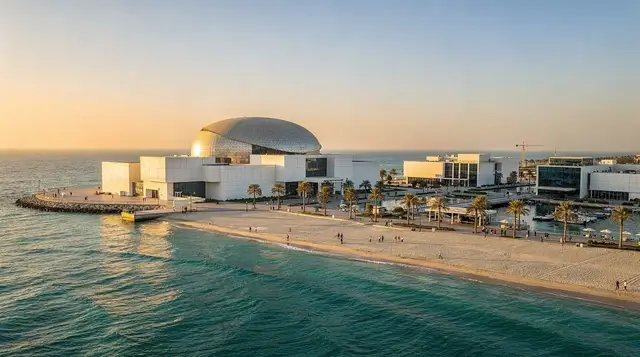
Opened in 2017 under a 30-year agreement with France’s Louvre and several other French museums, Louvre Abu Dhabi is a universal-history museum rather than a France-specific outpost — its collection spans human civilization and artistic tradition across cultures and eras, deliberately avoiding a single national or regional lens. The building itself, designed by Jean Nouvel, is as much the attraction as the art: a vast perforated dome floats above the museum’s white cube galleries, casting a moving “rain of light” pattern across the walkways below throughout the day.
Louvre Abu Dhabi general admission tickets are worth booking for a timed morning or late-afternoon slot to avoid both the midday crowds and the harshest heat crossing the outdoor plaza between galleries. If you’re visiting on a tight schedule or during a busy period, skip-the-line admission tickets save meaningful queuing time, particularly on weekends and UAE public holidays. Budget at least 2.5–3 hours to see the museum properly — the collection is large enough that a rushed hour barely covers the highlights.
The Louvre Abu Dhabi guide has gallery-by-gallery highlights and the best times to visit for photography of the dome’s light effect.
Saadiyat public beach
Beyond the museum, Saadiyat’s public beach is a genuine standout — clean, less crowded than most Dubai beaches, and backed by a low-rise dune landscape rather than the dense tower backdrop typical of Dubai Marina or Palm Jumeirah. It’s also a nesting site for hawksbill turtles during certain months, and the beach authority runs seasonal conservation programs worth checking if you’re visiting during nesting season. Facilities are modest but adequate: showers, loungers for rent, and a handful of beachside cafés. See the Dubai beaches guide for how Saadiyat compares to the wider region’s beach options if you’re weighing where to spend a beach day.
The cultural district and the Guggenheim
Saadiyat’s broader “cultural district” master plan, announced alongside the Louvre project, envisioned multiple major museums clustered together, most prominently a Frank Gehry-designed Guggenheim Abu Dhabi. As of 2026, the Guggenheim remains under construction with no confirmed public opening date — worth knowing so you don’t plan a trip around visiting it. The Louvre stands largely alone as the district’s completed anchor for now, alongside smaller galleries and NYU Abu Dhabi’s campus, which occasionally hosts public exhibitions and events worth checking if you’re on the island for other reasons.
NYU Abu Dhabi and the turtle nesting season
Saadiyat is also home to New York University Abu Dhabi’s campus, one of NYU’s three degree-granting “portal” campuses alongside New York and Shanghai, occupying a striking piece of contemporary architecture on the island’s eastern side. While it’s a working university rather than a tourist attraction, its arts center occasionally hosts public performances, exhibitions, and film screenings open to visitors, worth checking if your Saadiyat visit coincides with something on the calendar.
On the natural-history side, Saadiyat’s beaches are a nesting ground for hawksbill turtles, one of the world’s most endangered sea turtle species, typically nesting between roughly April and July. During nesting season, the beach authority runs conservation monitoring and occasionally organizes guided viewing of hatchling releases under controlled conditions — a genuinely rare wildlife experience this close to a major capital city, though access and timing depend on the season’s specific nesting activity and aren’t guaranteed on any given visit.
Dining and visiting with family
Saadiyat’s dining scene is concentrated mainly within its resort hotels and the Louvre’s own café and restaurant, which overlooks the water and makes a pleasant lunch stop between gallery sections rather than requiring a separate trip off-island. Options away from the resorts are more limited than in central Abu Dhabi or Dubai, so most visitors either eat at their hotel, at the museum, or plan a return to the mainland for dinner rather than expecting an independent restaurant scene to wander between.
For families, the Louvre runs family-oriented guided tours and activity trails designed to keep younger visitors engaged with the collection rather than simply walking past it, and the museum’s more open, plaza-style layout is easier to navigate with a stroller than a denser, more traditional museum floor plan. Combined with the public beach for downtime, Saadiyat works reasonably well as a family day out, provided expectations are set around a slower, more curated pace than a theme-park day elsewhere in the country.
How Saadiyat Island was developed
Saadiyat’s transformation from a largely undeveloped island into a cultural and residential district began in the mid-2000s under Abu Dhabi’s Tourism Development and Investment Company, with the stated ambition of building a globally significant arts and culture destination to complement the emirate’s political and economic weight. The Louvre agreement, signed in 2007, was the anchor deal that gave the wider cultural district plan its credibility and its most visible early result, with the museum eventually opening a decade later in 2017 after a lengthy construction process centered on Jean Nouvel’s complex geometric dome.
The wider master plan’s slower-than-announced pace — including the Guggenheim’s still-unbuilt status nearly two decades after the district was first conceived — reflects both the scale of ambition involved and the practical reality that major cultural infrastructure projects of this kind routinely take longer than initial announcements suggest, a pattern visible in ambitious cultural districts elsewhere in the world as well, not unique to Abu Dhabi.
Getting there and where to stay
Saadiyat is a short drive from central Abu Dhabi — roughly 15–20 minutes — making it easy to combine with a Grand Mosque or Qasr Al Watan visit on the same day, though the beach and museum together genuinely deserve their own half-day rather than being squeezed into a broader Abu Dhabi day trip.
From Dubai, it’s part of the same roughly 90-minute drive as the rest of Abu Dhabi; see transport between Dubai and Abu Dhabi for driving, bus, and tour options, and an Abu Dhabi half-day city tour with the Grand Mosque can be paired with a separate Saadiyat visit if you want to split cultural and beach time across two half-days rather than one long one.
The island’s resorts — several under major luxury hotel brands — are a genuine option for travelers wanting a quieter, beach-adjacent Abu Dhabi base rather than staying downtown or on Yas Island. Rooms here run at a premium reflecting the beach frontage and museum proximity; see the Dubai luxury guide for how Saadiyat’s pricing compares to equivalent Dubai properties, and consider the Dubai and Abu Dhabi combined itinerary or the Dubai luxury itinerary if a Saadiyat stay fits a longer, higher-budget trip plan.
Jean Nouvel’s dome and the museum’s design
It’s worth dwelling a little longer on why Louvre Abu Dhabi’s building itself draws as much attention as its collection. French architect Jean Nouvel designed the museum’s roof as a vast, intricately perforated dome, roughly 180 meters in diameter, built from thousands of interlocking geometric elements arranged in a pattern inspired by traditional Arabian mashrabiya latticework — the wooden screens historically used across the region to filter sunlight and provide privacy while allowing airflow. Sunlight passing through the dome’s layered pattern creates a shifting “rain of light” effect across the walkways and courtyards below throughout the day, changing in intensity and pattern as the sun moves.
Beneath the dome, the museum itself is arranged as a cluster of white cube gallery buildings connected by covered outdoor walkways and reflecting pools, deliberately evoking the layout of a traditional medina, with narrow passages opening onto small plazas. The design won broad architectural acclaim on completion and remains one of the most photographed buildings in the UAE outside Dubai’s skyline landmarks — worth arriving a little early or lingering a little later than your museum visit strictly requires, purely to experience the building itself at different times of day.
Honest take: is Saadiyat worth a dedicated visit?
For art and architecture-minded travelers, the Louvre alone justifies a stop, and it’s genuinely one of the best museums in the wider Gulf region rather than a token cultural attraction built for tourism optics. Pairing it with an afternoon on the public beach makes for one of the more relaxed, low-key days available anywhere in the Abu Dhabi–Dubai corridor — a useful contrast if the rest of your trip has been dense with theme parks and skyline photography. Where Saadiyat falls short of expectations is the broader “cultural district” framing: much of what’s marketed as part of that vision, the Guggenheim chief among it, simply isn’t built yet, so don’t structure a trip around anything beyond the Louvre and the beach as they exist today.
Comparing Saadiyat to Yas Island
Since both islands sit within Abu Dhabi and both get grouped together as “the two big Abu Dhabi day trip destinations” in a lot of trip planning, it’s worth being explicit about how differently they’re built. Yas Island is entertainment-first — four major theme parks, a Formula 1 circuit, and a mall, all designed for high-energy, full-day activity and best suited to families with children or thrill-seeking adults. Saadiyat is culture-and-relaxation-first — a single major museum, a genuinely good beach, and a much quieter overall pace, better suited to travelers who want a slower day of art and sand rather than queues and roller coasters.
Trying to combine both islands in a single day from Dubai is a mistake most first-time visitors make and regret — each deserves its own dedicated day if both interest you, and cramming them together means rushing the Louvre’s galleries and skipping Yas Island’s parks almost entirely, which defeats the purpose of visiting either. If you only have one day for an Abu Dhabi side trip beyond the Grand Mosque and Qasr Al Watan, choose based on what your group actually wants: theme-park energy points to Yas Island, art and a beach afternoon points to Saadiyat.
At a glance:
| Saadiyat Island | Yas Island | |
|---|---|---|
| Focus | Art, architecture, beach | Theme parks, F1, entertainment |
| Pace | Slow, curated | High-energy, full-day |
| Headline draw | Louvre Abu Dhabi | Ferrari World, Yas Waterworld |
| Best for | Couples, art lovers, quiet days | Families, thrill-seekers |
Practical tips for a Saadiyat day
Bring a hat and water for the walk between the Louvre’s outdoor plaza and the galleries — the covered walkways help, but the crossing between buildings is still open-air and the midday sun is intense outside winter. If you’re combining the museum with the beach, pack a swimsuit and change of clothes so you’re not driving back to a mainland hotel mid-visit. Cash isn’t really necessary — cards are accepted throughout the museum, resorts, and beach facilities — but a small amount is useful for beach loungers or café tips at less card-friendly stalls.
A practical pairing for a fuller Abu Dhabi day: an Grand Mosque and Qasr Al Watan guided tour in the morning, then a self-arranged afternoon on Saadiyat for the Louvre and beach — splitting the day this way avoids the rushed feeling of trying to fit both the mosque circuit and a proper museum visit into a single guided itinerary.
Frequently asked questions about Saadiyat Island
Is the Guggenheim Abu Dhabi open yet?
No, it remains under construction as of 2026 with no confirmed public opening date. Only the Louvre Abu Dhabi is currently open among the cultural district’s major planned museums.
How much time do I need for Louvre Abu Dhabi?
At least 2.5–3 hours to see the main galleries properly. A rushed visit under 90 minutes only covers a fraction of the collection.
Is Saadiyat’s beach open to the public?
Yes, there’s a dedicated public beach area separate from the resort-private stretches, with basic facilities including showers and loungers for rent.
How far is Saadiyat Island from central Abu Dhabi?
About 15–20 minutes by car, and roughly the same overall drive time from Dubai as the rest of Abu Dhabi, around 90 minutes via the E11.
Should I book Louvre Abu Dhabi tickets in advance?
Yes, especially for weekends and holidays — a timed-entry or skip-the-line ticket avoids the longest queues, which build up quickly once tour groups arrive mid-morning.
Can I combine Saadiyat with a Sheikh Zayed Grand Mosque visit?
Yes, they’re close enough to combine in a single day, though doing both properly (with real time at each) plus a Saadiyat beach stop is a genuinely full day rather than a rushed half-day add-on.
Is Saadiyat Island good for families?
The beach works well for families, and the Louvre has family-friendly guided tours, though the museum itself rewards a slower, more adult-paced visit than a typical theme-park day.
Are hotels on Saadiyat Island expensive?
Generally yes — the island positions itself as a luxury beach-and-culture destination, with resort pricing to match, comparable to or above equivalent properties in central Abu Dhabi or Dubai’s Palm Jumeirah.
Can I see sea turtles on Saadiyat Island?
Possibly — the beaches are a hawksbill turtle nesting ground, mainly between April and July, and the beach authority occasionally organizes guided hatchling-release viewings during that window, though sightings aren’t guaranteed on any specific visit.
Is NYU Abu Dhabi open to visitors?
It’s a working university campus, not a general tourist attraction, but its arts center occasionally hosts public performances and exhibitions open to visitors — worth checking the calendar if you’re already on the island.
Should I visit Saadiyat Island or Yas Island if I only have one day?
It depends on your group’s priorities — Yas Island suits theme-park energy and families with children, while Saadiyat suits a slower day built around art and beach time. Combining both properly in a single day isn’t realistic.
Is Saadiyat Island a good base for staying in Abu Dhabi?
Yes, for travelers prioritizing a beach-and-culture stay over a central downtown base — several luxury resorts here offer easy access to the Louvre and the public beach, at the cost of being a short drive from Abu Dhabi’s mosque, palace, and mall district rather than walking distance.
What’s the difference between Louvre Abu Dhabi and Louvre Paris?
Louvre Abu Dhabi operates under a 30-year partnership agreement with the French Louvre and several other French institutions, sharing expertise, loaned artworks, and the Louvre name, but it holds its own distinct collection curated around universal human history rather than duplicating the Paris museum’s holdings.
Can I visit Saadiyat Island without a car?
Taxis and ride-hailing apps like Careem cover the island reliably, so a rental car isn’t strictly necessary, though having one gives more flexibility if you’re planning to combine Saadiyat with other Abu Dhabi sights in the same day.
Is photography allowed inside Louvre Abu Dhabi?
Yes, in most gallery areas, though flash photography and photography in a small number of specially loaned exhibition spaces may be restricted — signage at each gallery entrance makes the specific rule clear.
What’s the best time of day to see the dome’s light effect?
Midday, when the sun sits highest, produces the most defined “rain of light” pattern across the walkways, while morning and late afternoon give softer, more diffuse lighting — both are worth experiencing if your schedule allows more than one pass through the outdoor plazas.
Are there guided tours of Louvre Abu Dhabi?
Yes, both general highlights tours and more specialized thematic tours are available, typically booked in addition to standard admission, and worthwhile for visitors who want curatorial context beyond the gallery placards.
Top experiences
Bookable activities with verified prices and instant confirmation on GetYourGuide.