Dubai car rental guide: rules, Salik tolls, and fines
Is it worth renting a car in Dubai?
Only for specific situations — mainly day trips to Abu Dhabi, Hatta, or Ras al-Khaimah, or staying somewhere the metro and taxis don't conveniently reach. Rental runs roughly AED 150-250 ($41-68) per day plus Salik tolls (AED 4/$1.1 per gate) and fuel. Within the city, metro plus taxi is usually cheaper and avoids parking and traffic entirely, so a car makes more sense for specific days than the whole trip.
| Where | Best for day trips: Abu Dhabi, Hatta, Ras al-Khaimah |
| Cost | roughly AED 150-250 ($41-68)/day plus Salik tolls (AED 4-6/gate) and fuel |
| Time needed | book ahead Nov-Mar peak season; walk-up fine off-peak |
| Getting there | counters at both DXB and DWC, plus city-center branches |
| Best time | rent only for the specific day-trip days, not the whole stay |
When renting a car in Dubai actually makes sense
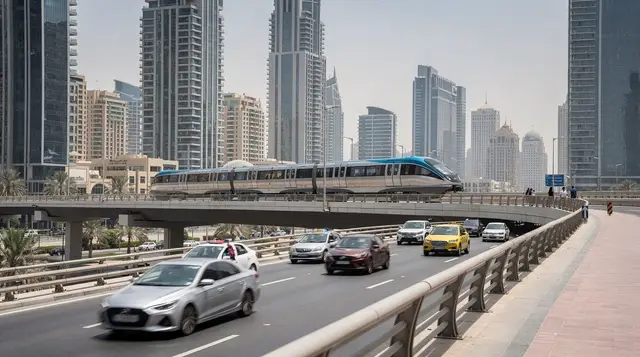
Dubai’s highways are wide, well-signed, and genuinely easy to self-drive by international standards, but that doesn’t mean a rental car is the right choice for most visitors’ whole trip. It earns its cost mainly for day trips outside the city — Abu Dhabi, Hatta, Ras al-Khaimah — or if you’re staying somewhere the metro and taxis don’t conveniently reach. Within the city itself, parking, Salik tolls, and Sheikh Zayed Road traffic during rush hour usually make metro plus taxi the more practical and often cheaper option, covered in the full comparison in getting around Dubai.
This is also why guided tours remain popular even among visitors who’d otherwise happily self-drive elsewhere — a driver who already knows the desert tracks, Salik-free shortcuts, and mosque parking logistics removes a layer of friction that a rental car doesn’t automatically solve on its own, especially on a first visit.
Requirements to rent
Most nationalities can rent with a valid home driving license, though a number of countries also require an International Driving Permit (IDP) alongside it — check your specific country’s requirement before booking, since agencies will refuse a rental without the correct documentation. A credit card in the driver’s name is standard for the security deposit, and minimum age requirements typically run 21-25 depending on the agency and vehicle category, with a young-driver surcharge common for renters under 25.
Which side of the road and basic driving rules
The UAE drives on the right, with left-hand-drive vehicles, matching continental Europe and North America rather than the UK or Australia — a real adjustment if you’re used to right-hand-drive countries. Seatbelts are mandatory for all occupants, using a phone while driving is banned and enforced, and drink-driving carries a strict zero-tolerance policy with serious legal consequences, not just a fine, given the UAE’s broader alcohol laws. Speed limits on highways typically run 100-120 km/h, and while a small camera tolerance margin has existed historically, relying on any assumed buffer above the posted limit is increasingly risky as enforcement has tightened over the years — the safer approach is simply not exceeding the posted number.
Salik: the toll system
Salik is Dubai’s fully automatic toll system, with no barriers, ticket booths, or manual payment — a windshield-mounted tag communicates with overhead gates on major roads, deducting a flat charge, generally AED 4-6 ($1.1-1.6) per gate, each time you pass through one. Rental cars come pre-fitted with a Salik tag, and charges accumulate on the rental company’s account before being billed to your card, either during the rental or as a post-trip statement. There’s no way to avoid Salik gates on many of Dubai’s main routes, including Sheikh Zayed Road itself, so budgeting a few gate charges into any cross-city drive is realistic rather than optional.
Parking in the city
Paid parking (marked by RTA signage, usually blue-and-white striped curbs or dedicated meters) applies in most commercial and Downtown areas, roughly AED 2-4 ($0.5-1.1) per hour during enforced hours, generally 8am to midnight with reduced hours on Fridays. Payment is via the RTA’s mobile app, SMS, or a physical meter depending on the zone — parking without paying, even briefly, risks a fine from routine enforcement patrols. Many residential areas and some zones are free overnight and on public holidays, worth checking the specific signage rather than assuming a blanket rule citywide. Malls almost universally offer free parking in large multi-story structures, a genuine convenience if your day revolves around mall-based attractions.
Common fines and how they’re issued
Beyond speeding, common ticketed offenses include using a phone while driving, not wearing a seatbelt, tailgating (Dubai’s roads have specific minimum-distance rules enforced by camera), and driving in an emergency lane. Fines are issued automatically via camera in most cases and appear on the rental company’s account rather than being handed to you on the spot, meaning you often only learn about a fine when it’s charged to your card, sometimes weeks after the rental ends, plus an administrative fee added by the rental company. Reading your specific rental agreement’s fine-handling clause before driving off is worth the few minutes it takes.
Fuel and returning the car
Petrol in the UAE is inexpensive relative to many countries, and most rentals work on a full-to-full basis — return the car with the same fuel level it had at pickup, or pay a refueling surcharge that’s usually pricier than filling it yourself at a nearby station before drop-off. Stations are plentiful and simple to use, with full-service pumping standard rather than self-service in most locations, so you generally don’t even get out of the car.
Driving to specific destinations
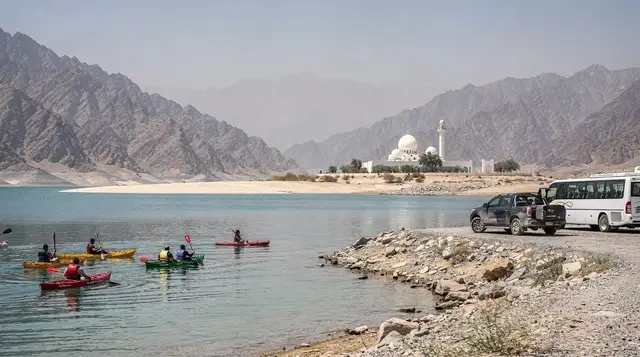
Sheikh Zayed Road runs the length of the city and continues directly into the E11 toward Abu Dhabi, a straightforward highway drive covered in the Dubai to Abu Dhabi transport guide. Reaching Hatta or the desert conservation areas involves a mix of highway and, for some off-road desert routes, unpaved terrain that a standard sedan isn’t equipped for — a 4x4 rental is the right call for anything beyond paved desert-adjacent roads, detailed in the desert day trip guide and the Hatta day trip guide.
Renting a 4x4 for desert routes
Standard sedans are fine for city driving and paved intercity highways but aren’t appropriate for actual dune driving or unpaved desert tracks, which require a proper 4x4 with the right tire pressure and, ideally, some experience or a guided convoy — this is exactly why most visitors book a guided desert safari with a professional driver rather than attempting solo dune bashing in a rental vehicle. If you specifically want to self-drive into desert terrain, only do so in a rented 4x4 explicitly approved for off-road use, and check your rental insurance’s off-road coverage terms carefully, since standard policies often exclude off-road damage entirely.
Insurance and what it actually covers
Rental agencies typically offer a basic insurance package included in the daily rate, with an excess/deductible that can be reduced by paying for additional coverage — reading the specific excess amount before declining the upsell is worth doing, since a comprehensive package that removes a large deductible can be genuinely good value for a short rental. Off-road driving, as noted above, is commonly excluded from standard coverage regardless of tier, so desert routes need explicit confirmation of coverage if you’re self-driving rather than joining a guided tour.
Cost comparison: renting vs taxis for a full trip
For a five-day trip staying mostly within the city, a rental car running roughly AED 150-250 ($41-68) per day plus tolls, parking, and fuel typically costs more overall than a metro-and-taxi combination covering the same ground, without the added mental overhead of navigating and parking in an unfamiliar city. The calculation flips for a trip built around several day trips outside Dubai, where a car for those specific days, rather than the whole stay, becomes the more efficient and comfortable choice — a hybrid approach (public transport in the city, a one- or two-day rental for outside trips) suits many visitors better than committing to a car for the entire stay.
Rental car vs metro-and-taxi: quick comparison
| Rental car | Metro + taxi | |
|---|---|---|
| Best for | Abu Dhabi, Hatta, RAK day trips | Getting around within the city |
| Typical daily cost | AED 150-250 + tolls + fuel | Usually cheaper for city-only days |
| Hassle | Parking, Salik tolls, unfamiliar roads | None — no navigation or parking needed |
| Verdict | Rent for specific out-of-city days | Default for the rest of the trip |
Automatic vs manual and vehicle categories
Automatic transmission is the norm across nearly all rental fleets in Dubai, so requesting a manual specifically (if you even prefer one) may narrow your options and isn’t necessary for most visitors. Vehicle categories run from economy hatchbacks well-suited to city driving up through SUVs and 4x4s for desert or off-road plans, and luxury and sports car rentals are also a notable niche in Dubai’s rental market for visitors wanting a specific driving experience rather than pure functional transport.
Common mistakes
The most frequent misstep is renting a car for the entire trip when it’s only genuinely needed for one or two day trips, paying for parking and tolls on days a taxi or metro would have worked just as well. The second is assuming any degree of camera tolerance above the posted speed limit, which is an increasingly unreliable assumption as enforcement has tightened over time. The third is attempting off-road desert driving in a standard rental sedan or without confirming insurance coverage, which risks both vehicle damage and a denied insurance claim.
Booking ahead vs on arrival
Rates and vehicle availability are noticeably tighter during peak season (November-March) and around major holidays, so booking a rental ahead of arrival, rather than assuming you can walk up to a counter and get a good rate, is worth doing if your trip includes specific day trips that depend on having a car. Outside peak season, walk-up availability is generally fine, though pre-booking still locks in a rate and avoids any awkwardness if a specific vehicle category is in short supply on your arrival date.
Picking up at the airport vs in the city
Most major agencies have counters at both DXB and DWC, letting you start a self-drive trip the moment you land, useful if you’re heading straight for an out-of-town destination like Abu Dhabi rather than transferring into central Dubai first. If your plan is to spend the first few days in the city on public transport and only rent a car for a later day trip, picking up from a city-center branch nearer your hotel avoids paying for days of parking you don’t need. The airport to city guide covers airport-specific rental pickup logistics in more detail.
Roundabouts, lane discipline, and local driving habits
Dubai’s newer highways mostly use signaled interchanges rather than roundabouts, though older parts of the city and some of the northern emirates still use them — standard right-of-way rules apply, giving way to traffic already in the roundabout. Lane discipline can feel more assertive than some visitors are used to, with lane-changing and tailgating more common on fast-moving highways than in many Western countries, even though tailgating specifically is a fineable offense when caught by camera. Staying in the right-hand lanes unless overtaking, and giving extra following distance, is a simple habit that reduces stress regardless of local driving norms around you.
Electric and hybrid rental options
A growing number of agencies now offer electric and hybrid vehicles, with charging infrastructure expanding across malls, hotels, and dedicated charging stations throughout the city, though it’s still less ubiquitous than fuel stations. If sustainability or trying an EV specifically appeals to you, it’s worth asking at booking whether charging logistics fit your planned route, particularly for a longer day trip toward Abu Dhabi or the northern emirates where charging stops need more deliberate planning than a quick fuel stop would.
Driving in summer heat
From June through September, dashboard temperatures inside a parked car can reach dangerous levels within minutes even with tinted windows, making it a firm rule never to leave a child, pet, or even electronics in a parked vehicle during those months. Air conditioning is standard on every rental, but it’s worth letting the car run and cool for a minute before driving off if it’s been parked in direct sun, and checking tire pressure periodically, since extreme heat affects it more than milder climates. See Dubai in summer for the broader picture of how summer heat reshapes daily planning beyond just driving.
Multi-day rentals for a longer itinerary
For visitors combining several day trips into one longer itinerary — say, Abu Dhabi one day and Hatta or Ras al-Khaimah later in the same week — a multi-day rental spanning that whole stretch is usually more efficient and cheaper per day than booking separate single-day rentals for each trip. Returning the car to a city-center branch on the days you’re not driving avoids ongoing daily parking charges if your hotel doesn’t offer free parking, worth checking before committing to a longer rental period.
What a typical week of mixed rental and public transport looks like
A common, cost-efficient pattern for a week-long trip: use metro and taxis for the first few days covering Downtown, Old Dubai, and the Marina, then pick up a rental car for a two-day stretch covering an Abu Dhabi day trip and a Hatta or desert day trip, then drop the car and return to public transport for the remaining city-based days.
This hybrid approach avoids paying for a car on days it adds no real value while still getting the flexibility of self-driving for the specific trips that benefit from it — a pattern reflected in itineraries like the 7-day Dubai itinerary and the desert and city itinerary.
Frequently asked questions about renting a car in Dubai
Is Dubai traffic hard to navigate for a first-time visitor driving themselves?
Highways are wide and well-signed with GPS navigation working reliably throughout, so most visitors adjust quickly; the main challenge is heavy congestion during rush hour rather than any confusing road layout.
Can I drop off a rental car at a different location than pickup?
Yes, most agencies offer one-way rentals within the UAE, sometimes for an additional fee, useful if you’re picking up at the airport and returning near your hotel or a different city.
Do I need to buy a Salik tag separately?
No, rental cars come pre-fitted with one, and charges are billed automatically through the rental agency rather than requiring you to purchase or top up a tag yourself.
Is it legal to drive from Dubai into Oman with a UAE rental car?
Some agencies permit cross-border rentals into Oman with additional paperwork and insurance, but many standard rental agreements exclude it — confirm explicitly with the agency before planning a trip like Musandam by self-drive.
What’s the minimum age to rent a car in Dubai?
Typically 21-25 depending on the agency and vehicle class, with a young-driver surcharge common for renters under 25.
Are there toll-free routes to avoid Salik charges?
Some slower surface roads avoid Salik gates entirely, but they add significant time compared to the tolled highways, making the toll cost usually worth it for the time saved on any longer cross-city or intercity drive.
Can I use a foreign GPS or navigation app in a rental car?
Yes, Google Maps and other standard navigation apps work reliably throughout the UAE with good mobile data coverage, and most rental cars also include a built-in navigation system as a backup.
Is roadside assistance included with a rental?
Most agencies include basic roadside assistance for mechanical breakdown as standard, though it’s worth confirming the specific terms and the emergency contact number provided at pickup before heading out on a longer intercity drive.
Can I rent a car with a debit card instead of a credit card?
Most agencies require a credit card specifically for the security deposit hold; a debit card is sometimes accepted but often with a higher deposit or additional restrictions, so confirming this before arriving at the counter avoids a rejected booking.