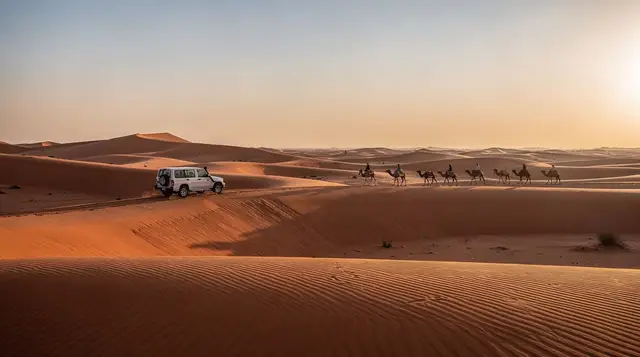
Private vs shared desert safari in Dubai
Dubai: private 6-hour desert safari with BBQ & Al Khayma camp
Duration: 6 hours
Should I book a private or shared desert safari in Dubai?
Shared safaris (AED 150-250 / 41-68 USD per person) work fine for most solo travelers, couples, and groups comfortable sharing a vehicle and camp with strangers. Private safaris (AED 800-1,400 / 218-381 USD per vehicle) are worth the premium for families, groups of four or more, travelers with dietary or mobility needs, or anyone wanting flexible timing and a calmer, less crowded experience.
Private vs shared desert safari at a glance
This is one of the more consequential logistical choices in planning a Dubai desert safari, and getting it right depends more on your group size and schedule than on any inherent quality difference between the two formats. Both formats run the same core sequence — dune bashing, a camel and sandboarding stop, and a camp dinner with entertainment — in the same Al Lahbab desert area outside Dubai. The difference is who you share the experience with and how much control you have over timing. Shared safaris put you in a vehicle with six to eight guests from different hotels on a fixed schedule; private safaris keep your group in its own vehicle with more flexible pickup timing and, on better packages, a smaller dedicated camp area.
The cost gap is real — expect to pay three to five times a shared per-person rate once you divide a private vehicle’s cost across your group.
| Shared cost | AED 150-250 (41-68 USD) per person |
| Private cost | AED 800-1,400 (218-381 USD) per vehicle |
| Group size | Shared: 6-8 strangers; Private: your group only |
| Flexibility | Private allows adjustable pickup timing |
| Best for private | Families of 4+, mixed needs, special occasions |
What a shared safari includes and costs
A shared desert safari is the default, mass-market booking: a Land Cruiser fills with unrelated guests picked up from different hotels along a set route, then everyone follows the same schedule through dune bashing, the photo stop, and the camp. This evening desert safari with buffet dinner is a well-reviewed example of the standard shared format, running AED 150-250 (41-68 USD) per person. The tradeoff for the lower price is less control — you can’t adjust pickup timing to suit your schedule, and the camp itself is typically the busiest version of the site, sometimes shared with several other tour operators’ groups on the same night.
What a private safari includes and costs
A private safari keeps your group — whether that’s a couple, a family, or friends traveling together — in its own vehicle for the full trip, with pickup timing that can often shift within a window to suit your schedule rather than a fixed convoy departure. This private 6-hour desert safari with BBQ dinner and Al Khayma camp is a solid mid-range private option, running roughly AED 800-1,400 (218-381 USD) per vehicle depending on group size and specific inclusions — a total that becomes reasonable per person once split across four to six travelers, but a genuine premium for a couple traveling alone.
Group size and vehicle differences
Shared safaris typically use full-size Land Cruisers seating six to eight guests, meaning your group is mixed with strangers for the pickup, dune-bashing drive, and photo stop, though the camp portion often has more space to spread out regardless of how you arrived. Private safaris size the vehicle to your group specifically — a couple might get a smaller SUV, while a family of six gets the same Land Cruiser used for shared tours but exclusively for their party.
This matters most during dune bashing itself, where a private group can ask the driver to adjust intensity (gentler for young kids or motion-sickness-prone travelers, more aggressive for thrill-seekers) in a way that’s harder to negotiate on a shared vehicle carrying guests with different preferences.
Flexibility: timing, dietary needs, and pace
Private safaris offer real, practical flexibility beyond just “your own vehicle”: pickup can sometimes shift by an hour to accommodate a late checkout or an early return for a flight, dietary requests can be communicated directly to the operator in advance rather than hoping a shared buffet has suitable options, and the overall pace — how long to linger at the camel stop, whether to skip a segment — has more room for adjustment than a fixed shared schedule allows. This flexibility particularly benefits families with young children, older travelers who move at a different pace, or anyone managing a health condition that benefits from a more adaptable schedule.
Who should pay for private
Families of four or more, groups with mixed mobility or dietary needs, couples celebrating a special occasion who want a quieter, more intimate camp experience, and anyone with a tight or unusual schedule that a fixed shared-tour timing wouldn’t accommodate are the clearest cases where private safaris earn their premium. Solo travelers and couples on a standard schedule, by contrast, often get comparable enjoyment from a well-reviewed shared safari at a fraction of the cost — the core dune-bashing and camp experience doesn’t fundamentally change based on vehicle exclusivity, only the social dynamic and scheduling flexibility around it.
This desert safari with premium BBQ dinner and a quad bike option is a useful middle-ground example — a shared-tour price point with premium inclusions layered in, for travelers who want an upgraded experience without paying full private rates.
Self-drive as a private-adventure alternative
For travelers who want a private experience with more physical involvement rather than just an exclusive passenger vehicle, self-drive dune buggy tours offer a genuinely different, inherently private alternative. This self-drive 4WD dune buggy guided desert adventure puts you behind the wheel of your own vehicle within a small guided convoy, a meaningfully different experience from either a shared or private passenger safari.
It requires a valid driving license and isn’t a direct substitute for the standard camp-and-dinner format, since most self-drive tours run shorter and don’t include the full evening camp experience — see the quad biking and dune buggy guide for the full breakdown of that format.
What repeat visitors say about the tradeoff
Travelers who’ve done both formats on separate trips to Dubai often describe the shared safari as the better first-timer experience — the social element and lower cost fit a first visit where the novelty of the desert itself is the main draw — and private as a better fit for a return trip, where the traveler already knows what to expect and is choosing to optimize for comfort, flexibility, and a calmer pace rather than novelty. This isn’t a universal rule, but it’s a reasonably common pattern worth considering if you’re deciding between the two for a trip that isn’t your first time in the UAE.
Booking and cancellation differences
Shared safaris generally have more available inventory and looser cancellation windows since operators run them at higher volume and can more easily reallocate a cancelled seat; private safaris often require earlier booking and can carry stricter cancellation terms given the vehicle and driver are held exclusively for your group. If your travel dates are firm and your group size justifies it, booking a private safari a few days ahead — longer in peak season (November-March) — gives more certainty than hoping for last-minute shared availability. Read the specific cancellation policy on your chosen listing either way, since terms vary by operator regardless of format.
Cost in context
Set against a full Dubai trip budget, the gap between shared and private is proportionally larger than most other single-activity decisions on this site. A family of four choosing private over shared might pay an extra AED 400-800 (109-218 USD) total for the day — a meaningful but not enormous addition to a multi-day trip budget, and one that often buys back real comfort and flexibility for a group that would otherwise be split across a shared vehicle’s fixed seating. The Dubai budget guide and the dubai desert safari guide put this decision into the context of a broader trip’s cost planning.
How camp experience differs
It’s a common misconception that “private” automatically means a private camp too — it doesn’t always. Some private safaris transport your group exclusively but still end at the same shared camp site used by multiple shared-tour operators that night, meaning you’ll still be dining and watching entertainment alongside other groups even though your drive there was exclusive. Higher-priced private packages specifically describe a smaller, dedicated camp area — read the listing carefully rather than assuming, and if a separate camp matters to you, look for explicit language confirming it (terms like “exclusive camp” or a stated smaller capacity) rather than inferring it from “private” in the tour name alone.
Private overnight camps: the same logic, higher stakes
The private-vs-shared decision compounds when you add an overnight stay. A shared overnight camp puts you in communal sleeping tents alongside other guests, while a private overnight package — covered in the overnight desert camp guide — offers a private cabin instead, a meaningful upgrade for anyone who’d rather not share sleeping quarters with strangers for a full night. Because overnight stays already cost more than standard evening safaris, the private premium on top is proportionally smaller than for a standard evening trip, making private a more common choice for overnight bookings specifically than for shorter safaris.
Families with young children
This is one of the clearest cases for private over shared. A shared vehicle’s fixed schedule doesn’t accommodate a toddler’s nap timing or a child who needs a bathroom break mid-route, and a shared camp’s crowding is harder to manage with young kids who can wander off in a busy compound. A private safari lets you set pickup timing around your child’s routine and, on better packages, secures a calmer camp section. See the desert safari with kids guide for age-specific guidance on which activities (dune bashing intensity, quad biking, camel riding) have minimum ages regardless of private or shared format.
Solo travelers and budget-conscious groups
For solo travelers, shared is almost always the better value — a private vehicle booked for one person costs the same as for a group of six, making the per-person premium extreme rather than merely elevated. Solo travelers who’ve read the best desert safari Dubai guide and picked a well-reviewed, appropriately sized shared operator get most of the benefits of a private tour (a comfortable, uncrowded camp) without the cost, since a good shared operator’s camp size is often not much larger than what a private package would offer anyway.
Comparing the decision across your whole trip
If you’re weighing private against shared for your desert safari, it’s worth thinking about it alongside the rest of your Dubai spending rather than in isolation. Travelers already booking private tours elsewhere in their trip — a private city tour, a chauffeured airport transfer — tend to find the private desert safari premium consistent with their overall travel style, while those traveling on shared tours throughout tend to find shared desert safaris a natural fit too.
The dubai desert safari guide, evening vs morning desert safari, and desert safari what to wear guides all apply equally regardless of which format you choose here — the private-vs-shared decision is independent of most of the other choices covered elsewhere on this site.
First-time versus repeat UAE visitors
Travelers on their first UAE trip, where the novelty of the desert landscape itself is the main draw, often get full value from a well-reviewed shared safari without feeling like they’re missing anything by not going private. Repeat visitors who’ve already experienced the standard dune-bashing-and-camp format once tend to value the private premium more, since they’re optimizing for comfort and pace on a second or third visit rather than experiencing the desert for the first time. This isn’t a strict rule, but it’s a useful gut-check if you’re genuinely torn between the two formats.
Special occasions and photography
Couples marking an anniversary, a proposal, or another special occasion sometimes choose private specifically for the photo opportunities a quieter, less crowded setting affords — it’s genuinely easier to get an uncluttered sunset dune photo or a relaxed camp portrait without dozens of other guests in the frame or competing for the same photogenic spots. Some private operators offer a small photography add-on for exactly this reason, though a decent phone camera and a private setting alone cover most of what a couple actually wants from these moments without needing to pay for a dedicated photographer.
Building the decision into your itinerary
Because a private safari offers more scheduling flexibility, it’s a better fit for travelers threading the desert trip between other fixed commitments — an early dinner reservation, a same-day flight, or a full multi-stop day. Shared safaris work better when your schedule is otherwise open and price matters more than exact timing control. The desert and city itinerary shows how either format fits into a broader multi-day trip plan, and it’s worth deciding on private versus shared before finalizing the rest of that day’s schedule, since a private safari’s flexible pickup window can shift by an hour or more depending on what else you’ve booked that day.
When shared quietly outperforms private
It’s worth being honest that a well-chosen shared safari sometimes beats a poorly chosen private one — a private booking with an inexperienced operator running a small, undermaintained vehicle and a lackluster camp isn’t automatically better than a well-reviewed, appropriately sized shared tour from a strong operator. The private-vs-shared decision matters less than the operator-quality decision covered in the best desert safari Dubai guide — get the operator right first, then decide whether the extra private premium is worth it for your specific group and schedule.
A simple way to decide
If you’re still unsure after weighing all of the above, a reasonable default is: book shared if you’re one to three travelers on a flexible schedule with no special dietary, mobility, or pacing needs, and book private if you’re four or more, traveling with young children or a group member who needs extra flexibility, or simply willing to pay a clear premium for a calmer, more controllable evening. Neither choice is a mistake — both deliver the same core dune-bashing and camp experience that makes a desert safari worth doing in the first place.
What to ask an operator before booking either format
A short round of questions before booking clarifies more than the listing description usually does: for a shared tour, ask roughly how many other groups share the same camp that night and how the pickup order is sequenced across hotels. For a private tour, ask directly whether the camp itself is exclusive to your group or shared with other operators’ shared-tour guests, since “private vehicle, shared camp” is a common but not always clearly advertised setup. Both questions take a minute over chat or email and meaningfully reduce the chance of a booking not matching what you expected on the night.
Shared vs private: the decision at a glance
| Shared | Private | |
|---|---|---|
| Cost | AED 150-250 pp (41-68 USD) | AED 800-1,400/vehicle (218-381 USD) |
| Vehicle | Shared with 6-8 strangers | Your group only |
| Pickup timing | Fixed schedule | Often flexible within a window |
| Camp | Usually the busiest version | Sometimes dedicated, check listing |
| Best for | Solo travelers, couples, flexible schedules | Families of 4+, special occasions, tight schedules |
Frequently asked questions about private vs shared desert safaris
How much more does a private desert safari cost?
Roughly three to five times the per-person shared rate once split across a group — a private vehicle for four to six runs AED 800-1,400 (218-381 USD) total, versus AED 150-250 (41-68 USD) per person shared.
Is a private desert safari worth it for a couple?
It depends on priorities — more flexibility and a quieter experience, but roughly double or more per person compared to a shared tour. Many couples find a well-reviewed shared safari perfectly satisfying.
Does a private safari mean a private camp too?
Not always. Some private safaris still end at a shared camp used by other tour groups; check the listing for explicit language confirming a dedicated camp if that matters to you.
Can I customize a private desert safari itinerary?
To a degree — flexible pickup timing and adjustable pacing at specific stops are common, though the overall structure and camp location are usually fixed by the operator.
Is self-drive a private alternative worth considering?
Yes, for a genuinely different experience — self-drive dune buggy tours are inherently private and more physically involved, though they require a driving license and aren’t a direct substitute for the standard camp format.
What group size makes private worth it?
Once you’re a group of four or more, the per-person cost of private gets close enough to shared pricing that the extra flexibility often justifies it.
Are private safaris safer than shared ones?
No meaningful safety difference — both use the same licensed vehicles and trained drivers. The difference is exclusivity and flexibility, not safety.
How far ahead should I book a private safari?
A few days ahead is reasonable, and longer in peak season (November-March), since private safaris have less flexible inventory than shared tours.
Is shared or private better for a first-time visitor?
Shared, generally — the social element and lower cost suit a first visit where the novelty of the desert itself is the main draw; private tends to appeal more on a return trip once you already know what to expect.
Does a private safari always cost more per person than shared for a large family?
Not necessarily — once a group reaches four to six people, splitting a private vehicle’s flat cost can land close to shared per-person pricing while adding real flexibility, making it worth comparing directly rather than assuming shared is automatically cheaper.
Top experiences
Bookable activities with verified prices and instant confirmation on GetYourGuide.