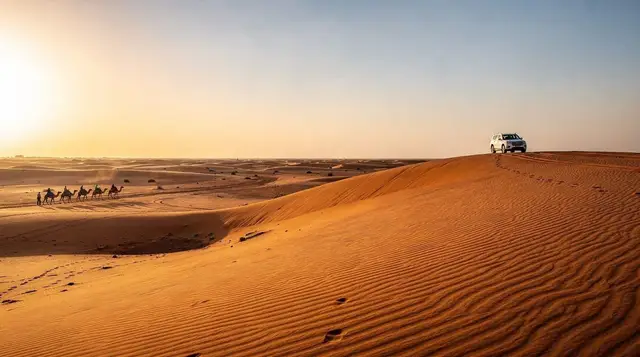
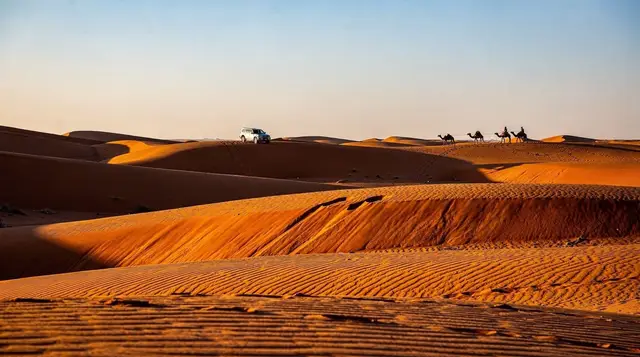
Overnight desert camp in Dubai: what to expect
Overnight Dubai desert safari with BBQ dinner
Duration: 17 hours
What does an overnight desert camp in Dubai include?
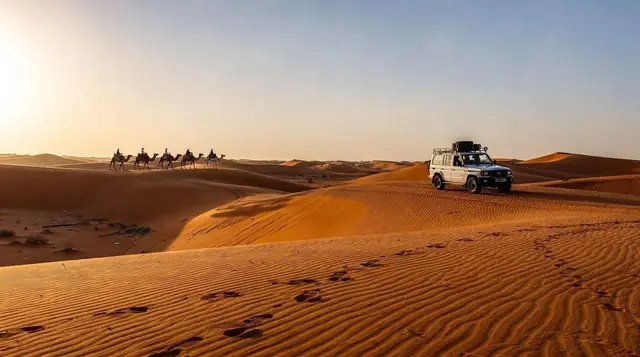
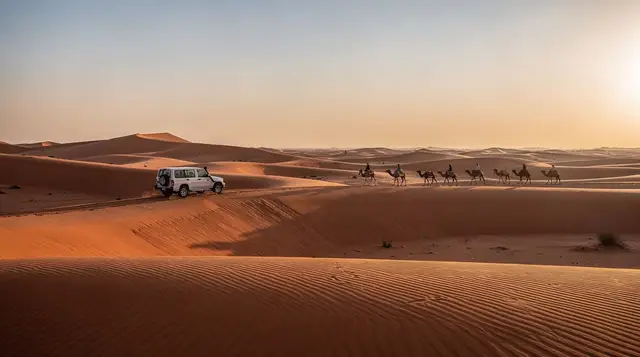
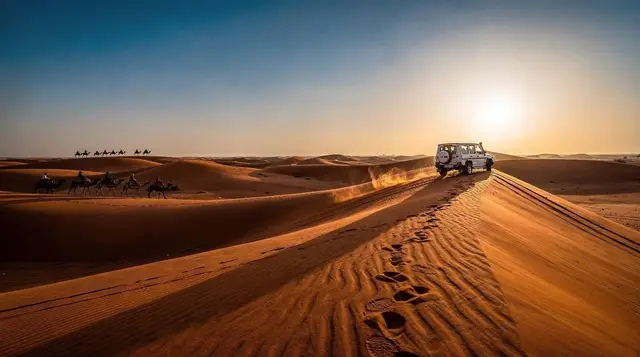
The standard evening desert safari — dune bashing, camel and sandboarding stop, BBQ dinner and entertainment — extended with a night in the desert, either shared Bedouin-style tents or, on pricier packages, private cabins, plus stargazing away from city light pollution and breakfast before the return drive the next morning.
What an overnight desert camp actually is
It’s the least-booked of the standard Dubai desert safari formats, largely because it demands more time and a higher budget than the shorter alternatives — but for travelers who prioritize genuine stargazing and a quieter, less rushed camp atmosphere over convenience, it’s also the format that delivers something the shorter trips simply can’t. An overnight desert safari takes the standard evening format — dune bashing, camel and sandboarding stop, BBQ dinner, entertainment — and extends it into a full night in the desert, finishing with stargazing after the crowds and day-trip guests have gone home, and a return drive to Dubai the following morning after breakfast.
It’s a meaningfully different experience from the standard half-day safari, not just a longer version of it: the desert at 11pm, with most vehicles gone and the camp quiet, feels genuinely different from the same site at 7pm during peak dinner service.
This overnight desert safari with BBQ dinner is a standard, well-reviewed version of the format and a reasonable starting point if you’re considering an overnight trip for the first time.
| Where | Desert camps roughly 45–90 min from Dubai |
| Cost | Around AED 250–450/person (more for private cabins) |
| Time needed | ~20 hours, afternoon pickup to mid-morning return |
| Getting there | Included pickup/drop-off from most Dubai hotels |
| Best time | November–March for comfortable nights |
A typical overnight schedule
Pickup happens in the afternoon, following the same dune-bashing and photo-stop sequence as a standard evening safari. Dinner and entertainment run in the early evening as usual, but rather than departing afterward, day-trip guests are driven back to their hotels while overnight guests remain at camp. The night settles into a quieter phase: sitting around a fire pit, tea, and — on clear nights — genuinely good stargazing, sometimes with a guide pointing out visible constellations and planets.
Guests retire to tents or cabins for the night, with a wake-up call before sunrise on some packages for those who want to catch it, followed by a simple breakfast (flatbread, eggs, dates, tea and coffee) before the drive back to Dubai, typically arriving by mid-morning.
Sleeping arrangements: tents vs private cabins
Standard overnight packages use shared, fixed Bedouin-style tents furnished with mattresses, bedding, and sometimes basic lighting — a step up from backpacking-style camping but still without private bathrooms or air conditioning in the tent itself (shared washroom facilities are provided at the camp). This overnight desert safari with a stay in a private cabin is the upgrade path for travelers who want their own enclosed space rather than a shared sleeping tent — a meaningful difference for couples or families who’d rather not share sleeping quarters with strangers on a mixed-group tour.
Private cabins typically include better bedding and sometimes a small fan or basic cooling, though genuine full air conditioning is rare outside the most premium desert resort packages, which are a different (and considerably pricier) category from a standard overnight safari.
Stargazing and why it’s worth the extra time
This is the feature that a standard evening safari simply can’t offer, since those trips finish and depart before true night sets in. Away from Dubai’s skyline glow, the desert sky at 10pm-midnight shows dramatically more stars than anywhere in the city — the Milky Way is visible on clear, moonless nights, and planets and major constellations are identifiable without any equipment. This overnight safari with dinner, stargazing, and an Al Khayma camp stay builds the stargazing segment explicitly into the schedule rather than treating it as an incidental extra.
Timing matters: a trip planned around a new moon (check the lunar calendar before booking specific dates) gives noticeably darker skies than one that coincides with a full moon.
Food and facilities
Dinner follows the same BBQ buffet format as a standard evening safari — grilled meats, rice, mezze, and dessert — with breakfast the next morning typically simpler: flatbread, eggs, cereal, fruit, and hot drinks. Washroom facilities are shared and basic rather than hotel-standard; don’t expect hot showers at most camps, though some premium packages do offer them. This heritage overnight safari with breakfast and a Bedouin host leans into the cultural-heritage angle more explicitly, with a host explaining Bedouin desert traditions as part of the overnight stay rather than just facilities and food.
Who it’s for, and who it isn’t
Overnight desert camps suit travelers who genuinely want the stargazing and slower pace, who don’t mind basic camping-adjacent facilities for one night, and who have enough time in their itinerary to give up a hotel night without disrupting the rest of the trip. They’re a poor fit for anyone with a tight schedule, a preference for hotel-standard comfort every night, or young children not used to camping-style sleeping arrangements — the desert safari with kids guide has more specific age guidance, and for most families, a standard evening safari followed by a comfortable hotel night is the better fit.
Solo travelers and couples looking for a genuinely different Dubai experience beyond the skyline tend to get the most out of an overnight stay.
Cost versus a standard evening safari
The gap between a standard evening safari (AED 150-250 / 41-68 USD per person) and an overnight camp (AED 250-450 / 68-123 USD per person, more for private cabins) reflects the extra facilities, staffing overnight, and breakfast — not a fundamentally different core experience. It’s also worth factoring in the hotel night you’re not using: if your Dubai hotel is already paid for on a non-refundable rate, an overnight desert trip effectively means paying for lodging twice on that date. See the private vs shared desert safari guide for how private cabin overnight packages compare cost-wise to a private single-night evening safari.
Overnight vs standard evening safari, side by side
| Standard evening safari | Overnight desert camp | |
|---|---|---|
| Duration | ~6 hours | ~20 hours |
| Cost | AED 150–250/person | AED 250–450/person (more for cabins) |
| Stargazing | Limited, before departure | Full, after day guests leave |
| Sleeping | None | Shared tent or private cabin |
| Best for | Tight schedules, first-timers | Slower pace, dedicated stargazers |
What to pack for an overnight stay
Beyond the standard desert safari packing list — loose clothing, closed shoes, sun protection — an overnight stay needs a warmer layer than a standard evening trip, since desert nights after midnight drop noticeably even in warmer months and significantly in winter (10-15°C, December-February). A basic toiletry kit, a phone charger or power bank (camps often have limited charging access), and any personal medication are worth packing since you won’t have access to your hotel room until the next day.
The full desert safari what to wear guide covers seasonal clothing choices in more detail, and it’s worth pairing an overnight stay with the dune bashing guide if you haven’t done a standard safari before, since the daytime portion of an overnight trip is identical to the standard format.
Night photography at camp
Beyond daytime dune photos, an overnight stay opens up night photography that a standard evening safari’s earlier departure doesn’t allow for. A basic tripod or a phone propped against a rock, combined with night mode or a long-exposure setting, captures the star field far better than a handheld shot in low light. Camp fire pits and tent lighting create warm foreground light that works well against a dark sky background — a genuinely different photo opportunity from the sunset dune shots that dominate standard safari photography. Bring a fully charged battery or a power bank, since camps have limited charging infrastructure and cold overnight temperatures in winter drain phone batteries faster than usual.
How it compares to Abu Dhabi’s desert resorts
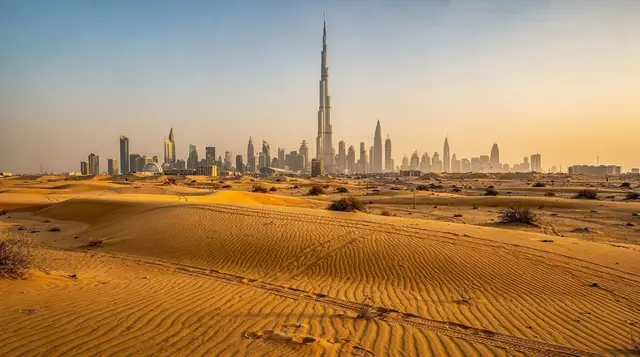
For a more polished, resort-style overnight desert experience, Abu Dhabi’s Liwa desert region, home to the Empty Quarter’s much larger dune sea, hosts dedicated desert lodges with genuine air-conditioned rooms and higher-end facilities than a standard Dubai overnight safari camp — but at a considerably higher price and a longer drive from Dubai (roughly 2.5-3 hours). The Liwa Empty Quarter guide covers that option in more detail.
A standard Dubai overnight desert safari sits in a different, more accessible category: close to the city, straightforward to book as a single-night add-on, and priced well below a dedicated desert resort stay, but with correspondingly simpler facilities.
Cultural context: Bedouin heritage and modern tourism
The Bedouin-camp framing used across almost every overnight (and standard) desert safari draws on a genuine historical tradition — Bedouin communities lived semi-nomadically across the Arabian desert for centuries, and elements of that heritage (majlis-style seating, traditional coffee service, storytelling around a fire) are woven into the modern tourism product. It’s worth holding two things at once: the experience is a commercialized, tourist-facing version rather than an authentic unmediated encounter with Bedouin life today, and it’s also a reasonably respectful nod to real cultural history rather than pure invention.
Operators that bring in an actual host who explains the traditions, rather than treating the heritage framing as pure set dressing, tend to deliver a more substantive version of this — worth checking reviews for mentions of this specifically if the cultural angle matters to you more than the camping novelty.
Alcohol and connectivity at camp
Some overnight camps hold a license to serve alcohol with dinner, typically included or available for an extra charge on premium packages, while others run entirely dry — check a specific listing’s inclusions if this matters to your evening, since it varies more between operators than at a standard evening safari. Mobile signal is usually workable given the camps’ relative proximity to Dubai (45-90 minutes), but don’t expect strong data speeds, and treat the overnight stay as a genuine break from constant connectivity rather than assuming seamless video calls or streaming.
Pairing an overnight stay with other desert activities
For travelers wanting more than dune bashing during the daytime portion, some overnight packages fold in quad biking or a dune buggy session before the evening camp routine begins, and a handful pair a hot air balloon flight at dawn the next morning as a premium add-on before the return drive. Both are worth checking against a specific listing’s inclusions rather than assuming they’re bundled by default, since pricing and availability vary considerably between operators. The adventure sports guide rounds up the fuller range of desert-based activity add-ons beyond the standard format.
Health and comfort considerations for an overnight stay
A few practical health notes worth knowing before committing to a full night away from your hotel: shared tent facilities mean less privacy and climate control than a hotel room, which matters if you’re a light sleeper or sensitive to temperature swings. Insects are a minor but real presence around camp lighting and food areas after dark, particularly in warmer shoulder-season months (April, May, October) — a light insect repellent is a sensible addition to your packing beyond what a standard evening safari would need. If you have mobility limitations, ask specifically about terrain between the parking area, camp, and sleeping tents, since the ground is soft sand rather than a paved path throughout.
Booking and timing considerations
Overnight camps have less availability than standard evening safaris since they require dedicated overnight staffing and a fixed number of tents or cabins — book several days ahead, and further in advance during peak season (November-March) when demand for the format is highest thanks to comfortable nighttime temperatures. Confirm the lunar calendar for your travel dates if stargazing is your main motivation, and check the camp’s exact location relative to Dubai’s light pollution, since some operators run their overnight product from sites closer to the city than their standard evening safari location.
Combining an overnight desert stay with a broader trip plan works well through the desert and city itinerary, which shows how to build a full night in the desert into a multi-day Dubai schedule without losing a full day elsewhere.
Combining an overnight stay with the rest of your trip
Because an overnight desert safari consumes an entire calendar day plus part of the next morning, it works best scheduled mid-trip rather than on your arrival or departure day, when jet lag or a tight flight connection adds unnecessary risk if the return drive runs late. A reasonable pattern for a five-to-seven day Dubai trip is city sightseeing (Burj Khalifa, Dubai Mall, Old Dubai) for the first two or three days, the overnight desert stay in the middle, and a final day or two back in the city or on a day trip to Abu Dhabi or Hatta before departure.
The 7-day itinerary and the desert and city itinerary both show fuller versions of this sequencing.
Photography beyond the star field
Beyond the night-sky shots covered earlier, an overnight stay’s early wake-up call on some packages sets up sunrise dune photography that a standard evening safari never offers, since those trips finish the night before. The soft, low-angle morning light across the dunes, with far fewer footprints disturbing the sand than after a full day of vehicle and camel traffic, produces noticeably cleaner compositions than the same dunes at sunset. The photography tours guide covers timing and settings for both the sunrise and night-sky opportunities an overnight stay specifically opens up.
Is one night enough?
For almost everyone, yes — a single overnight stay delivers the stargazing and slower-camp experience that’s the main reason to choose this format over a standard evening safari, and a second night in the same desert camp adds cost without adding much beyond repeating the prior evening’s activities. Travelers wanting a longer desert immersion are usually better served by combining a Dubai overnight safari with a separate visit to a different desert landscape later in their UAE trip — Liwa in Abu Dhabi, for instance — rather than extending the same Dubai camp stay to two or three nights.
What guests tend to underestimate
The most common surprise for first-time overnight guests isn’t the sleeping arrangements or the food — it’s simply how long the day runs. Pickup in the mid-afternoon followed by a full night at camp and a return drive the next morning means an overnight desert safari occupies close to 20 hours of your trip, more than double the time commitment of a standard evening safari. Guests who treat it as a quick add-on rather than planning around it as effectively a full extra day sometimes end up rushing the following day’s plans.
Building in a lighter, low-commitment day immediately after an overnight stay — rather than another packed sightseeing day — makes for a smoother overall trip, since the shared-tent sleeping arrangement, however comfortable, rarely delivers as restful a night as a hotel bed.
Weather and seasonal timing for an overnight stay
Winter (December-February) is the most popular season for overnight desert stays, precisely because the cooler air makes sitting around a fire pit and sleeping in a tent genuinely pleasant rather than a heat-management exercise. Summer overnight stays are possible but far less common, since even after dark the desert can hold onto daytime heat longer than the city does thanks to the exposed, unshaded terrain — pack accordingly if you’re booking outside the peak season window, and expect a much warmer night than the winter figures quoted elsewhere in this guide.
Shoulder months (April, May, October) sit in between, comfortable enough for most travelers without needing the heaviest winter layers, but still worth packing a jacket for regardless, since a clear desert sky loses heat quickly once the sun is fully down.
Frequently asked questions about overnight desert camps
How much does an overnight desert safari cost in Dubai?
Expect AED 250-450 (68-123 USD) per person for a shared overnight camp, roughly AED 100-250 (27-68 USD) more than a standard evening safari. Private cabin packages run AED 500-800 (136-218 USD) per person.
Is an overnight desert safari worth it?
If genuine stargazing and a slower, less rushed camp experience appeal to you, yes. If you’re mainly after the dune-bashing thrill and dinner, a standard evening safari delivers that for less.
What are the sleeping arrangements like?
Most packages use shared, fixed Bedouin-style tents with mattresses and bedding provided. Higher-priced packages offer private cabins for couples or families.
Is it cold at night in the desert?
In winter (December-February), yes — temperatures can drop to 10-15°C after midnight. Bring a warm layer regardless of season, since desert nights cool faster than the city.
Can I see stars clearly from a Dubai desert camp?
Much better than anywhere in the city, though not perfectly dark-sky given Dubai’s proximity. A clear, moonless night gives noticeably better stargazing than one near a full moon.
Is an overnight safari suitable for young children?
It depends on the child — basic camp facilities and no air conditioning in shared tents suit families comfortable with simple camping better than very young children used to a fixed bedtime routine.
Do I need to bring my own sleeping bag or bedding?
No — standard overnight packages provide mattresses and bedding in the tents or cabins. Bring only a warm outer layer and personal items.
How early should I book an overnight desert safari?
Several days ahead, and further in advance during peak season (November-March), since overnight camps have fewer available tents or cabins than standard evening safaris have vehicle seats.
Is alcohol served at overnight desert camps?
Some licensed camps serve it with dinner, included or as an extra charge on premium packages; others run entirely dry. Check the specific listing’s inclusions if this matters.
Will I have phone signal overnight in the desert?
Usually workable given most camps sit 45-90 minutes from Dubai, though data speeds are slower than in the city — treat it as a break from constant connectivity rather than expecting seamless streaming.
Top experiences
Bookable activities with verified prices and instant confirmation on GetYourGuide.