Self-drive dune buggy Dubai: the complete guide
Dubai: self-drive 4WD dune buggy guided desert adventure
Duration: 1-2 hours
What does self-drive dune buggying in Dubai actually involve?
You drive your own off-road buggy (typically a Polaris RZR or similar), single or two-seater, in a guided convoy through the red dunes, following an instructor's lead vehicle over a fixed route lasting 1-3 hours. A valid driver's license is required, along with a minimum age typically around 18 to drive. Prices run roughly US$50-150 depending on buggy type, session length, and whether BBQ or camel add-ons are included.
What self-drive dune buggying actually is
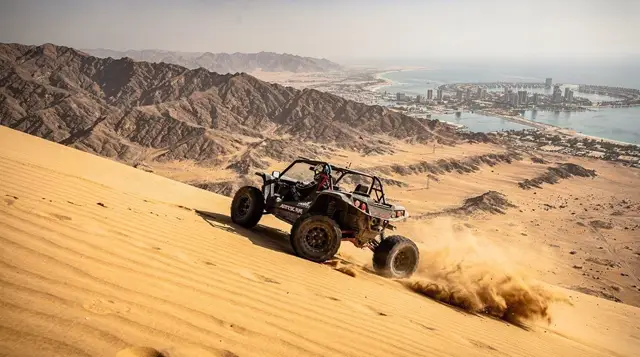
Self-drive dune buggying puts you behind the wheel of an off-road buggy — typically a Polaris RZR or similar side-by-side vehicle with a roll cage, bucket seats, and a steering wheel and pedal layout closer to a car than a motorcycle — for a guided drive through Dubai’s red dune terrain. Unlike the standard desert safari, where a professional driver handles the dune bashing while you ride as a passenger, dune buggying puts the controls directly in your hands, following an instructor’s lead vehicle through a fixed route at a pace the guide sets and adjusts for group experience.
| Where | Red dune desert, around 45-60 minutes from central Dubai |
| Cost | around US$50-150 per session |
| Time needed | 1-3 hours depending on package |
| Requires | Valid driver’s license, minimum age around 18 |
| Best time | Early morning or evening (summer), any time Nov-Mar |
This self-drive 4WD dune buggy guided desert adventure is a standard shorter-format introduction to the activity, running 1-2 hours and requiring nothing beyond a valid driver’s license and the willingness to follow the guide’s lead through genuinely challenging dune terrain.
Dune buggy vs quad bike vs standard dune bashing
These three related desert activities get confused with each other more than almost any other category in Dubai’s adventure lineup, so it’s worth being precise. A dune buggy is a four-wheeled, roll-caged vehicle you sit inside, strapped in with a proper harness, steering with a wheel and controlling speed with foot pedals — the most car-like and, for most first-timers, the most immediately comfortable of the three formats. A quad bike is a straddled, motorcycle-style four-wheeler controlled with handlebars, simpler mechanically but exposing the rider more directly to dust, heat, and terrain impact.
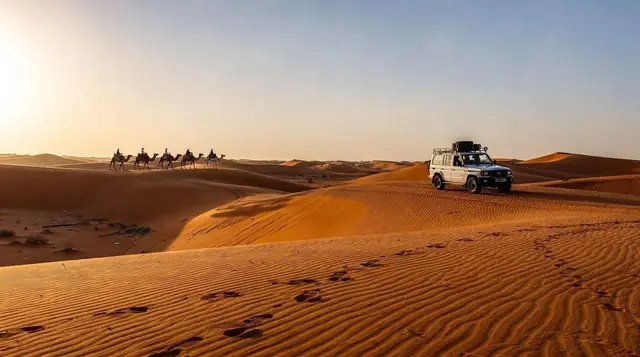
Standard dune bashing, the format built into every desert safari, puts you as a passenger in a full-size 4x4 Land Cruiser driven by a professional, with no personal vehicle control at all.
The honest recommendation: buggying suits travelers who specifically want active control and don’t mind a slightly more involved license and briefing process; quad biking suits those wanting a simpler, lower-cost thrill without needing to manage a full vehicle’s controls; and standard dune bashing suits anyone who’d rather sit back, including families with young children or travelers uncomfortable with the idea of driving unfamiliar terrain themselves. See the dune bashing guide for the passenger-seat version in full detail.
License and age requirements
A valid driver’s license — your home country’s license, in most cases, or an international driving permit depending on the specific operator’s policy — is required to drive a buggy, along with a minimum age typically around 18, matching standard driving-age requirements. This is checked at check-in rather than treated as an assumption, so bring your physical license rather than relying on a photo or digital copy, since policies on acceptable documentation vary between operators. Younger travelers or those without a valid license can usually still participate as a passenger in a two-seater buggy driven by a licensed adult, a reasonable way to include a broader family or group without excluding non-drivers entirely.
Single vs double buggies
This 3-hour self-drive dune buggy safari with pickup is available in both single and double-seat buggy configurations, a decision worth making based on your group and comfort level rather than defaulting to whichever is cheaper. Single buggies give one person full, independent control and are the more common choice for confident solo drivers or couples who each want their own vehicle. Double buggies let a licensed driver bring a passenger — useful for couples where only one person wants to drive, or for including a family member who doesn’t hold a valid license or driving confidence for the terrain.
This self-drive adventure with the 1000cc Ranger dune buggy and BBQ uses a larger, more powerful buggy model, generally suited to drivers who’ve done a standard buggy session before and want more performance, or larger groups wanting a bigger vehicle for a family or friend group rather than splitting into multiple smaller buggies.
What a session actually involves
Sessions begin with a safety briefing covering the buggy’s controls, the convoy format, hand signals or radio communication with the lead guide, and basic off-road driving technique for sand — notably different from paved-road driving in how the vehicle responds to soft sand, inclines, and sudden dips. A short practice stretch typically follows before the group joins the main route, giving less experienced drivers a chance to build basic comfort with the vehicle before tackling steeper dune sections.
This guided dune buggy driving experience in the desert structures the session specifically around this progressive format, easing newer drivers in rather than dropping everyone straight into the most challenging terrain.
The main convoy drive covers a mix of flatter stretches and steeper dune climbs and descents, with the guide setting pace and route to match the group’s collective comfort level — a genuinely more physical, hands-on experience than being a passenger in a standard safari vehicle, since you’re actively managing throttle, braking, and steering through shifting sand the entire time.
Safety gear and what’s provided
Operators supply a helmet, and often goggles and a dust mask or buff given how much sand kicks up during a multi-buggy convoy drive, along with a harness system in the buggy itself beyond the standard seatbelt. Closed-toe shoes are required, and loose clothing that could catch on the roll cage or pedals should be avoided in favor of fitted, practical gear. Communication with the lead guide, whether via radio, hand signals, or a simple follow-the-leader visual system, is covered in the pre-drive briefing, and stopping or slowing if you feel unwell or lose confidence with the vehicle at any point is standard practice guides expect and accommodate.
Pricing and what to expect to pay
Dune buggy sessions run roughly US$50-150, with the range driven mainly by session length (1-hour introductory sessions at the low end, 3-hour extended safaris at the higher end), whether you book a single or double buggy, and whether BBQ dinner, camel riding, or sandboarding are bundled in as add-ons rather than treated as a separate booking. Evening sessions combined with a desert camp dinner tend to price toward the higher end of the range given the added catering and entertainment, similar to how a standard desert safari’s evening format costs more than its shorter morning equivalent.
Who should skip dune buggying
Pregnant travelers and anyone with a herniated disc, recent back or neck surgery, or a significant heart condition should skip dune buggying, similar to the standard dune-bashing restrictions covered in the desert safari guide — the jarring, physical nature of driving over dune terrain applies the same forces to a buggy driver as to a dune-bashing passenger, arguably more so given the active driving involvement. Travelers uncomfortable with the idea of operating an unfamiliar vehicle on genuinely challenging terrain, even under guided supervision, are better served by a standard passenger-seat desert safari instead, where a professional driver handles every technical decision.
Weather and seasonal timing
Summer heat (June-September, with midday temperatures reaching 45-48°C) makes daytime dune buggying genuinely demanding and most operators shift sessions to early morning or evening specifically to avoid the worst of it — a midday summer buggy session that isn’t scheduled around this heat pattern is worth double-checking before booking. November through March brings the most comfortable conditions for extended time in an open-sided buggy exposed to sun and wind, and is correspondingly the busiest booking period, so reserving a day or two ahead is a reasonable precaution during peak season.
How it compares to Hatta’s outdoor activities
Travelers weighing dune buggying against Hatta’s mountain biking and kayaking as an active, hands-on outdoor option should note the two deliver genuinely different terrain and driving or physical demands. Dune buggying is entirely desert-based and vehicle-driven; Hatta trades the desert for mountain trail biking and calm-water kayaking, activities requiring different physical skills and appealing to a somewhat different traveler profile. Both share the same broad appeal of active participation over passive sightseeing, making either a reasonable pick depending on whether desert or mountain terrain appeals more for your specific trip.
Booking tips and getting there
Most dune buggy operators depart from meeting points on the edge of the city or offer hotel pickup as part of the package, with the actual dune driving happening in the same broad desert areas used for standard safaris, roughly 45-60 minutes from central Dubai. Book at least a day ahead in peak season, and confirm whether your specific package includes hotel transfer or requires you to reach a separate meeting point, since this varies between listings and materially affects your morning or evening logistics. See the Dubai adventure sports overview for how dune buggying fits alongside the UAE’s other adrenaline activities if you’re planning more than one during your trip.
Evening buggy sessions with BBQ and camel add-ons
Beyond the standard daytime format, several operators run evening dune buggy sessions timed around sunset, combining the drive itself with a desert camp stop for BBQ dinner and, on some packages, a camel ride or sandboarding — effectively a self-drive alternative to the standard evening desert safari’s passenger-seat format. These evening sessions tend to price toward the higher end of the buggy range given the added catering, entertainment, and generally longer overall session length, but they solve a real scheduling problem for travelers who want the desert camp experience without giving up active vehicle control for the drive itself.
Sunset timing also brings the same photography benefit as a standard safari — the 20-30 minutes before sunset produce the best dune lighting of the day, and driving through it yourself rather than watching from a passenger seat is part of the specific appeal these evening packages are built around.
What happens if you get stuck
Getting a buggy briefly stuck in soft sand is a normal, expected part of the activity rather than a sign of driver error or a dangerous situation — dune terrain shifts constantly, and even experienced guides occasionally need to adjust a stuck vehicle’s approach. Guides carry recovery equipment and know the standard techniques for freeing a buggy from soft sand, typically involving a brief reverse-and-redirect maneuver or, in more stubborn cases, a tow strap connected to the lead vehicle or another buggy in the convoy.
This is worth knowing upfront specifically so first-time drivers don’t panic or feel embarrassed if it happens — it’s routine enough that guides address it directly in the pre-drive briefing rather than treating it as an unusual complication.
Group bookings and celebrations
Dune buggying has become a popular choice for bachelor and bachelorette parties, corporate team outings, and larger friend groups, given the format’s active, genuinely fun group dynamic compared to riding together passively in a shared safari vehicle. Multi-buggy convoys accommodate groups naturally, with each buggy carrying one or two people and the whole group moving together under the same guide, making it easy to keep a larger party together through the full session.
Operators running the evening BBQ format are generally well set up for group celebrations specifically, often able to add a cake, decorations, or a private camp area for an additional fee if requested in advance — worth asking about directly rather than assuming it’s automatically included in the standard package.
A brief history of dune buggying as a UAE tourism product
Dune buggying developed in the UAE as an extension of the country’s long-established desert safari industry, adapting off-road vehicles originally used for recreational and sport driving into a guided tourism format once demand grew for a more active alternative to passenger-seat dune bashing. It’s followed a broader regional pattern also seen in quad biking and, more recently, self-drive sandboarding and dune buggy racing experiences — a steady diversification of desert tourism products beyond the original standard safari format that dominated the market through the 2000s and early 2010s.
Understanding this context helps explain why so many similarly named buggy products exist side by side today, each a slight variation on the same core self-drive desert format rather than fundamentally different activities.
Photography during a buggy session
Capturing photos while actively driving isn’t realistic or safe, so most buggy photography happens during scheduled stops along the route — a photo point partway through the drive, or the sunset break on evening sessions — rather than continuously throughout. Bring a phone or camera in a secure pocket or a small dashboard mount if the buggy has one, and expect a genuinely dusty lens by the end of the session given how much sand a multi-buggy convoy kicks up; a microfiber cloth is worth having on hand.
Some operators offer a photographer stationed at a scenic point along the route who captures action shots of each buggy passing by, available afterward as a paid add-on — a reasonable way to get genuine action photography without risking your own device mid-drive.
Comparing session lengths and what changes as you go longer
Session length affects the experience more than most first-time bookers expect. A 1-hour introductory session covers the safety briefing, a practice stretch, and a shortened version of the main route — enough to get a genuine feel for the activity but not much time on the more dramatic dune sections. A 2-hour session gives noticeably more time on the varied terrain that makes buggying memorable, generally the sweet spot for a first-timer with no time pressure. The full 3-hour extended safari, especially the evening BBQ format, adds a proper camp stop and typically reaches further into the dune sea than the shorter formats, but demands more physical stamina across a longer, hotter (or, in the evening, longer and more tiring) drive. Matching session length to your group’s fitness and attention span matters more here than for a standard passenger-seat safari, since every minute in the buggy is active driving rather than passive riding.
Buggy, quad bike, or standard dune bashing: quick comparison
| Dune buggy | Quad bike | Standard dune bashing | |
|---|---|---|---|
| Control | You drive, wheel + pedals | You drive, handlebars | Professional driver, you’re a passenger |
| License needed | Yes | Sometimes, varies | No |
| Min. age to drive | Around 18 | Around 16-18, varies | Not applicable |
| Physical exposure | Roll cage, harness | More exposed to dust/heat | Fully enclosed vehicle |
| Best for | Confident drivers wanting control | Simpler, lower-cost thrill | Families, non-drivers, passive riders |
Fuel, maintenance, and what happens if the buggy breaks down
Fuel and routine maintenance are the operator’s responsibility, not yours — buggies are checked and refuelled between sessions, and you are never expected to handle mechanical upkeep beyond basic operation. If a buggy develops a genuine mechanical fault mid-session, which is uncommon but not unheard of on a multi-buggy convoy, the standard response is for the guide to either swap you into another vehicle from the group or arrange a replacement from base, rather than ending your session early without resolution. This is worth asking about at booking if a full, uninterrupted session matters to you, since response times can vary between more and less established operators.
Frequently asked questions about dune buggying in Dubai
Do I need a special license to drive a dune buggy in Dubai?
A valid driver’s license is required — your home license or an international driving permit, depending on the operator. No specialized off-road license is needed.
What’s the difference between a dune buggy and a quad bike?
A buggy is a roll-caged, four-wheeled vehicle steered with a wheel, closer to a small car. A quad bike is a straddled, handlebar-steered four-wheeler with more direct terrain exposure.
How much does dune buggying cost in Dubai?
Roughly US$50-150 depending on session length, single vs double buggy, and whether BBQ or camel add-ons are included.
Is dune buggying safe?
With a licensed operator and guided convoy format, yes, though it carries genuine off-road driving risk. Pregnant travelers or those with back or neck conditions should skip it.
Can I drive a dune buggy if I’ve never driven off-road before?
Yes — sessions include a briefing and practice stretch before the main route, with guides adjusting pace for less experienced drivers.
Is dune buggying better than a standard desert safari’s dune bashing?
They’re different rather than one being better — buggying gives you active control, standard dune bashing lets a professional driver handle everything as you ride along.
What’s the minimum age to drive a dune buggy in Dubai?
Typically 18, matching standard driving license age requirements, though this varies by operator. Younger passengers can usually ride along in a two-seater with a licensed adult driving.
What happens if my buggy gets stuck in the sand?
It’s a normal, routine part of the activity rather than a sign of a problem — guides carry recovery equipment and know standard techniques for freeing a buggy from soft sand, usually resolved within a few minutes.
Can I book a dune buggy session for a group celebration?
Yes — multi-buggy convoys suit bachelor and bachelorette parties, birthdays, and corporate outings well, and some operators can add a cake, decorations, or a private camp area for group bookings with advance notice.
Do I need my own driving gloves or goggles?
No — operators typically provide a helmet and goggles as part of the standard package, though bringing your own driving gloves is a reasonable personal preference if you have a pair, since grip comfort over an extended session varies by hand.
What happens if my buggy breaks down mid-session?
Guides typically swap you into another buggy from the convoy or arrange a replacement from base rather than ending your session early — ask about this at booking if an uninterrupted session matters to you.
Should I choose a dune buggy or standard dune bashing?
Choose buggying if you specifically want active driving control; choose standard dune bashing if you’d rather sit back and let a professional handle the technical driving, or if you’re traveling with young children or non-drivers.
Top experiences
Bookable activities with verified prices and instant confirmation on GetYourGuide.