Camel riding in Dubai: what it's really like
Dubai: half-day desert safari, camel ride & quad bike option
Is camel riding in Dubai worth doing, and is it ethical?
A short, guided, walking-pace ride at a desert safari photo stop is a low-intensity add-on rather than a highlight in itself — genuinely worth doing once for the novelty, but entirely optional. Animal welfare quality varies by operator: better ones limit riding rotations and provide shade and rest, while the cheapest, highest-volume stops show more wear on their camels. It's worth a moment's thought rather than an automatic booking.
Camel riding in the desert safari context
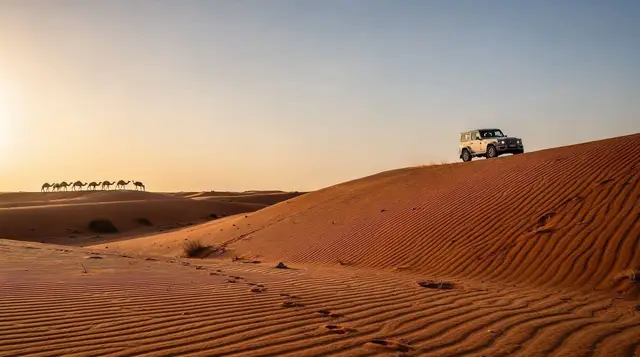
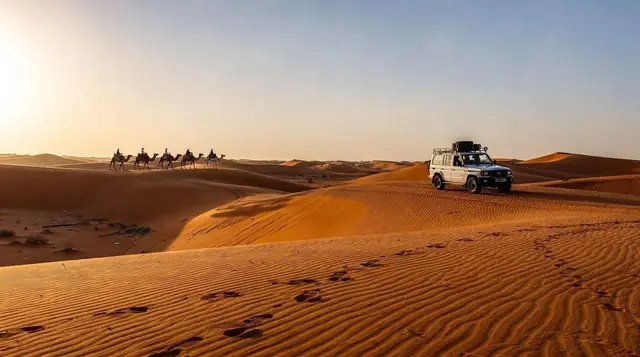
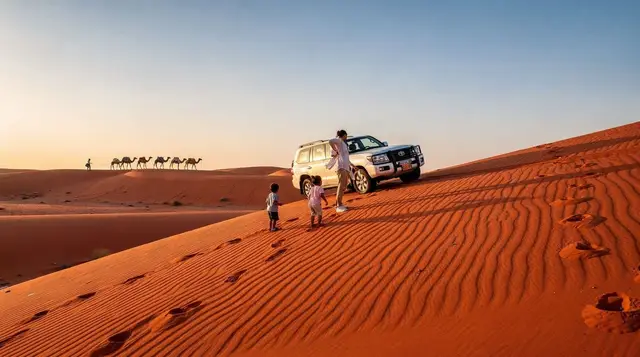
Camel riding is bundled into almost every Dubai desert safari as part of the photo stop between dune bashing and the camp dinner — a fenced area with a handful of camels available for a short, guided ride at walking pace, usually alongside sandboarding on a nearby dune. It’s a brief, optional element rather than a standalone activity for most visitors, and it’s worth understanding what you’re actually getting (and what you’re not) before treating it as a must-do highlight.
| Where | Desert safari photo stop, usually 45-60 min from the city |
| Cost | Usually bundled in the base safari price |
| Duration | A few minutes, walking pace |
| Included | Mounting, a short guided loop, dismounting |
| Alternative | Observe, photograph, or pet without riding |
What the experience is actually like
A camel is seated (kneeling) for you to mount, then a handler leads it on a short loop, typically a few minutes long, at a slow walking pace — this isn’t a trek or an independent ride, and you won’t be given control of the animal. It’s a small part of the wider sequence described in the dune bashing guide and the standard evening or morning format compared in evening vs morning desert safari. The mounting and dismounting process, with the camel rising and kneeling, is arguably the most memorable physical sensation of the whole thing, since a camel’s gait when standing up is distinctly two-stage and can catch first-timers off guard if they’re not braced for it.
Most operators include this as part of the base safari price, though a small number treat it as a paid add-on — worth checking your specific booking’s inclusions.
Animal welfare: the honest picture
This is worth addressing directly rather than glossing over, in keeping with a genuinely honest look at what a Dubai desert safari involves. Camels used for short tourist photo rides generally have an easier working life than camels bred and trained for racing, since the rides are brief, low-intensity, and spread across a working day rather than sustained exertion. That said, welfare standards vary meaningfully between operators: some limit each camel to a set number of rides per shift with genuine rest and shade breaks between groups, while the highest-volume, cheapest operators run their animals close to continuously during peak evening hours when multiple tour groups arrive back to back.
Visible signs of a well-treated animal include access to shade and water between rides, an unhurried handler who doesn’t rush the mounting process, and camels that aren’t visibly favoring a leg or showing skin sores from harnesses. If something looks off, it’s reasonable to skip the ride and mention the observation in your review afterward — feedback is one of the few levers that pushes operators toward better practices.
How to choose operators that treat camels better
Reviews are, again, the most useful source here, though people mention animal welfare less consistently than crowding or food quality — search recent reviews specifically for mentions of the camels’ condition or the pace of the rotation if this matters to you. The general operator-vetting approach in the best desert safari Dubai guide — checking group size, reading recent review text rather than star ratings alone, and avoiding the very cheapest listings — tends to correlate with better animal care too, since the same corner-cutting that produces an overcrowded camp usually shows up in how animals are managed as well.
This half-day desert safari with a camel ride and quad bike option and this morning adventure with quad biking, sandboarding, and a camel ride are both structured around a smaller-group morning format, which generally means less camel-rotation pressure than the highest-volume evening mass-market tours. Operators explicit about camel care in their listing descriptions, or that mention a dedicated handler rather than a shared rotating staff pool, are a modestly better signal, though this information isn’t consistently disclosed across the industry.
Camel racing and camel markets: broader cultural context
Camel racing remains a genuine, actively practiced part of Emirati culture, distinct from the tourist photo-ride experience — major race tracks exist near Dubai and Abu Dhabi, and races are a real spectator sport with serious breeding and training investment behind them. The sport underwent a significant, well-documented reform in the mid-2000s: the UAE banned the use of child jockeys (historically trafficked boys from South Asia, weighing little enough to minimize the camel’s load) and moved to small robotic jockeys operated remotely by the camel’s owner from a following vehicle — a genuine improvement in a practice that had drawn serious international criticism before the reform.
If you want a deeper, more culturally grounded look at camels beyond the safari photo stop, this desert discovery tour with red dunes, sandboarding, and camels spends more time at the camel stop than a rushed evening safari, and the Al Ain camel market — a genuine working livestock market rather than a tourist attraction — is a meaningfully different experience, covered in the Dubai to Al Ain day trip guide.
Al Ain’s market trades camels for milk, meat, and racing stock, and while it isn’t set up as a visitor attraction in the way a safari camp is, tour groups can walk through respectfully, and it gives a far more grounded sense of the animal’s ongoing working role in the region than a five-minute tourist photo ride does.
Alternatives if you’d rather skip riding
If you’d rather not ride at all, every standard safari lets you observe, photograph, and pet the camels (where handlers permit it) without mounting one — a reasonable middle ground if you’re curious but uneasy about the welfare question or simply not physically comfortable with the mounting process. Sandboarding, the other photo-stop activity typically offered alongside camels, is a good alternative if you want an active element at the same stop without the animal-welfare consideration at all.
What to wear and bring for the camel stop
Comfortable, non-restrictive clothing works better than tight activewear for mounting and dismounting, and closed shoes are worth it given the amount of loose sand around the camel enclosure. A light layer helps if your safari’s photo stop happens closer to sunset, when temperatures begin dropping. The full desert safari what to wear guide covers the rest of the packing list for the broader trip, and the dune bashing guide and dubai desert safari guide cover how the camel stop fits into the full sequence of a standard safari.
Camel riding with kids
Most operators set a minimum age or require an accompanying adult for young children riding camels, generally accepting children from around age four or five with a parent close by, though policies vary — check with your specific operator if traveling with young kids. The desert safari with kids guide covers age guidance across the whole safari, not just the camel segment, including dune bashing and quad biking minimums, which tend to be stricter than the camel-ride minimum.
Falconry: a related, optional add-on
Some desert safari camps include a falconry display alongside the camel stop — a handler presenting a trained falcon, sometimes flying it briefly, as a nod to a genuinely significant piece of Emirati heritage; falconry is recognized by UNESCO as an element of intangible cultural heritage across several countries including the UAE. As with camels, the welfare picture varies: falconry has deep roots as a working hunting practice rather than a tourism invention, and reputable handlers keep birds well cared for since a healthy, well-conditioned falcon is central to the practice itself, not incidental to it.
It’s worth treating a photo-op falconry display the same way as the camel stop — an optional, brief add-on rather than the central reason to book a particular safari, and one where a calm, unstressed bird and an attentive handler are reasonable things to look for if it interests you.
How to research an operator’s animal welfare before you book
Beyond reading reviews for specific mentions, a few other checks help. Operators affiliated with, or that mention compliance with, UAE animal welfare regulations (the country has tightened rules around working animals in tourism over the past decade) are a modestly better signal than those with no such reference. Photos in a listing that show camels resting in shaded areas between rides, rather than exclusively action shots of tourists riding, suggest at least some attention to the animals’ downtime. It’s also reasonable to simply ask the tour guide or handler on the day how many rides a given camel does per shift — a confident, specific answer is a better sign than vagueness or irritation at the question.
Sandboarding as the natural alternative activity
At almost every safari photo stop, sandboarding sits alongside the camels as the other hands-on activity — sliding down a dune face on a board, similar in concept to snowboarding but slower given the sand’s higher friction compared to snow. It’s a reasonable way to fill the same slot in your safari itinerary if you’d rather not ride a camel at all: physically engaging, free of any animal-welfare consideration, and genuinely fun for most ages, though it does mean a short uphill walk back through soft sand after each run, which can be tiring in desert heat if attempted repeatedly.
Where the camels come from and how they’re used year-round
The camels used at desert safari camps aren’t wild animals brought in for tourism — they’re domesticated dromedaries, the single-humped species native to the Arabian Peninsula, and many belong to Emirati families who have kept camels for generations, sometimes leasing them to tour operators as a secondary income stream alongside racing or breeding. This matters for understanding the welfare picture: an animal that’s part of a family’s working herd, moved between racing, breeding, and tourism duties across the year, is generally in a different situation than one used exclusively and continuously for tourist rides.
It’s also part of why camel quality and temperament can vary noticeably between safari operators — some source from established herds with experienced handlers, others contract more loosely with whoever has camels available on a given night.
Photographing camels respectfully
If you want a good photo with a camel, a few small habits make it a better interaction for the animal too: approach calmly rather than rushing up for a selfie, ask the handler before feeding anything (most camps don’t permit visitor feeding for exactly this reason), and avoid pulling on reins or attempting to direct the animal yourself, which is the handler’s role. Camels are generally calm, patient animals around tourists when handled well, and a settled, unhurried interaction tends to produce better photos anyway than a rushed, crowded one.
The bigger picture: one small part of a longer evening
It’s worth keeping some perspective on how much weight to put on the camel-riding decision specifically. Within a 5-6 hour desert safari, the camel stop occupies perhaps 10-15 minutes — a small fraction of an evening built primarily around dune bashing, the drive itself, and the camp dinner and entertainment. Treating it as one of several optional elements you can pick and choose from, rather than either an unmissable highlight or something to avoid entirely, is the most realistic way to approach it. The dubai desert safari guide puts the camel stop back into that fuller context if you’re planning your first trip and want to understand how all the pieces fit together.
Comparing Dubai’s camel tourism to global animal-tourism concerns
Camel riding in Dubai sits in a milder category of animal tourism compared to some of the more heavily criticized global examples — elephant riding camps in parts of Southeast Asia, for instance, have drawn far more scrutiny for the harsh training methods historically used and the sheer physical load placed on the animals during multi-hour treks.
A brief, walking-pace tourist camel ride is a lower-intensity activity by comparison, but “lower intensity than the worst examples elsewhere” isn’t the same as “no welfare consideration at all,” which is why it’s worth the same basic diligence — checking reviews, observing the animals on the day, and being willing to skip the ride if something looks wrong — that a thoughtful traveler would apply to any animal encounter built into a tourism product, anywhere in the world.
If you’re traveling with a group that has mixed preferences
It’s common for a mixed group — some members enthusiastic about riding, others uneasy about it — to split at the camel stop rather than needing consensus. Riders queue for their short loop while others photograph, try sandboarding, or simply wait nearby; the stop is set up for exactly this kind of mixed participation, and staff don’t expect or push for full group uptake. This is one of the easier moments in a desert safari to accommodate different comfort levels within a group without anyone feeling like they’re holding others back or being pressured into something they’d rather skip.
A brief note on cost
Camel riding is bundled into the base price of nearly every standard desert safari rather than sold as a separate paid ticket, so there’s rarely a direct cost decision to make beyond choosing which overall safari package to book in the first place. Where operators do charge separately — occasionally for a longer ride or a more elaborate costumed photo setup — it’s typically a modest add-on in the AED 20-50 (5-14 USD) range, worth confirming at the stop itself before agreeing rather than assuming it’s included.
How this decision fits into planning your whole safari
If animal welfare genuinely matters to your travel choices, it’s worth applying the same scrutiny to the camel stop that you’d apply to any other part of the safari booking — checking reviews, comparing operators, and reading the best desert safari Dubai guide before settling on a listing rather than booking whichever comes up first in a search. That said, it’s worth keeping proportion: the camel stop is a small fraction of a multi-hour evening built around dune bashing, dinner, and entertainment, and treating it as one factor among several in choosing an operator — rather than the single deciding factor — reflects how most travelers realistically approach the decision.
For visitors who’d rather sidestep the question entirely, booking a morning desert safari format tends to mean smaller groups and less camel-rotation pressure than the highest-volume evening mass-market tours, since morning slots draw fewer bookings overall. A private safari, which spaces out camp visits from other groups entirely, is another route worth considering if crowding at the camel enclosure specifically is the concern rather than the ride itself.
Ride vs skip: a quick comparison
Neither choice is “correct” — it comes down to comfort with the welfare question and what you personally want from the photo stop.
| Riding | Skipping | |
|---|---|---|
| Time cost | A few minutes | None extra |
| Money cost | Usually included in base price | None |
| Welfare consideration | Direct, worth vetting the operator | Avoided entirely |
| Alternative activity | — | Sandboarding, photography, petting |
Choosing to skip doesn’t disrupt a group — most safaris are set up for mixed participation, with some riding while others photograph or try sandboarding at the same stop.
What better desert safari operators are doing differently
A small but growing number of Dubai desert safari operators have begun explicitly marketing improved camel welfare practices — capped ride rotations per shift, dedicated shade structures at the enclosure, and a named handler rather than a rotating shared pool. This isn’t yet universal or independently verified across the industry, so it’s worth treating as a positive signal to look for in a listing rather than an assumed standard. The broader vetting approach in the best desert safari Dubai guide — smaller group sizes, specific review text over star ratings, avoiding the cheapest listings — correlates reasonably well with these improved welfare practices too, since operators cutting corners on group size and crowding tend to cut corners on animal care in the same package.
Frequently asked questions about camel riding in Dubai
Do I have to ride a camel on a desert safari?
No — it’s optional at every standard safari, and staff don’t pressure guests who’d rather skip it.
Is camel riding cruel in Dubai?
It depends on the operator. Tourist photo rides are generally shorter and less demanding than camel racing, but welfare standards vary — some operators rotate and rest their animals properly, others don’t.
How long is a typical camel ride?
Just a few minutes — a short, guided loop at walking pace, framed as a photo opportunity rather than a sustained activity.
Are camel races still practiced in the UAE?
Yes, and the sport moved to robotic jockeys operated remotely after the UAE banned child jockeys in the mid-2000s, a genuine reform of a previously exploitative practice.
Can I visit a camel market or farm instead of a safari photo-stop ride?
Yes — Al Ain, roughly two hours from Dubai, has a working camel market that’s a more culturally grounded experience than a tourist photo stop.
What should I wear for the camel stop?
Comfortable, non-restrictive clothing and closed shoes, plus a light layer if the stop happens near sunset.
Can I just watch without riding?
Yes — every standard safari lets you observe and photograph the camels without mounting one, and handlers usually allow petting where safe.
Is there a minimum age for camel riding?
Most operators accept children from around age four or five with a parent nearby, though policies vary by operator — check when booking if traveling with young children.
How can I tell if a specific operator treats its camels well?
Look for shade and water access between rides, an unhurried handler, and camels not visibly favoring a leg or showing harness sores — and don’t hesitate to ask the handler directly how many rides a camel does per shift.
Does skipping the camel ride disrupt the rest of the group?
No — every standard safari is set up for mixed participation, letting some guests ride while others photograph, try sandboarding, or simply wait nearby without holding anyone up.
Top experiences
Bookable activities with verified prices and instant confirmation on GetYourGuide.