Old Dubai vs new Dubai in one tour: how to combine both eras
Dubai: Frame tickets, Creek, souks & Blue Mosque guided tour
Can you see Old Dubai and new Dubai in one tour?
Yes — several half-day guided tours combine the Creek, souks, and Al Fahidi with a Downtown or Frame stop, and a self-guided version is realistic too: roughly 4-5 hours covers both if you start in Old Dubai in the morning and move to Downtown by early afternoon. The Dubai Frame itself is built specifically around viewing both skylines from one structure.
Why “old vs new” is Dubai’s defining contrast
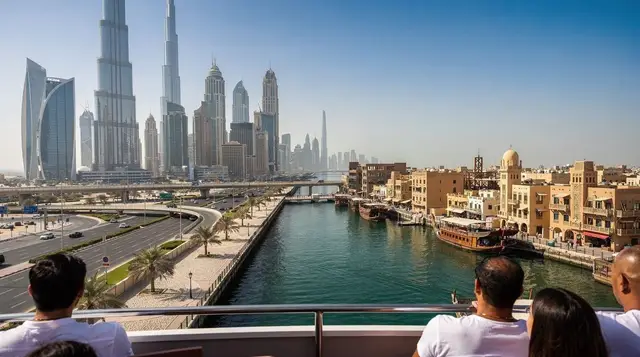
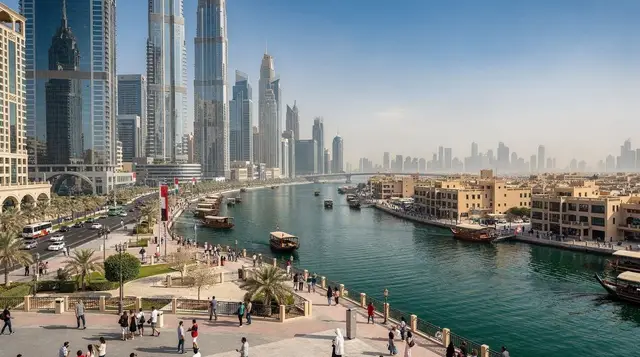
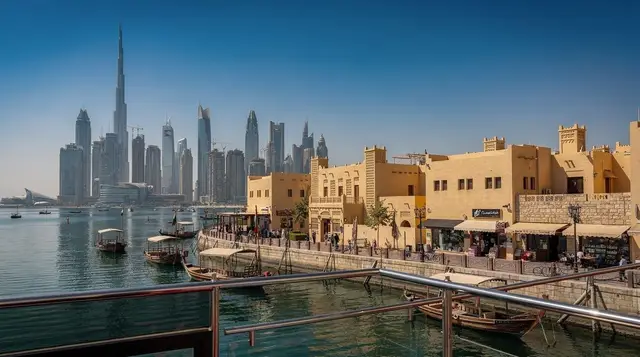
No single comparison captures Dubai better than its own recent history: a settlement built around pearling and a creek crossing, transformed within a few decades into a city with the world’s tallest building and some of its most engineered skylines. Seeing both halves in the same day or tour isn’t just efficient sightseeing — it’s the clearest way to actually understand what makes Dubai distinctive, more so than visiting either half in isolation. This guide covers the guided options that combine both, a realistic self-guided route for anyone who’d rather plan it independently, and how to sequence the day so neither half feels rushed or shortchanged by the other.
| Where | Al Fahidi/Deira/Bur Dubai (old) + Downtown (new) |
| Time needed | Around 4–5 hours self-guided, or a half-day tour |
| Cost | Little beyond metro/taxi fares if self-guided |
| Getting there | Metro (one change) or taxi between the two halves |
| Best time | Morning in Old Dubai, afternoon/evening in Downtown |
A brief history behind the contrast
Dubai’s transformation from a modest pearling and trading settlement to a global city happened within a single lifetime — the Creek was the economic heart of the city well into the mid-20th century, with Al Fahidi’s wind-tower houses built to cool merchants’ homes before mechanical air conditioning existed. The shift toward the skyline visitors recognize today accelerated from the 1990s onward, driven by oil-funded infrastructure investment and a deliberate strategy to diversify into tourism, finance, and trade beyond hydrocarbons.
Understanding this timeline is part of what makes visiting both halves in one trip so effective — you’re not looking at two unrelated cities, but two snapshots of the same place a few decades apart, connected by the same waterway and the same underlying ambition to build something distinctive out of a modest starting point.
What counts as “Old Dubai” here
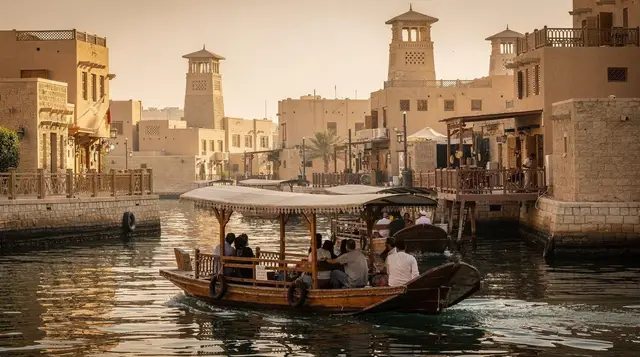
Old Dubai centers on Al Fahidi’s wind-tower architecture, the gold and spice souks in Deira and Bur Dubai, and the Creek itself, crossed by traditional wooden abras for 1 AED. This is Old Dubai the destination in the fullest sense — narrow lanes, low-rise buildings, and a pace that feels closer to a traditional Gulf trading port than the rest of the city. It’s compact enough to cover meaningfully in a few hours, unlike the more spread-out modern districts.
What counts as “new Dubai” here
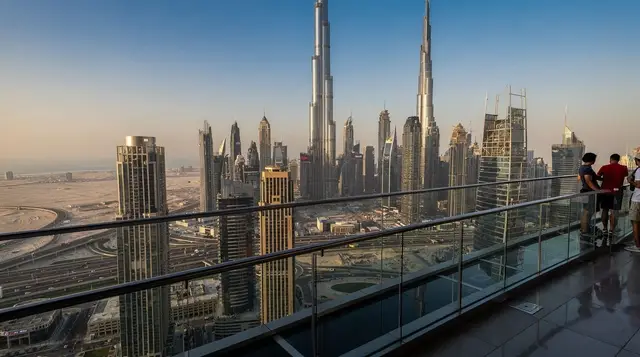
New Dubai spans Downtown’s skyline anchored by the Burj Khalifa, the Marina and JBR waterfront, and newer landmarks like the Museum of the Future and Dubai Frame. Unlike Old Dubai’s walkable compactness, these areas sit further apart from each other and require a taxi, metro, or tour vehicle to move between — factor this into planning rather than assuming a similarly compact, walkable layout.
Old Dubai vs new Dubai side by side
| Old Dubai | New Dubai | |
|---|---|---|
| Core areas | Al Fahidi, Deira, Bur Dubai, the Creek | Downtown, Marina/JBR, Business Bay |
| Pace | Walkable, compact | Spread out, needs taxi/metro |
| Best time of day | Morning | Afternoon into evening |
| Typical cost | Low — souks, abra crossing (1 AED) | Moderate–high — malls, towers |
| Signature stop | Al Fahidi district | Burj Khalifa |
Crossing the Creek by abra
Part of what makes Old Dubai worth the morning slot is the abra crossing itself — a shared wooden motor boat crossing Dubai Creek for 1 AED, running continuously rather than on a fixed schedule. It’s one of the cheapest genuine experiences in the city and a natural link between the gold souk on the Deira side and the spice souk and textile lanes on the Bur Dubai side, so build the crossing into the route rather than treating it as a detour.
The Dubai Frame: built for exactly this contrast
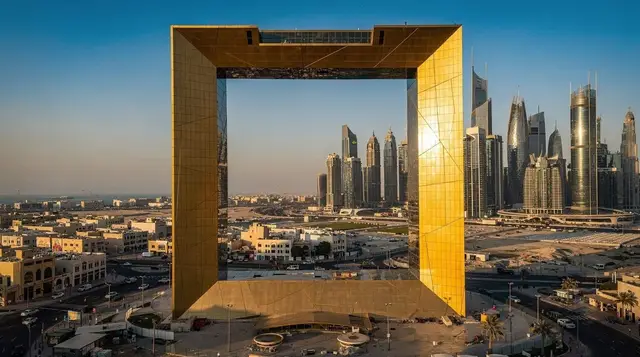
The Dubai Frame is the single structure most literally built around this comparison — a 150-meter sky bridge with one side overlooking Old Dubai’s lower-rise districts and the other overlooking Downtown’s modern skyline including the Burj Khalifa. At around AED 50 ($14), it’s also one of the cheapest ways to grasp the contrast in a single stop, though standing on the bridge is a different experience from actually walking through both areas at ground level.
Many combined tours use the Frame as a literal midpoint between the two halves of the itinerary, both geographically and conceptually, which is part of why it appears so consistently across guided old-and-new itineraries rather than being just one more attraction on the list.
Guided tours combining both eras
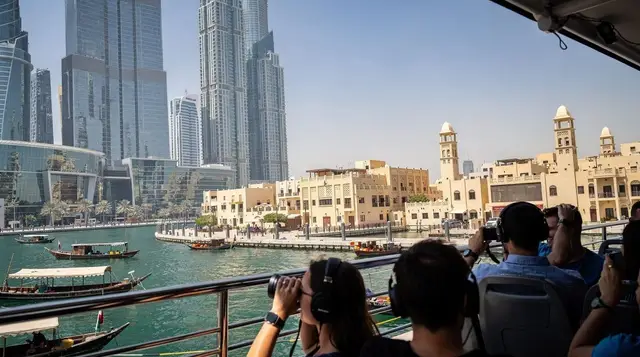
Several operators build half-day itineraries specifically around this old-and-new pairing. A guided tour combining Dubai Frame tickets, the Creek, and the souks uses the Frame as a hinge point between an Old Dubai walking segment and a Downtown-adjacent stop, while a half-day city tour covering the Creek, souks, and a Jumeirah mosque stop weights the itinerary more toward the historic side with a modern-district drive-past.
For visitors wanting a private, more flexible version of the same combined itinerary, a private city tour with the Frame and Burj Khalifa lets you adjust how much time goes to each half based on your own interest.
Using a hop-on hop-off pass for this combination
A 24-48h hop-on hop-off ticket is another workable way to cover both halves at your own pace, since most tickets include stops in both Old Dubai and Downtown, connected by the bus network rather than requiring you to arrange your own transport between them. This suits visitors who want the self-guided flexibility of getting on and off freely without the commentary and fixed schedule of a guided tour, though the two loops are usually linked rather than one continuous route, so budget time for the connection the same way you would with any self-guided plan.
A private version of this route
For visitors who’d rather not follow a fixed shared-group schedule, a private tour built around this same old-and-new pairing lets you adjust how much time goes to each half based on your own pace — spending an extra 30 minutes in the souks if they’re capturing your interest, or cutting a Downtown stop short if the heat is getting uncomfortable. This flexibility comes at a real cost premium over either the guided shared option or a fully self-guided day, worth weighing against how much control over pacing actually matters to your specific trip.
A realistic self-guided route
Start in Old Dubai in the morning, roughly 9-11am, while temperatures stay manageable — walk through Al Fahidi, cross the Creek by abra, and browse the gold and spice souks on the other bank. By early afternoon, take a taxi or the metro (with one change) toward Downtown, arriving in time for lunch and an afternoon at the Burj Khalifa’s base and Dubai Mall. If energy allows, extend into early evening for the Dubai Fountain show, a fitting, free way to end a day that’s spanned both eras of the city. This whole sequence realistically takes a full day rather than a rushed few hours if you want to actually absorb both halves rather than just photograph them.
Timing considerations specific to this combination
Old Dubai’s souks and outdoor lanes are more comfortable earlier in the day, particularly outside winter, while Downtown’s mix of indoor mall space and evening skyline views suits the afternoon and evening better. This isn’t arbitrary — it’s the sequencing most guided combined tours default to as well, for the same practical reason: front-load the more heat-exposed segment and end in a more climate-controlled, evening-friendly area. See Dubai in summer for how to adjust this further if you’re visiting between June and September.
Photography across both eras in one day
The visual payoff of combining both areas is considerable for photography-focused visitors — morning light suits Old Dubai’s textured architecture and the souks’ layered displays, while golden hour and blue hour suit Downtown’s glass towers and illuminated skyline. The photography tours guide goes deeper into timing and specific vantage points for exactly this kind of combined old-and-new shoot, including how to sequence a day around light rather than just logistics.
Eating across both eras
Old Dubai and Deira offer some of the city’s best inexpensive food — Emirati, Iranian, and South Asian dishes in unglamorous but genuinely good settings, often a fraction of the price of a Downtown restaurant for comparable quality. Downtown and the newer districts skew toward higher-end dining and international chains, reflecting the area’s positioning rather than necessarily better food. A day combining both areas naturally sets up a good food contrast too — a modest lunch near the souks followed by a more polished dinner in Downtown, or vice versa, gives a fuller sense of Dubai’s range than sticking to one price tier throughout.
Shopping across both eras
The contrast extends to shopping, too. Old Dubai’s gold and spice souks operate on visible haggling and open-stall pricing, a genuinely different retail experience from Downtown’s fixed-price malls. Pairing a souk browse in the morning with a Dubai Mall stop in the afternoon gives a fuller sense of how differently Dubai handles retail depending on which half of the city you’re in, and it’s worth carrying a little cash for the souks specifically, since haggling culture there doesn’t translate to card payments the way mall shopping does.
Adding the Museum of the Future to a modern-Dubai stop
If the newer half of your combined day has room for one more stop beyond the Burj Khalifa, the Museum of the Future sits close to Downtown and represents the most architecturally distinctive addition to Dubai’s skyline in recent years, its calligraphy-etched torus shape standing out even among the city’s already ambitious modern architecture. It pairs naturally with a Downtown afternoon without requiring significant extra travel time, making it a reasonable third stop if your combined old-and-new day has any remaining energy and schedule room.
A version for repeat visitors
If you’ve already done a standard old-and-new day on a previous trip, a repeat visit can go deeper on one half rather than repeating the full loop — spending a full morning in Deira’s lesser-visited lanes beyond the main gold souk, or an evening focused on Downtown’s rooftop bars rather than the standard Burj Khalifa and Fountain combination. This suits return visitors who’ve already covered the essentials and want texture over checklist coverage on a second or third Dubai trip.
Should you add the Marina as a third stop?
Adding the Marina to an already combined Old Dubai and Downtown day is possible but tends to overstuff the schedule, given it sits a further 20-30 minutes beyond Downtown. Most visitors get a better experience treating the Marina as a separate day or evening, covered in the city tour guide for combined itinerary options, rather than trying to fit three distinct areas into one day, which usually ends up rushing all three rather than doing any of them justice.
Extending into an evening night tour
If your combined old-and-new day still has energy left by evening, a fixed-departure night tour covering the illuminated skyline adds a third visual register to the day — daytime historic Old Dubai, afternoon modern Downtown, and an evening view of the same modern skyline lit up after dark. This isn’t necessary to appreciate the old-versus-new contrast, which works fine as a two-part daytime comparison, but it’s a natural extension for visitors who want to round out the day rather than ending once the sun sets.
Budget considerations for combining both halves
A self-guided version of this combined day costs relatively little beyond metro fares, a few taxi hops, and any attraction entry you choose to add, making it one of the more budget-friendly ways to see a meaningful cross-section of the city. A guided version costs more but removes the planning and navigation effort, particularly valuable for the Old Dubai segment where a first-time visitor might otherwise spend extra time simply figuring out the souks’ layout. Neither approach is inherently better — it’s a genuine trade-off between cost and convenience, similar to most tour-versus-self-guided decisions covered elsewhere on this site.
Why this pairing suits first-time visitors especially
For a first-time visitor trying to get an efficient, well-rounded sense of Dubai without a week to spare, deliberately combining old and new Dubai into a single planned day is one of the highest-value moves available — it covers the two most distinctive, non-overlapping sides of the city in one outing rather than leaving one of them out due to time pressure, which is a common regret among visitors who only saw the modern skyline and skipped Old Dubai entirely.
Who this combination suits best
First-time visitors with limited days benefit most from combining old and new Dubai deliberately, since it maximizes the range of what you see relative to time spent, and gives the clearest possible sense of the city’s character in a single outing. Visitors on a longer trip with time to spare might prefer splitting the two across separate, more leisurely days instead — there’s no wrong answer here, it depends entirely on how much total time you have and whether efficiency or pacing matters more to your trip. Either way, understanding both options before you land makes it easier to commit to one approach rather than second-guessing the plan once you’re already in the city.
Common mistakes when planning this combination
The most frequent mistake is underestimating travel time between the two areas and ending up rushing one half — build in a genuine 20-30 minute transition rather than assuming you can walk or arrive instantly. A second is scheduling Old Dubai’s outdoor walking segment during the hottest part of the day rather than the morning, which turns what should be an enjoyable wander through the souks into an uncomfortable slog, particularly outside the winter months.
A third is treating the Dubai Frame’s sky-bridge view as a substitute for actually visiting both areas at ground level — it’s a genuinely useful complement to the on-the-ground experience, not a replacement for it, since the texture and atmosphere of walking through Al Fahidi’s lanes or Downtown’s plazas doesn’t come through from an elevated vantage point alone.
How much walking is involved
Old Dubai involves the most walking of the two halves — Al Fahidi’s lanes, the souks, and getting to and from the abra crossing add up to a couple of kilometers of uneven, sometimes crowded ground if you explore thoroughly. Downtown involves less continuous walking, mostly moving between the Burj Khalifa’s base, the mall, and the fountain promenade, with more air-conditioned indoor stretches available to break up outdoor segments.
Comfortable, closed shoes suit both halves better than sandals, particularly given the uneven surfaces in some of Old Dubai’s older lanes, and a light, breathable layer helps manage the temperature swing between outdoor heat and the more aggressively air-conditioned indoor stretches of the Downtown half of the day.
Frequently asked questions about combining old and new Dubai
Can I do this combination using only public transport?
Yes — the metro connects reasonably well between the areas near Old Dubai and Downtown, with a change required, and short taxi hops fill in the last-mile gaps to the souks and the Creek itself. A Nol card covers metro, bus, and the abra crossing on a single stored-value card.
Is the contrast between old and new Dubai as dramatic in person as in photos?
Yes, if anything more so — standing in a narrow Al Fahidi lane and then arriving at the base of the Burj Khalifa an hour later makes the scale difference feel more immediate than any single photograph conveys.
Does visiting both areas in one day feel rushed?
It can if you try to do everything in each area; focusing on a few key stops per side (the souks and an abra crossing for Old Dubai, the Burj Khalifa base and mall for Downtown) keeps the day comfortable rather than frantic.
Is there a mosque worth visiting as part of this combined route?
Some combined tours add a stop at a Jumeirah-area mosque built in Ottoman style; if a genuine cultural mosque visit matters more to you specifically, the Sheikh Zayed Grand Mosque in Abu Dhabi is the more significant option, though it requires a separate day trip rather than fitting into a Dubai-only itinerary.
What should I wear for this combined day?
Modest, comfortable clothing covering shoulders and knees works for both halves of the day, suitable for the souks, any mosque stop, and Downtown’s more polished but still casual dress norms.
Is this combination suitable for a layover?
It’s tight for a short layover but workable for one of 10+ hours, since Old Dubai and Downtown sit close enough together to cover both in a compressed version of the full-day route — a dedicated layover tour guide covers the time math for exactly this kind of tighter schedule.
Can I do this combination at night instead of during the day?
Partially — Old Dubai’s souks and Downtown’s skyline are both viewable in the evening, but the daytime version gives a fuller experience of the souks’ actual commerce and the Creek’s daily activity, which quiets down considerably after dark compared to the illuminated but less active modern side of the city.
Which souk should I prioritize if I’m short on time?
The gold souk on the Deira side is the most visually striking for a quick stop; the spice souk across the Creek adds more sensory variety if you have an extra 20-30 minutes for the abra crossing and a walk-through.
Do I need a Nol card for this route?
It’s the most convenient option — a single Nol card covers the metro, bus, and the abra crossing, avoiding the need for small cash at each individual step of the route.
Top experiences
Bookable activities with verified prices and instant confirmation on GetYourGuide.