Dubai city tour guide: half-day and full-day options compared
Dubai: half-day city tour with guide
What does a Dubai city tour typically include?
A half-day guided city tour, roughly 4-5 hours, usually covers a Downtown photo stop at the Burj Khalifa, a drive along Sheikh Zayed Road past the Marina, and a stop in Old Dubai near the Creek or souks. Full-day versions add more stops and sometimes a private vehicle instead of a shared minibus, at a higher price.
What “Dubai city tour” actually means
The phrase covers a broad category rather than one fixed product: a guided outing, usually by minibus or private car, that strings together several of Dubai’s main sights with a live guide narrating along the way, as distinct from a self-guided hop-on hop-off bus or a fully private itinerary built around one traveler’s interests. Most fall into a half-day or full-day format, run either as a shared small-group tour with a fixed pickup and drop-off, or as a private version with just your own party in the vehicle. The core value proposition is the same across variations: someone else handles routing, parking, and pacing, and you get a live guide rather than a recorded audio track.
This guide walks through what each format realistically covers, how pricing breaks down, and where a guided tour genuinely beats planning your own day versus where it doesn’t.
| Half-day | Around 4-5 hours, AED 150-280 ($40-75) shared |
| Full-day | Around 7-8 hours, roughly double the half-day price |
| Private | From around AED 550-900 ($150-245) per vehicle |
| Includes | Live guide, transport, exterior photo stops |
| Usually excludes | Attraction entry tickets, lunch |
Half-day vs full-day: what’s realistically covered
A half-day tour, typically 4-5 hours, usually covers a compact loop: a Downtown photo stop near the Burj Khalifa and Dubai Mall exterior, a drive-past of the Marina and JBR skyline, and a stop in Old Dubai for the Creek or a souk. A full-day version, 7-8 hours, adds more depth — extra time in Old Dubai, a stop at the Museum of the Future exterior or Dubai Frame, and sometimes a lunch break built into the schedule. Neither format typically includes actual entry into paid attractions; both are built around exterior photo stops and orientation rather than ticketed visits, so plan separate time and budget if you want to go inside the Burj Khalifa or another landmark.
Shared group tours vs private tours
Shared tours run on a fixed schedule with other travelers in the same minibus, priced lower per person and less flexible on pacing or stop order. Private tours put just your party in the vehicle, cost more, and let you adjust which stops matter most or skip ones that don’t — the full comparison, including pricing ranges and when private makes sense, sits in the private tours guide.
A half-day Dubai city tour with a guide is a reasonable shared-group starting point if you’re undecided, while a full-day private Dubai city tour suits visitors who’d rather set their own pace across a longer day.
| Shared group | Private | |
|---|---|---|
| Price basis | Per person | Per vehicle |
| Pace | Fixed, timed stops | Flexible |
| Group size | 8-20 people | Just your party |
| Best for | Budget, solo travelers | Families, small groups |
What to wear and bring
Dress modestly enough to cover shoulders and knees if the itinerary includes a mosque stop — see the dress code guide for the specifics, since some operators turn away guests who arrive underdressed at that particular stop. Comfortable closed shoes suit the walking segments in Old Dubai’s souks better than sandals, and sunscreen, a hat and water matter year-round given how much of a half-day tour happens outdoors between stops. A light layer helps too, since the vehicle’s air conditioning is often set noticeably colder than the outdoor heat.
The classic route: Downtown and the Burj Khalifa
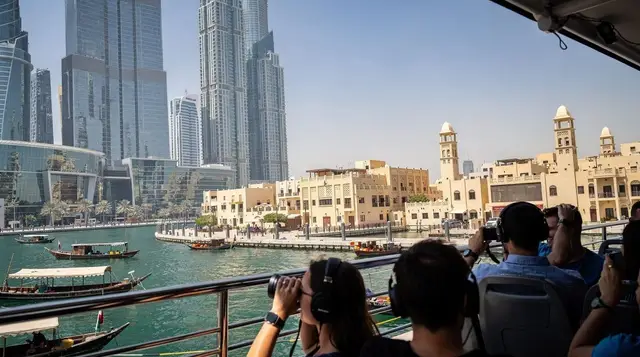
Most half-day tours anchor around Downtown Dubai, with a stop near the Burj Khalifa’s base for photos and a walk through or past Dubai Mall, before continuing along Sheikh Zayed Road. This is the single most photographed and most requested stop on any Dubai city tour, and for good reason — it’s the most recognizable skyline shot in the city. If getting inside the tower matters to you rather than just photographing it from outside, that’s a separate booking covered in the Burj Khalifa tickets guide, since city tour stops here are almost always exterior-only.
Old Dubai add-ons: Creek, souks, and mosque stops
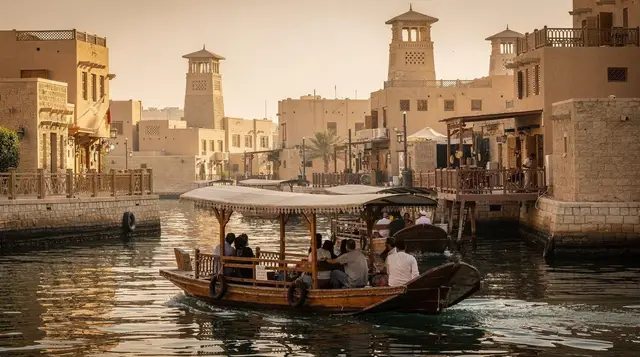
Many half and full-day tours extend into Old Dubai, stopping at the Creek for an abra crossing, and often a walk through the gold or spice souks. Some itineraries — including a half-day city tour with the Creek, souks, and a Jumeirah-area mosque stop — add a visit to a Jumeirah mosque built in Ottoman style, sometimes marketed under the “Blue Mosque” label because of its blue-toned domes, distinct from Istanbul’s far more famous namesake.
It’s worth treating that label as tour marketing shorthand rather than an established Dubai landmark name, and confirming with the operator which specific mosque is included before assuming it’s a major must-see stop.
Modern Dubai add-ons: Marina, Palm, and new landmarks
Tours branded around “modern Dubai” typically swap the Old Dubai stops for more time along the Marina waterfront, a drive past Palm Jumeirah, and stops near newer landmarks like the Museum of the Future or Dubai Frame exteriors. A half-day modern Dubai city tour is built specifically around this newer-development angle rather than mixing in the historic districts, useful if you’ve already covered Old Dubai separately or simply prefer the skyline-and-waterfront side of the city. See the old vs new tour guide if you’d rather combine both eras in a single outing instead of choosing one.
What a live guide adds over a recorded audio track
The practical difference between a guided city tour and the hop-on hop-off bus, detailed in the hop-on hop-off guide, comes down to interactivity: a live guide can answer an unexpected question about a building you’re passing, adjust commentary based on what the group actually seems interested in, and flag things a fixed audio track can’t, like a temporary road closure or an event happening at a stop that day. This matters more on stops with cultural nuance, such as a mosque visit or the souks, where context and etiquette guidance from a real person tends to land better than a recorded script.
It matters less on purely visual stops like a skyline photo point, where the view speaks for itself regardless of who’s narrating.
Photography opportunities on a guided tour
Guides who do the route daily generally know which specific angle or time of day produces the best shot at each stop, a genuine edge over figuring it out yourself on a first visit — ask directly, since most are happy to point out a preferred spot once asked. The Downtown stop near the Burj Khalifa and the Marina drive-past are consistently the two most photographed points on any city tour itinerary. For a more complete list of vantage points worth seeking out beyond what a standard tour stops at, see Dubai skyline photo spots or the dedicated photography tours guide if photography is your main reason for touring rather than a secondary benefit.
Pricing ranges and what drives the cost
Shared half-day group tours typically run roughly AED 150-280 ($40-75) per person, while private half-day tours run substantially higher, often AED 550-900 ($150-245) for the vehicle regardless of group size within capacity, making private tours relatively better value for families or small groups splitting the cost. Full-day tours roughly double the half-day price in either format. The main cost drivers are group size (private vs shared), vehicle type, and how many stops or add-on tickets are bundled in — a tour advertised as unusually cheap is often a shorter route with fewer stops rather than genuinely better value.
Group size and pace
Shared tours typically run in minibuses seating 8-20 people, meaning stops are timed to suit the group rather than any one traveler’s preference — expect set windows of 15-30 minutes at photo stops rather than open-ended time. This works fine for visitors happy to follow a schedule, but is a real limitation for anyone who wants to linger at a specific spot, take extended photos, or skip a stop that doesn’t interest them. Private tours remove this constraint entirely, which is the main reason they command a higher price despite covering similar ground.
What’s usually not included
Beyond attraction entry tickets, most city tours exclude lunch (unless explicitly stated), drinks, and any shopping purchases at souk or mall stops. Hotel pickup and drop-off is standard for most operators within central Dubai zones, though outlying accommodation may incur a supplement or require meeting at a central point instead. Confirm pickup logistics at booking rather than assuming door-to-door service applies universally across every hotel in the city.
Honest value vs building your own day
For a visitor comfortable navigating on their own, replicating a half-day tour’s stops using metro, a Careem, and a bit of planning is genuinely cheaper — you’re mainly paying for the guide’s commentary, fixed logistics, and not having to plan your own sequencing. Where a guided tour earns its price is context: a live guide can answer questions on the spot, point out details a self-guided visitor would miss, and handle the awkward parts of navigating unfamiliar areas like the souks. If you’re confident and have time to research, see getting around Dubai for a DIY version of the same ground; if you’d rather not plan it yourself, the guided option removes that friction for a real but moderate premium.
Best time of day and season to book
Morning tours, starting around 8-9am, generally beat the worst of both traffic and, outside winter, the heat — particularly relevant for any Old Dubai walking segments. Afternoon and evening slots suit tours weighted toward the Marina or Downtown skyline at sunset, though summer heat (June-September) makes any outdoor walking stretch, including souk visits, considerably more taxing in the middle of the day; see Dubai in summer for how to plan outdoor time around that. Winter (November-March) is the most comfortable season for any format, and also the busiest, so book slightly further ahead during peak months.
Who should book a guided city tour
First-time visitors short on time, travelers uncomfortable navigating public transport or driving in Dubai’s traffic, and anyone who values a live guide’s context over a lower price all get real value from a guided city tour. It’s a weaker fit for budget-focused independent travelers, visitors who already know the city, or anyone who strongly prefers setting their own pace — for that group, either a self-guided approach or a fully private tour will likely serve better than a fixed-schedule shared option.
Combining a city tour with a day trip
A Dubai city tour and an Abu Dhabi day trip are almost always separate bookings rather than combinable in one day, given Abu Dhabi sits roughly 1.5 hours away each way — trying to squeeze both into a single day usually means shortchanging one or the other. A more realistic pairing is a Dubai city tour on one day of a trip and a dedicated day trip to Sharjah on another, keeping each outing unrushed rather than trying to compress the whole region into one exhausting day.
City tours for families with kids
Half-day formats generally suit families better than full-day ones, since younger children tend to lose patience with multiple sequential stops and a moving vehicle for a full 7-8 hours. The Old Dubai souk stops work reasonably well for kids given the sensory novelty of the spice souk in particular, while a mosque visit requires the same modest dress rules for children as adults, so pack accordingly. If the itinerary includes extended walking in open sun during the warmer months, a private tour lets you shorten or skip that segment in a way a fixed-schedule shared tour won’t accommodate — relevant background sits in the Dubai with kids guide.
Ramadan and seasonal scheduling notes
During Ramadan, some city tour operators adjust stop timing and duration around prayer times and the shift in public eating norms during daylight hours, and certain souk or market stops may have reduced opening hours. It’s not a reason to avoid touring during this period, but it’s worth confirming the specific itinerary hasn’t been trimmed for the season before booking, and reviewing the Ramadan guide for the wider etiquette context that applies to any tour taken during that month. Outside Ramadan, the main seasonal factor remains simply heat management between June and September rather than any operational change to the tours themselves.
Common booking mistakes
The most frequent mistake is assuming a city tour includes attraction entry tickets by default, then being surprised by an additional cost or a locked-out interior visit at the Burj Khalifa or another paid site. A second is booking a full-day tour when a half-day would have covered the actual list of must-see stops, paying for extra hours of driving between lower-priority add-ons. A third is not checking pickup location requirements in advance, particularly for travelers staying outside central Dubai zones, which can mean an early alternate meeting point rather than the door-to-door pickup assumed from the listing photos.
Booking a city tour on a layover
A Dubai layover of 6-8 hours or more is enough time for a half-day city tour if immigration and airport transfers go smoothly, and several operators specifically market a layover-friendly version with guaranteed airport drop-off timed to your departure flight. Book a shared tour rather than a private one for a layover unless budget allows otherwise, since the fixed schedule of a shared tour actually works in your favor here — it forces a return to the airport by a set time rather than leaving the return timing open-ended the way a fully flexible private tour might. Confirm your visa situation for a layover stop before booking, since requirements vary by nationality and airline, and double-check the tour’s guaranteed return time against your flight’s boarding cutoff with a comfortable margin.
Which stops matter most if you can only pick a few
If a tour’s full itinerary feels like more than you want to fit into a half-day, the Downtown Burj Khalifa exterior stop and an Old Dubai souk or Creek stop are the two most consistently worthwhile inclusions — between them they cover Dubai’s two defining visual identities, the ultramodern skyline and the historic trading-post waterfront, in a way no other single pairing does. A Marina drive-past or a mosque stop add real value but are more skippable if time is genuinely tight, particularly if you’re already planning a dedicated Dubai Marina visit or a Sheikh Zayed Grand Mosque day trip to Abu Dhabi later in your stay.
How a city tour compares to booking attractions individually
Booking the Burj Khalifa, a Dubai Frame ticket and an Old Dubai walking tour separately generally costs more in total than a bundled half-day city tour, but gives you far more time at each stop and lets you skip anything that doesn’t interest you. A city tour trades that flexibility for convenience and a lower combined price, which is the right trade for a first full day in the city, but a weaker one on a return trip when you already know which specific attractions you want to spend real time inside rather than photograph from outside.
Cancellation policies and booking flexibility
Most reputable city tour listings offer free cancellation up to 24 hours before the scheduled start, which is worth checking explicitly before paying, particularly if your Dubai schedule is still loosely planned around weather or flight timing. Confirmation is usually instant for standard shared tours, while some private tour requests take a short window to confirm availability and exact pickup time, so book those a little further ahead if your dates are fixed.
Reading recent reviews for the specific operator and route, rather than just the overall city tour category, is worth the extra few minutes — quality varies more between individual operators running similar-sounding itineraries than the marketing descriptions suggest, and a specific guide’s knowledge and pacing can make a bigger difference to the experience than which stops are technically included.
Frequently asked questions about Dubai city tours
Do I need to tip the guide on a city tour?
Tipping isn’t mandatory but is customary and appreciated for a good guide, typically in the range of AED 20-50 per person for a half-day tour depending on group size and service quality.
Can I request specific stops on a shared group tour?
Generally no — shared tours follow a fixed itinerary agreed for the whole group, so specific requests are better handled by booking a private tour instead.
Are city tours suitable for wheelchair users?
It varies by operator and vehicle; check accessibility specifics directly with the tour provider before booking if this is a requirement, since minibus configurations differ.
Is a city tour worth it if I only have one full day in Dubai?
It can be an efficient use of limited time for a first visit, though a well-planned self-guided day or the hop-on hop-off bus can cover similar ground at a lower cost if you’re comfortable navigating independently.
Do city tours run in extreme summer heat?
Yes, tours operate year-round, but outdoor walking segments in Old Dubai are noticeably more taxing from June to September, and some operators adjust pacing or timing seasonally.
What language are city tour guides usually available in?
English is standard on most tours, with some operators offering additional languages on request or for specific fixed-departure slots — confirm at booking if you need a language other than English.
How far in advance should I book a city tour?
A day or two ahead is usually sufficient outside peak winter season (December-February), though booking further ahead guarantees your preferred time slot during the busiest months.
Can I combine a half-day city tour with a desert safari on the same day?
It’s possible but tight — a morning half-day city tour followed by an afternoon or evening desert safari makes for a genuinely long day, and most visitors find it more comfortable to split these across two separate days rather than stacking both into one, particularly given how differently paced and physically demanding a desert safari can be compared to a city tour.
Top experiences
Bookable activities with verified prices and instant confirmation on GetYourGuide.