Jebel Jais via ferrata: the UAE's only fixed-cable climbing route
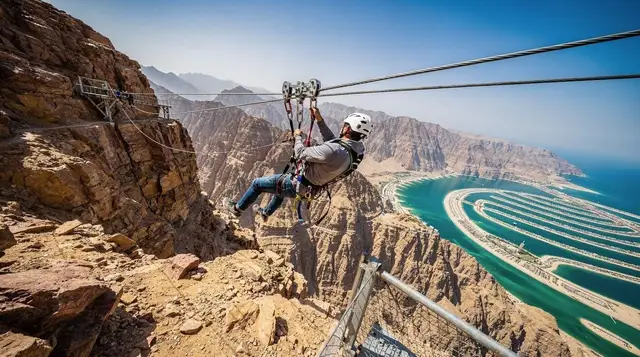
Ras al-Khaimah: Jais Sky Tour zipline adventure
What is the Jebel Jais via ferrata and who is it for?
It's a fixed-cable, iron-rung climbing route bolted into the cliff face on Jebel Jais, the UAE's only via ferrata and the country's closest equivalent to guided rock climbing without technical experience. It suits reasonably fit adults and older teenagers comfortable with exposed heights; it isn't for young children, anyone with a serious fear of heights, or those with mobility or cardiac limitations. Sessions are guided, run a few hours, and are typically booked directly through the mountain's adventure-park operator rather than through general tour marketplaces.
| Where | Jebel Jais Adventure Park, around 1.5-2 hrs from Dubai |
| Cost | Booked directly through the mountain’s operator; check current pricing |
| Time needed | Half a day, including briefing, climb, and breaks |
| Getting there | Rental car, taxi, or organized transfer (no public transport) |
| Best time | Oct-Apr for coolest conditions; early morning in summer |
What via ferrata actually is
Via ferrata — Italian for “iron road” — is a climbing format that uses fixed metal cables, iron rungs, and bolted steps to let people ascend genuinely exposed rock faces without the technical skills, ropes, and protection placement that traditional rock climbing requires. It originated in the Alps, adapted from routes built for troop movement through mountainous terrain, and has since spread worldwide as a way to give hikers and adventure travelers access to climbing-grade terrain with a fraction of the training. Jebel Jais, the UAE’s highest mountain at 1,934 meters, hosts the country’s first and only via ferrata routes, built into the mountain’s adventure park alongside its better-known ziplines.
The appeal is specific: it’s a genuine middle ground between a guided hike and technical rock climbing, giving climbers real exposure to a cliff face and real physical exertion without needing gear or experience beyond what a short on-site briefing covers.
The two routes and their difficulty
Jebel Jais runs two via ferrata routes of differing difficulty along the mountainside, giving a reasonable spread between an introductory experience and a more demanding climb for confident participants. Both traverse genuinely exposed rock, with drops below that are the entire point of the format rather than an incidental risk — this isn’t a gentle nature walk with handrails, and anyone booking expecting otherwise should recalibrate before showing up. Guides assess group ability at the start and can adjust pacing, though the routes themselves are fixed rather than customizable mid-session.
Sustained grip strength and general fitness matter more here than technical skill — the iron rungs and cables do the structural work, but pulling yourself up a cliff face for an extended stretch is genuinely tiring even for reasonably fit adults, and it’s honest to expect sore forearms the next day.
Gear, safety, and what’s provided
Operators supply the technical gear: a climbing harness, helmet, and a via ferrata lanyard system with two carabiners that clip to the fixed cable, always keeping at least one attachment point secured as you move between cable sections — the core safety mechanism of the entire format. Guides run a safety briefing before the climb covering exactly how to manage the lanyard system at transition points, since incorrect clipping technique is the main risk factor in via ferrata generally, more so than the height exposure itself once correctly clipped in.
You’re expected to bring closed-toe athletic shoes with reasonable grip — trail runners or hiking shoes work well, sandals and worn-smooth soles do not — along with clothing suited to sustained physical exertion in UAE heat even at altitude. Gloves are worth bringing or renting if offered, since the iron rungs get warm in direct sun and repeated gripping is tough on bare hands over a multi-hour session.
How it compares to Jais Flight and the Sky Tour
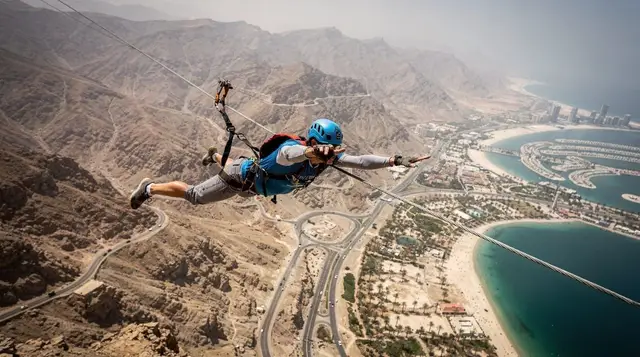
The via ferrata is a fundamentally different activity from Jebel Jais’s ziplines despite sharing the same mountain and adventure-park branding. Jais Flight is a single, fast, largely passive descent — you’re clipped into a harness and gravity does the work. The Jais Sky Tour zipline adventure is a longer multi-line course, still fundamentally a mechanized ride between platforms. Via ferrata, by contrast, is active and physical throughout — you climb the entire route under your own strength, with the safety system there to catch a fall rather than move you along.
That distinction matters for who should book which activity. Visitors wanting a big adrenaline moment with minimal physical effort lean toward the ziplines; those wanting a genuine physical challenge and a slower, more immersive experience of the cliff face itself lean toward via ferrata. For the exact detailed step-by-step of booking and riding Jais Flight specifically, see the Jais Flight booking guide.
Fitness and who should book it
Via ferrata rewards honest self-assessment more than most adventure activities on this list. Reasonable fitness is a genuine requirement, not a marketing caveat — expect sustained arm and grip exertion over a multi-hour session, in heat that, even moderated by altitude, remains real UAE heat outside the coolest winter months. Comfort with exposed heights is equally non-negotiable; the routes are built specifically to expose climbers to real drops, and a participant who freezes partway along a cable section creates a genuine logistical problem for the guide and group behind them.
It suits fit adults and older teenagers well. It’s a poor fit for young children regardless of enthusiasm, for anyone with uncontrolled cardiac conditions or significant joint or back problems, and for those with a fear of heights that goes beyond ordinary first-timer nerves — the zipline options or the summit viewing deck are the better alternative for that last group, since they deliver a view and a thrill without requiring sustained self-propelled climbing on an exposed face.
Booking the via ferrata
Unlike Jais Flight and the Jais Sky Tour, which are readily bookable through GetYourGuide as standard tickets, via ferrata sessions on Jebel Jais are typically arranged directly through the mountain’s adventure-park operator, reflecting the guided, capacity-limited, small-group nature of the activity rather than a simple walk-up ticket format.
If a listing for it isn’t available through the same channel you’re using for the ziplines, that’s expected — book Jais Flight or the Sky Tour through the usual channel for those activities, and check the operator’s own site directly for current via ferrata availability, group sizes, and pricing before finalizing a Jebel Jais day plan that includes it.
A full adventure day on Jebel Jais
Fitting via ferrata alongside Jais Flight or the Sky Tour into a single visit is physically demanding and logistically tight rather than a casual double-booking — each activity individually consumes a meaningful chunk of a day once check-in, briefing, and transfer time are factored in, and via ferrata specifically leaves you genuinely tired in a way a zipline ride doesn’t. Groups with a full day and strong general fitness sometimes do manage both, typically running the more physically demanding via ferrata earlier when energy and grip strength are freshest, saving a zipline for later in the day.
Families or mixed-ability groups often split instead, with some members climbing while others do the Sky Tour or simply enjoy the summit viewing deck and 1484 by Puro, the mountain’s high-altitude restaurant, before regrouping.
Weather and seasonal timing
Via ferrata sessions are more weather- and temperature-sensitive than the ziplines, since the activity is sustained and physically exposed rather than a quick mechanized ride. October through April brings the most comfortable climbing conditions, when Jebel Jais’s altitude keeps temperatures noticeably cooler than the coast even during the warmer shoulder months. Summer sessions, where offered, are best scheduled for early morning to avoid the worst of the heat, since a multi-hour climb in full sun during peak summer temperatures is a genuinely different proposition from a five-minute zipline run.
High wind and lightning can pause or cancel sessions for safety, similar to the ziplines, so building flexibility into a Jebel Jais day plan is sensible if the via ferrata is a priority rather than an optional add-on.
Getting to Jebel Jais
By car, Jebel Jais is roughly 1.5 to 2 hours from central Dubai via the E11 highway north to Ras Al Khaimah, followed by 30-45 minutes on the mountain’s paved switchback access road. There’s no public transport to the summit, so a rental car, taxi, or organized tour transfer is necessary — see the Dubai to Ras Al Khaimah day trip guide and car rental guide for planning specifics. Given the driving time plus a multi-hour via ferrata session, most visitors treat this as a full-day trip or pair it with an overnight stay in RAK rather than attempting it as a rushed same-day round trip alongside other Dubai plans.
Why via ferrata exists as a format
Via ferrata routes date back to the Dolomites in the early twentieth century, originally built to move troops and supplies through mountainous terrain during wartime, with fixed cables and iron ladders bolted into rock faces that would otherwise require technical climbing to cross. After the routes fell out of military use, they were gradually adopted and expanded for recreational climbing, spreading across the Alps and eventually worldwide as a way to give a broader range of people access to genuinely exposed mountain terrain without years of climbing training.
Jebel Jais’s routes are a modern, purpose-built adaptation of that same core idea rather than a historical route repurposed for tourism, engineered specifically for guided commercial use with contemporary safety hardware.
Understanding that lineage helps explain what makes the format distinct from both hiking and technical climbing: it was never meant to be effortless, but it was specifically designed to remove the technical skill barrier that keeps most people off exposed rock faces entirely.
What the climb actually feels like
Unlike a zipline’s short burst of speed, via ferrata is a sustained, physically engaging experience that unfolds over a couple of hours rather than a couple of minutes. Early sections tend to ease climbers into the exposure and the lanyard-clipping rhythm, while later stretches on the more difficult route push into genuinely steep terrain where the drop below is a constant, visible presence rather than an abstraction. Most climbers describe an initial adrenaline spike at the first truly exposed section that settles into a steadier, more meditative focus as the clipping and climbing rhythm becomes familiar — arguably the most distinctive part of the experience compared to a one-shot adrenaline activity like a zipline or skydive.
Rest points and small ledges along the route give genuine breaks rather than a nonstop climb, and guides typically pace groups to allow photos and a breather at the most scenic stretches rather than rushing straight through.
Combining with 1484 by Puro and the viewing deck
Near the Jebel Jais summit, a free-to-access viewing deck and 1484 by Puro — the highest restaurant in the UAE, named for its elevation in meters — sit close to where via ferrata sessions typically begin or end, making a natural pairing for a full mountain day. A post-climb meal at altitude, with sweeping views over the Hajar range toward the Gulf coast on clear days, is a fitting way to close out a physically demanding session, though it’s priced at a premium reflecting both the setting and the logistics of running a kitchen at altitude. Reservations are worth making ahead on weekends given the restaurant’s limited capacity and popularity as a scenic lunch stop even among visitors not doing any adventure activities that day.
Photography on the route
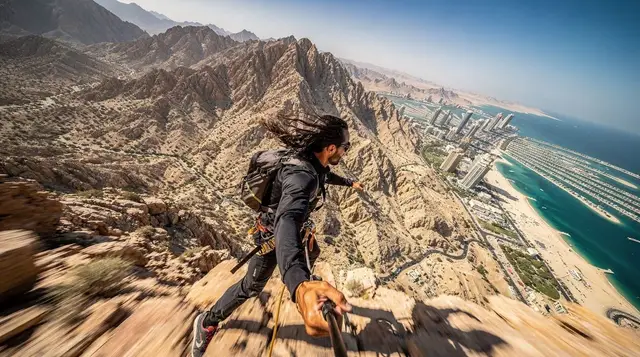
Via ferrata photography is genuinely difficult to do well as a participant, since both hands are typically occupied managing the lanyard clips at any given moment — this is one adventure activity where hiring or requesting a guide-operated camera package, where offered, produces meaningfully better results than attempting your own shots mid-climb. The scenery itself rewards the effort: layered rock faces, sweeping views down toward the valley floor, and on clear days a hint of the Gulf coastline in the distance, a genuinely different perspective from the summit viewing deck’s more conventional wide shots.
If a camera package isn’t offered, a small action camera mounted securely on the helmet, cleared with the guide beforehand, is a more practical option than trying to operate a phone mid-route.
Comparing to Hatta’s outdoor activities
Travelers weighing Jebel Jais against Hatta, Dubai’s own mountain exclave, as an outdoor day-trip option should note they offer genuinely different terrain and activity types rather than a direct substitute for one another. Hatta centers on water — kayaking the turquoise Hatta Dam reservoir — alongside a purpose-built mountain-biking hub, while Jebel Jais is entirely about vertical terrain: ziplines, via ferrata, and mountain-road driving with no equivalent water activity.
Travelers with time for only one northern day trip and a strong preference for climbing and height-based adventure over water sports should lean toward Jebel Jais; those wanting a broader mix of gentler activities, including options more suited to families with younger children, tend to get more out of Hatta.
| Via ferrata | Jais Flight / Sky Tour | Hatta | |
|---|---|---|---|
| Type | Active, self-propelled climbing | Passive, mechanized descent | Kayaking, mountain biking |
| Duration | Half a day | Minutes to under an hour | Half to full day |
| Physical demand | High, sustained | Low | Moderate |
| Best for | Fit adults comfortable with heights | Big adrenaline, minimal effort | Families, water-focused day |
Packing checklist for a via ferrata day
Bring closed-toe athletic or hiking shoes with real tread rather than fashion sneakers, since grip on the metal rungs matters more than it might seem from photos. A small daypack for water and snacks works if the operator allows it during the climb, though check first, since some routes require hands-free movement at all times. Sun protection matters even at altitude — sunscreen, a hat for the approach and descent sections away from direct rock exposure, and sufficient water for a multi-hour session in UAE conditions, tempered but not eliminated by elevation. Gloves, either brought or rented on-site if offered, meaningfully reduce hand fatigue and hot-metal discomfort on longer sessions, particularly on the more difficult of the two routes.
Training beforehand: is it worth it
Travelers with genuine concern about their grip strength or general fitness sometimes ask whether specific training beforehand is worth doing, and the honest answer is that moderate preparation helps but isn’t strictly necessary for the introductory route. A few weeks of general upper-body and core conditioning — nothing specialized, just regular activity that builds baseline grip and shoulder endurance — makes a real difference in how tired you feel afterward, though the routes themselves are designed for reasonably fit non-climbers rather than requiring athlete-level preparation. Rock climbing gyms, if accessible before the trip, offer a genuinely useful preview of the grip-and-pull movement pattern involved, closer to the real thing than generic cardio training would be.
For travelers without time to prepare specifically, honest self-assessment on the day matters more than any advance training — telling the guide upfront if you’re struggling partway along a route is a normal, expected part of the process rather than something to push through silently, and guides are experienced at adjusting pace or offering a rest point rather than treating a request to slow down as a problem.
Solo travelers and the group dynamic
Via ferrata sessions run as guided groups rather than one-on-one, so solo travelers booking without companions are typically placed into a group with other visitors rather than needing their own private session — a genuinely social way to do the activity, and one that removes any awkwardness about pacing since the guide manages the whole group’s rhythm rather than any one participant setting it. Solo bookers sometimes worry about being the slowest or least confident in a mixed group, but guides routinely handle exactly this mix of ability levels and pace groups accordingly, so it’s rarely the issue solo travelers anticipate going in.
For solo travelers specifically nervous about the height exposure, mentioning this at booking or check-in lets the guide position you appropriately within the group and offer extra reassurance at the more exposed sections, rather than discovering mid-climb that more support would have helped.
Group sizes are kept deliberately manageable for safety reasons, so a solo booking rarely means waiting long for a session to fill — operators typically run sessions on a set schedule regardless of exact headcount, within a reasonable minimum.
Is the Jebel Jais via ferrata worth it
For fit travelers genuinely drawn to climbing, exposed heights, and physical challenge rather than passive thrill rides, yes — there’s nothing else like it in the UAE, and it’s a legitimately different experience from the ziplines that share the same mountain. For visitors without that specific interest, the time, physical demand, and logistics involved make it a harder sell than Jais Flight’s shorter, more universally accessible thrill. Weigh it honestly against your own fitness and comfort with heights before booking, and consider the Dubai adventure sports overview if you’re deciding how to spend limited adventure-activity time and budget across a UAE trip.
Frequently asked questions about the Jebel Jais via ferrata
Do I need climbing experience for the via ferrata?
No — fixed cables, iron rungs, and a clipped-in safety system do the technical work. You need reasonable fitness and genuine comfort with height exposure.
How difficult is the Jebel Jais via ferrata?
Two routes of differing difficulty run along the mountainside, suiting both first-timers and more confident climbers, though both involve sustained exertion and real exposure.
What gear is provided?
A harness, helmet, and via ferrata lanyard system are provided. Bring closed-toe athletic shoes with good grip and clothing suited to physical exertion.
How long does a via ferrata session take?
Budget half a day, including briefing, gear fitting, the climb, and breaks, since sessions are guided rather than self-timed.
Can children do the via ferrata?
It’s not recommended for young children given the height exposure and physical demands. It suits fit teenagers and adults far better.
How do I book the Jebel Jais via ferrata?
It’s typically booked directly through the mountain’s adventure-park operator rather than a general marketplace. Book the ziplines separately through the standard booking channel.
Is the via ferrata safe?
With correct harness use and a trained guide, yes, by the format’s long global safety record — though it involves real height exposure and physical effort throughout.
What’s the best time of day to do the via ferrata?
Early morning, when temperatures are coolest and the route is least crowded, particularly outside the peak October-April season when midday heat makes sustained physical exertion on exposed rock considerably harder.
Is via ferrata better than the Jebel Jais ziplines?
Neither is objectively better — they’re different formats. Via ferrata suits travelers wanting active climbing and sustained physical challenge; Jais Flight or the Sky Tour suit those wanting a fast, largely passive adrenaline hit.
Should I combine via ferrata with lunch at 1484 by Puro?
It’s a natural pairing given the proximity, but book a table ahead on weekends — the restaurant has limited capacity and draws scenic-lunch visitors independent of the adventure activities.
Top experiences
Bookable activities with verified prices and instant confirmation on GetYourGuide.