Dubai's modern architecture: what the buildings are actually saying
A skyline built to make an argument
Dubai’s architecture rarely happens by accident. Almost every landmark building was commissioned to prove something specific — that the city could out-build its Gulf rivals, that it could turn a fishing and pearling town into a global capital within two generations, that it could keep generating a “biggest” or “first” superlative on demand. Understanding that intent changes how the skyline reads: less a random collection of striking towers, more a decades-long argument made in glass and steel.
| Best entry point | Burj Khalifa observation deck, for scale and structure |
| Free to see | Museum of the Future exterior, Burj Al Arab silhouette, Dubai Frame from the park |
| Ticketed | Burj Khalifa decks, Museum of the Future interior, Dubai Frame skybridge |
| Older heritage | Al Fahidi’s wind-tower architecture |
| Best vantage | The View at The Palm, for the skyline as a system |
Burj Khalifa: the argument for scale
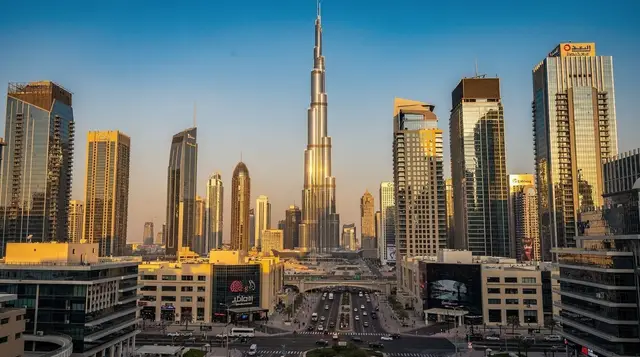
The Burj Khalifa, at 828 metres the tallest building on Earth since 2010, is the clearest example of this instinct. Its Y-shaped floor plan, tapering as it rises, was engineered specifically to reduce wind load at extreme height — a structural solution to a problem that didn’t previously exist at this scale. The design draws on the Hymenocallis desert flower and traditional Islamic geometric patterning, a detail easy to miss from the ground but visible in the tower’s spiraling setbacks when viewed from above. Level 124/125 observation deck tickets put you inside that geometry rather than just looking at it from below.
Museum of the Future: the argument for spectacle with substance
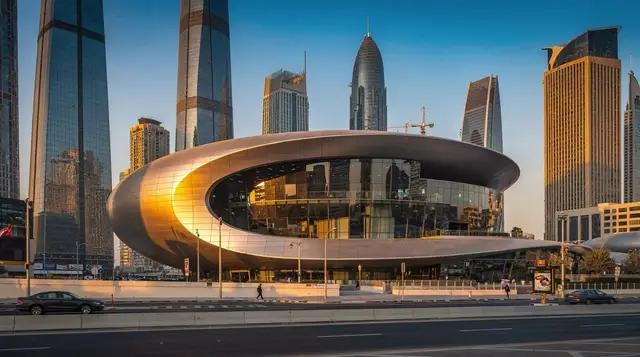
Museum of the Future is the newest entry in this lineage and arguably the most architecturally daring: a torus-shaped structure with no internal columns, its stainless-steel facade wrapped in Arabic calligraphy quoting the UAE’s late ruler on the future of knowledge and innovation. The engineering challenge — a column-free elliptical void spanning multiple floors — required a diagrid steel structure fabricated in sections and assembled on site, a genuinely unusual approach even by the standards of a city used to unusual approaches.
Museum of the Future admission gets you inside the structure the calligraphy wraps around, not just the exterior most visitors photograph from the street.
Burj Al Arab: the argument for exclusivity as design
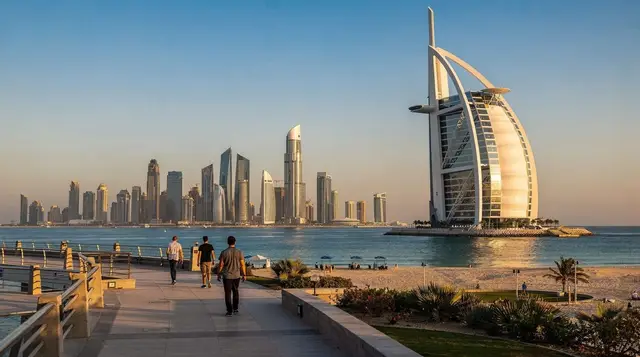
The sail-shaped Burj Al Arab, completed in 1999, predates most of the current skyline and set the template Dubai has followed since: a single, unmistakable silhouette designed to be recognized instantly, built on an artificial island specifically so its form would read cleanly against open water rather than competing with a dense skyline. It remains one of the only Dubai landmarks that most visitors never enter, which is arguably intentional — its exclusivity is part of the architectural statement, not an accident of pricing.
Dubai Frame: the argument for narrative
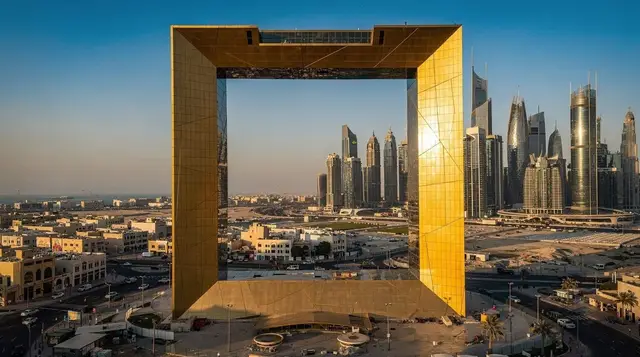
The Dubai Frame, a 150-metre gilded picture frame straddling Zabeel Park, is more conceptually driven than most of the skyline: it’s positioned deliberately between Old Dubai to one side and the new downtown skyline to the other, turning a walk across its skybridge into a literal frame around the city’s transformation from a modest trading port to its current form. It’s a smaller, more literal architectural idea than the Burj Khalifa or Museum of the Future, which is part of why it works better as a quick, legible stop than a headline destination.
Ain Dubai: engineering ambition without a matching narrative
Ain Dubai on Bluewaters Island, the world’s largest observation wheel at 250 metres, is a genuine engineering achievement — its scale required a bespoke support structure rather than an adaptation of an existing Ferris wheel design. Where it falls short of the buildings above is narrative: it doesn’t carry the same cultural or symbolic weight as the Burj Khalifa’s height record or the Museum of the Future’s calligraphy, which is part of why it tends to underperform relative to its engineering credentials.
Where the skyline is heading: Business Bay and the Creek
Business Bay, Dubai’s newer canal-front business district, and the ongoing development around Dubai Creek both represent the current phase of the city’s architectural ambition — dense clusters of towers along waterways designed at street level rather than purely for skyline photographs, a shift from the earlier era’s single-statement landmarks toward neighborhood-scale urban design. It’s a less photogenic phase than the Burj Khalifa era, but arguably a more mature one.
Palm Jumeirah: architecture at the scale of geography
Palm Jumeirah belongs in any conversation about Dubai’s architecture even though it’s technically land reclamation rather than a building — an artificial archipelago shaped like a palm tree, visible from space, that reorganized an entire stretch of coastline around a single decorative form. Atlantis The Palm, anchoring the frond’s tip, was designed specifically to be the visual payoff at the end of that shape, which is why the resort’s pink-hued, arch-heavy design reads as a destination in its own right rather than simply another hotel.
City Walk: architecture designed at pedestrian scale
Not everything in Dubai is built to be photographed from a distance. City Walk, a newer pedestrian district anchored by Coca-Cola Arena, represents a deliberate shift toward street-level design — low-rise buildings, wide pavements, and facades meant to be experienced walking past rather than glimpsed from a car or a hotel window. It’s a useful counterpoint to the tower-and-superlative logic that defines most of this list, and worth a stop for anyone interested in how Dubai’s architectural ambitions are evolving beyond the single-landmark model.
The best vantage points for seeing it as a system
Individual buildings photograph well from the ground, but the skyline reads as a coherent argument only from height. The View at The Palm puts the Palm’s shape and Atlantis’s position in context; the Burj Khalifa’s own observation decks look back across Downtown’s cluster of towers around it. The best viewpoints guide and skyline photo spots guide both cover where to actually stand to see the skyline as a designed whole rather than as isolated landmarks.
The desert as an architectural constraint, not just a backdrop
It’s easy to read Dubai’s skyline as pure ambition, but much of its design language is also a direct response to an extreme desert climate. Deep-set windows, reflective glass coatings, and building orientations calculated to minimize direct sun exposure all show up across the newer skyline, often invisibly to a casual visitor. Old Dubai’s wind-tower architecture in Al Fahidi did the same job centuries earlier using entirely passive means — tall, slatted towers designed to catch and funnel breeze down into living spaces before mechanical air conditioning existed.
Seen side by side, the two eras represent the same underlying problem solved with radically different tools, which is arguably a more interesting architectural story than height records alone.
The counterpoint: Abu Dhabi’s different architectural language
Dubai’s skyline is worth contrasting with the Sheikh Zayed Grand Mosque and Louvre Abu Dhabi in neighboring Abu Dhabi, both of which pursue a different kind of statement — the mosque through scale and traditional Islamic craft executed at an almost unprecedented level, the Louvre through Jean Nouvel’s perforated dome designed to scatter light like sunlight through palm fronds. Seeing both cities’ landmark buildings in the same trip is the clearest way to understand how differently each emirate has chosen to make its architectural argument.
Comparing the landmarks by what they’re arguing
| Building | The argument | Best way to see it |
|---|---|---|
| Burj Khalifa | Scale and structural innovation | Level 124/125 observation deck |
| Museum of the Future | Spectacle with engineering substance | Interior admission |
| Burj Al Arab | Exclusivity as design | Public beach view, or a booked restaurant table |
| Dubai Frame | Narrative — old vs new Dubai | Skybridge entry |
| Ain Dubai | Engineering ambition | Ground level, Bluewaters/JBR waterfront |
Al Fahidi and the wind-tower tradition, up close
Al Fahidi Historical District, Dubai’s old wind-tower quarter, is worth pairing with any modern-architecture-focused day precisely because it makes the newer skyline’s climate-response logic legible — walking the narrow, shaded lanes and standing beneath a wind tower shows in person what a deep-set window or reflective glass coating on a modern tower is doing more abstractly. It’s a short taxi ride from Downtown and works well as a half-day counterpoint to a morning spent at the Burj Khalifa or Museum of the Future.
Frequently asked questions about Dubai’s modern architecture
Why does Dubai have so many record-breaking buildings?
Largely a deliberate strategy: with limited natural tourism draws compared to older world capitals, Dubai used architecture and superlatives (tallest, largest, first) to manufacture global attention and investment starting in the 1990s and accelerating through the 2000s.
What’s the most architecturally significant building in Dubai?
The Burj Khalifa, both for its height record and its structural innovation (the Y-shaped tapering floor plan), though the Museum of the Future is the most technically daring recent addition.
Is Dubai’s architecture all new, or is there older heritage?
Both exist side by side — Old Dubai’s wind-tower buildings in Al Fahidi predate the modern skyline by decades and represent a genuinely different, climate-adapted architectural tradition worth seeing alongside the newer landmarks.
Can I visit the inside of the Burj Al Arab?
Only with a hotel reservation or a booked restaurant table — casual walk-ins aren’t permitted past the causeway checkpoint, which is part of the building’s designed exclusivity.
Where’s the best place to photograph the whole skyline at once?
Across the water from Downtown, or from height via the Burj Khalifa’s own decks or The View at The Palm, depending on whether you want Downtown’s cluster or the Palm’s geography in frame.
Is it worth visiting both Dubai’s and Abu Dhabi’s landmark architecture?
Yes — they pursue genuinely different design languages, and seeing both gives a far more complete picture of the UAE’s architectural ambitions than either alone.
How has Dubai’s architectural style changed over time?
Broadly, from single-statement landmarks built primarily for the skyline photograph (Burj Al Arab, the earlier phase of the Burj Khalifa era) toward denser, street-level urban design (Business Bay, City Walk) that prioritizes how a district feels to walk through over how it photographs from a distance. Both eras are worth seeing to understand the fuller arc of the city’s development.
Is Al Fahidi worth visiting alongside the modern skyline landmarks?
Yes — its wind-tower architecture makes the newer skyline’s climate-driven design choices easier to understand in person, and it works well as a half-day counterpoint to Burj Khalifa or Museum of the Future.
Do I need to go inside the buildings to appreciate Dubai’s architecture?
Not entirely — exteriors like Museum of the Future’s facade, Burj Al Arab’s silhouette, and the Dubai Frame from the park are all free to see, though interior sections (the DNA tower atrium, the skybridge) require a ticket.