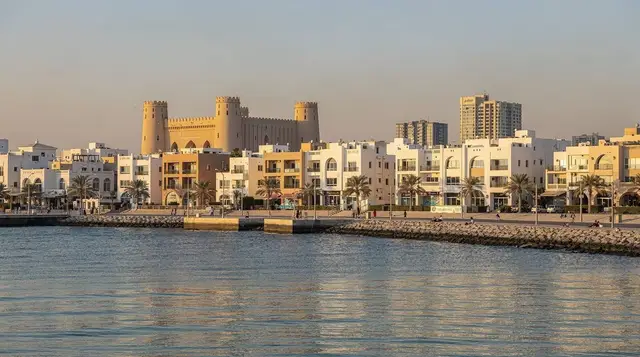
Umm Al Quwain — the UAE's quietest emirate and its lagoon
Umm Al Quwain guide: Dreamland Aqua Park, mangrove kayaking on Khor Al Beidah lagoon, the old fort and museum, Al Sinniyah bird island, honestly assessed.
Quick facts
- Distance from Dubai
- ~50–60 minutes by car via E11/E311
- Population
- Smallest resident population of the seven emirates
- Best for
- Quiet lagoons, birdwatching, an older-style water park
- Currency
- AED (same as Dubai)
- Typical day-trip cost
- AED 100–250 (27–68 USD) including Dreamland entry
The quietest emirate in the UAE
Umm Al Quwain — usually shortened to UAQ — is the UAE’s least populated and least visited emirate, sitting on a narrow peninsula between a shallow lagoon and the Arabian Gulf, roughly 50–60 minutes north of Dubai. It has deliberately stayed out of the tourism arms race that’s transformed Dubai and, more recently, Ras Al Khaimah — there’s no skyline, no resort strip, and no headline landmark competing for attention. What UAQ does have is genuine quiet: a working old town, a protected lagoon system that’s one of the better birdwatching sites in the country, and one of the region’s older water parks at a fraction of Dubai’s ticket prices.
It’s worth being honest about what this means for a visit: UAQ rewards travelers specifically looking for an unpolished, low-key contrast to the rest of the UAE, and it will underwhelm anyone expecting a scaled-down version of Dubai’s density of attractions. There isn’t currently a GetYourGuide-bookable tour specific to UAQ at the time of writing, which itself says something about how far it sits from the mainstream tourist circuit — everything here is visited independently, by rental car or taxi.
Dreamland Aqua Park
Dreamland Aqua Park has operated along UAQ’s lagoon since the mid-1990s, making it one of the older water parks in the country, and it shows in the best and worst ways: the slides and pools are noticeably less polished than Dubai’s Aquaventure or Wild Wadi, but ticket prices run well below either, and the grounds include a campsite area alongside the water rides, an option that doesn’t exist at Dubai’s more compact urban parks. For budget-conscious families, or anyone who’s already done a Dubai waterpark and wants a cheaper, more relaxed second outing rather than a repeat of the same experience, Dreamland fills a real gap.
It’s not going to compete with Dubai’s flagship parks on ride variety or theming, and visitors expecting Aquaventure-level production values will likely leave disappointed — this is a straightforward, unpretentious water park rather than a resort-anchored attraction, and it’s priced and built accordingly.
The lagoon and mangroves
UAQ’s defining geographic feature is Khor Al Beidah, a shallow tidal lagoon and wetland system recognized as a Ramsar site for its ecological importance, particularly for migratory birds — flamingos, herons, and osprey are regularly spotted here, especially outside the peak summer heat. Kayaking through the mangrove channels gives a genuinely different UAE experience from the desert-and-skyline imagery most visitors associate with the country, and it’s considerably quieter and less commercialized than mangrove kayaking options closer to Dubai. See mangrove kayaking in the UAE for how UAQ’s lagoon compares to sites in Ajman and elsewhere.
Because this is a working ecological reserve rather than a built tourist attraction, infrastructure is minimal — bring your own gear or arrange kayak rental in advance, since there isn’t a dense network of on-demand rental kiosks the way there might be at a more developed destination.
UAQ Fort and museum
Umm Al Quwain’s old fort, in the heart of the old town, houses a small museum covering the emirate’s pearling and fishing history, alongside archaeological finds from sites in the surrounding area that point to a long history of settlement on this stretch of coast predating the modern emirate by centuries. It’s a modest museum by design, reflecting UAQ’s overall scale, and a visit takes well under an hour — worth combining with a walk through the surrounding old town, where narrow lanes and older buildings give a more lived-in, less restored feel than Sharjah’s Heart of Sharjah or similar heritage projects elsewhere.
A working fishing town, not a staged one
Unlike heritage districts elsewhere in the northern emirates that have been deliberately restored and curated for visitors, UAQ’s old town and fishing harbor remain genuinely functional — wooden fishing boats still operate out of the harbor daily, and the fish market runs on the same practical, unglamorous schedule it always has, aimed at supplying the local population rather than putting on a show for tourists. Early morning is the best time to see the harbor at its most active, with boats returning from overnight trips and the day’s catch being sorted and sold.
This working character is arguably UAQ’s most genuine selling point over more polished heritage attractions elsewhere: nothing here has been rebuilt or repositioned specifically for visitors, which means there’s less to formally “see” in the way a curated museum district offers, but what is here reflects an ordinary working coastal town more honestly than anywhere else covered in this guide. Visitors comfortable with that trade-off — less curation, more authenticity — tend to come away from UAQ more satisfied than those expecting a scaled-down tourist product.
Al Sinniyah Island
Just offshore, Al Sinniyah Island is a protected marine and wildlife reserve, historically used by pearl divers as a base and now managed primarily for conservation, with populations of gazelle and seabirds that draw occasional guided eco-tours from operators based in UAQ or nearby emirates. Access generally requires arranging a boat trip in advance rather than a walk-up visit, and it’s a niche addition best suited to travelers with a specific interest in wildlife or marine conservation rather than a default stop on a first UAQ visit.
A brief history: pearling, fishing, and staying small
Umm Al Quwain’s economy before oil rested almost entirely on pearling and fishing, and its position on a narrow peninsula between the lagoon and the open Gulf made it a natural base for the small fishing fleets that worked this stretch of coast for generations. It joined the UAE federation in 1971 as one of the six founding emirates, but unlike Abu Dhabi and Dubai, it never had significant oil reserves of its own to fund rapid development, and unlike Sharjah, it didn’t pursue a deliberate culture-and-museums investment strategy either. The result is an emirate that has simply grown more slowly and stayed smaller by most measures — population, built-up area, tourism infrastructure — than any of its neighbors.
That slower pace isn’t framed locally as a shortfall so much as a different set of priorities: UAQ’s economy today leans on fishing (still a genuinely significant local industry), a modest free trade zone, and a small but growing tourism sector built around exactly the quiet, uncrowded character that makes it a harder sell to visitors chasing landmarks. For a visitor, the practical upshot is a place that feels closer to how the wider UAE coast might have looked several decades ago, before large-scale tourism development reshaped Dubai, Abu Dhabi, and even RAK’s coastlines.
Weather and when to visit
UAQ follows the same seasonal pattern as the rest of the UAE’s Gulf coast — extreme heat and humidity from June through September, with daytime temperatures regularly exceeding 40°C, and comfortable, dry conditions from November through March, broadly in line with best time to visit Dubai. Because kayaking, birdwatching, and Dreamland Aqua Park are all outdoor activities, the seasonal swing matters considerably here: winter is unambiguously the better time to visit for comfort, while a summer visit means restricting outdoor time to early morning or accepting significant heat exposure. See Dubai’s weather month by month for the wider regional context.
Getting to Umm Al Quwain
By car, UAQ is roughly 50–60 minutes from central Dubai via the E11 or E311, continuing past Sharjah and Ajman on the same coastal corridor. There’s no metro or reliable direct public transport option, making a rental car the most practical way to visit — see the car rental guide for planning specifics. Given the lack of a dedicated bookable tour product for UAQ specifically, most visitors reach it either as a self-drive day trip or as an extension of a broader northern-emirates loop that also covers Sharjah and Ajman, both of which do have organized tour options covering the drive north from Dubai.
What UAQ doesn’t have, said plainly
In the interest of setting accurate expectations: UAQ has no skyline, no major shopping mall comparable to Dubai’s, no beach club or resort scene, and no headline landmark on the level of Jebel Jais or Sharjah’s museum district. There’s a single mid-range hotel presence rather than the dense resort clusters found on Al Marjan Island or Al Aqah, and evening entertainment options are minimal even by the modest standards of the other northern emirates.
None of this is a defect exactly — it’s simply what “the UAE’s quietest emirate” means in practice, and travelers should weigh it honestly against what they actually want from a day or two on the road north of Dubai, rather than assuming UAQ offers a miniature version of what its neighbors provide.
Where to eat
UAQ’s dining scene is minimal and locally oriented — simple seafood restaurants near the old town and corniche serve grilled catch and Arabic staples at prices well below anything in Dubai, generally AED 30–60 (8–16 USD) per person. There’s no resort or fine-dining scene here, consistent with UAQ’s overall low-key character; pack food or plan meals around Dreamland Aqua Park’s on-site options if spending a full day there.
Is Umm Al Quwain worth visiting?
For travelers specifically drawn to birdwatching, mangrove kayaking, or a deliberately unpolished, low-tourist alternative to the rest of the UAE, yes — UAQ delivers something genuinely different from anywhere else in the country. For a first-time visitor prioritizing landmarks, dining, and a dense list of things to do, it’s a low priority; the honest comparison is that Sharjah and Ajman both offer more per hour of driving time for a typical sightseeing-focused visitor. UAQ makes the most sense as the final stop on a longer northern-emirates road trip, or as a specific day trip for the lagoon and Dreamland Aqua Park rather than a default add-on.
See best day trips from Dubai for how it stacks up against other single-day options.
UAQ with kids
Dreamland Aqua Park is the obvious family draw, priced well below Dubai’s parks and including a broader range of slide intensities suited to different ages, though parents should set expectations around the park’s dated infrastructure compared to Dubai’s newer facilities. The lagoon and fort museum both work fine with children in tow at a relaxed pace, though neither is designed with the interactive, kid-focused programming found at some of Dubai’s larger museums. See Dubai with kids for broader family-trip planning that applies to a UAQ day.
Combining UAQ with the rest of your trip
Because there’s no dedicated tour product covering UAQ on its own, it works best folded into a self-driven northern-emirates loop that also takes in Sharjah’s museums and Ajman’s beach and fort, using the same drive north rather than a separate round trip purely for UAQ. A typical full-day version: Sharjah in the morning, Ajman around midday, and UAQ’s lagoon or Dreamland Aqua Park in the afternoon before heading back to Dubai in the early evening. Travelers continuing further north to Ras Al Khaimah can treat UAQ as a stop along the way rather than a dedicated detour, since it sits directly on the coastal route between Ajman and RAK.
UAQ vs Sharjah vs Ajman, quickly
Since all three sit on the same northbound drive from Dubai and often get grouped into a single “northern emirates” day, here’s how they actually differ:
| Umm Al Quwain | Sharjah | Ajman | |
|---|---|---|---|
| Headline draw | Lagoon, birdwatching, Dreamland | Museums, Blue Souk | Corniche, fort, beach |
| Pace | Quietest, least developed | Museum-and-souk, curated | Small-city, low-key |
| Best for | Nature, budget families | Culture, art lovers | A brief coastal stop |
| Bookable tours | None dedicated | Yes, several | Yes, paired with Sharjah |
Photography and quiet spots
UAQ’s appeal for photographers is precisely what it lacks in polish elsewhere — the working fishing harbor at dawn, wooden boats returning with the day’s catch, and the lagoon’s flamingo and heron populations against mangrove backdrops offer genuinely different subject matter from Dubai’s skyline shots. The old town’s narrow lanes, less restored than Sharjah’s Heart of Sharjah, have an unstaged, lived-in quality that rewards a slow walk with a camera rather than a quick drive-through.
Practical tips for a UAQ day
Fuel up before heading out — while UAQ itself has petrol stations, options thin out compared to Dubai, and it’s worth planning a full tank before the drive north given the round-trip distance. Cash and cards both work at Dreamland Aqua Park and the fort museum, but smaller local restaurants near the harbor may lean more heavily on cash, so carrying some AED notes is a sensible precaution. Mobile signal and navigation apps work reliably throughout the emirate, so getting lost isn’t a real concern even given the more rural feel compared to Dubai or Sharjah.
Frequently asked questions about Umm Al Quwain
How far is Umm Al Quwain from Dubai?
Roughly 50–60 minutes by car via the E11 or E311, continuing past Sharjah and Ajman on the same northbound route.
Is Dreamland Aqua Park as good as Dubai’s water parks?
No, not in terms of ride variety or theming — it’s an older, simpler park — but it’s considerably cheaper, which makes it a reasonable choice for budget-focused families or a second water park day after visiting one of Dubai’s flagship parks.
Is there a bookable tour to Umm Al Quwain from Dubai?
Not currently as a dedicated product — most visitors reach UAQ by self-drive rental car or as part of a broader northern-emirates day trip that also covers Sharjah and Ajman, both of which do have organized tour options.
What is Khor Al Beidah, and is it worth visiting?
It’s UAQ’s protected tidal lagoon and wetland, recognized internationally for its bird life. It’s genuinely worth a stop for anyone interested in birdwatching or mangrove kayaking, though it requires arranging your own gear or a guide in advance.
Can I visit Al Sinniyah Island independently?
Generally no — access typically requires arranging a boat trip with a local operator in advance rather than a walk-up visit, since it’s managed primarily as a conservation reserve.
Is Umm Al Quwain safe to visit?
Yes, as safe as anywhere else in the UAE — if anything, its low visitor numbers make it feel even quieter and more low-key than the rest of the country.
Should a first-time UAE visitor prioritize Umm Al Quwain?
Not on a short trip — Sharjah and Ajman both offer more to see for the same drive time. UAQ is better suited to repeat visitors, birdwatchers, or travelers specifically seeking the least developed, quietest emirate.
Is Umm Al Quwain’s fishing harbor open to visitors?
Yes, informally — there’s no ticket or formal tour, and visitors are generally free to walk around and watch the harbor’s daily activity, particularly in the early morning when boats return with the day’s catch.
Why does Umm Al Quwain have so little tourism development compared to its neighbors?
Largely a combination of limited oil revenue to fund rapid development, a smaller population and land area, and a slower, more conservative approach to growth than Dubai, Abu Dhabi, or more recently Ras Al Khaimah have taken with their own tourism sectors.
Can I drink alcohol in Umm Al Quwain?
Rules here are more limited than in Dubai or RAK — some resort properties hold licenses, but the selection of licensed venues is far smaller than in the larger emirates, so don’t expect the same availability found in Dubai hotels.
Is there phone signal and navigation coverage in Umm Al Quwain?
Yes — mobile coverage and navigation apps work reliably throughout the emirate, so despite its rural feel compared to Dubai, getting around or getting lost isn’t a practical concern.
Is Umm Al Quwain a good honeymoon or romantic getaway destination?
Not really as a standalone choice — it lacks the resort infrastructure, dining variety, and polish that a romantic getaway typically calls for. It works better as a quiet daytime add-on to a broader trip based in Dubai, RAK, or Sharjah than as a destination for a romantic stay in its own right.
How does UAQ compare to Sharjah for a day trip?
Sharjah offers considerably more to see — museums, the Blue Souk, Al Noor Mosque — in the same drive time, and has organized tour options UAQ lacks. UAQ is the better choice specifically for birdwatching, mangrove kayaking, or a deliberately quieter, self-driven day.