Dubai safety guide: real risks and laws tourists miss
Dubai: desert safari with VIP BBQ and optional quad bike
Is Dubai safe for tourists?
Yes, by most measures — violent crime is rare, and walking around Downtown, the Marina, or JBR at night carries little of the risk common in many major cities. The realistic dangers are heat-related illness in summer, road traffic, and a handful of laws around public conduct, alcohol, and medication that tourists break without realizing, which carry real if uncommon legal consequences.
The short version
Dubai has a genuinely low violent-crime rate by international standards, and the realistic safety concerns for most visitors are heat, road traffic, water conditions, and a specific set of laws around public conduct, alcohol, and medication that catch tourists off guard rather than being obscure or unreasonable once you know them. This guide separates the low-probability, high-anxiety fears (violent crime, being targeted) from the higher-probability, lower-drama risks that actually cause most tourist problems here, and covers the legal gray areas worth knowing before you land.
| Violent crime | Rare, among the lowest of major tourist cities |
| Real risks | Heat, road traffic, medication rules, PDA laws |
| Emergency | 999 police, 998 ambulance, 997 fire (free, English) |
| Insurance | Strongly recommended, mainly for medical costs |
| Alcohol | Licensed venues only — public drinking is an offense |
Crime rate: the actual picture
The UAE consistently ranks among the safer countries globally for violent crime, theft, and assault, and Dubai specifically benefits from a heavy police presence, extensive CCTV coverage, and strict enforcement that most visitors experience as a general sense of order rather than anything overt.
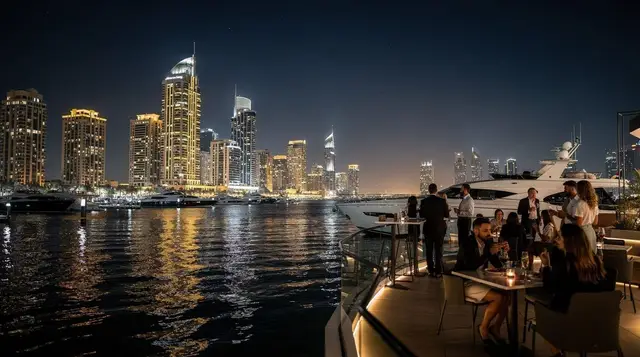
Walking through Downtown Dubai, the Marina, or JBR late at night carries little of the wariness that’s routine in many major cities, and leaving a phone or bag unattended briefly at a café table is less risky here than in most tourist capitals — though “less risky” isn’t “risk-free,” and opportunistic theft still happens occasionally in crowded tourist spots like the souks or Global Village.
Petty scams targeting tourists exist and are worth knowing about specifically because they’re more about being overcharged than being endangered. Unlicensed taxi drivers around some tourist zones and the airport occasionally quote inflated flat fares to visitors who don’t know the standard metered rate — sticking to licensed cream-colored taxis or Careem avoids this entirely.
Aggressive “free” desert safari or city tour pitches from street touts, particularly around Old Dubai and some mall entrances, typically lead to a lower-quality, oversold experience rather than an actual scam in the criminal sense, but they waste time and money regardless — the honest guide to desert safari scams covers how to spot a legitimate operator. Timeshare-style property pitches, occasionally aggressive in tourist-heavy retail areas, are a nuisance rather than a danger; declining firmly and walking away ends the interaction.
Heat: the most underestimated risk
For visitors coming from temperate climates, heat is the single most likely cause of a ruined day or a real medical issue in Dubai, and it’s consistently under-discussed relative to how often it actually affects people. From June through September, daytime highs of 40-48°C turn simple activities — walking between attractions, waiting outdoors for a car, an afternoon at a theme park — into genuine heat-exhaustion risk, particularly for visitors who underestimate how quickly dehydration sets in in that kind of heat. Even in the more comfortable November-to-March season, with highs of 20-30°C, midday sun during a desert safari or beach day is still strong enough to cause sunburn or mild heat strain if hydration and shade aren’t managed.
Practical precautions are simple but genuinely matter: carry water at all times rather than only when thirsty, limit strenuous outdoor activity to early morning or evening between May and September, wear sunscreen and a hat even on cloudy-feeling days since UV intensity doesn’t track visible cloud cover here the way it does at higher latitudes, and treat any dizziness, nausea, or confusion in the heat as a signal to get indoors and hydrate immediately rather than pushing through it. Children and older travelers are at higher risk and need more deliberate hydration schedules than they’d need at home.
A desert safari with VIP BBQ and quad biking booked through a licensed operator will build sensible shade and hydration breaks into the schedule, which is one more reason to avoid the cheapest, least-regulated tour options in peak heat months.
Road traffic and driving style
Dubai’s roads are well-built and well-lit, but driving style is faster and more aggressive than many visitors are used to, with frequent lane-changing without signaling and higher average speeds on highways like Sheikh Zayed Road. As a pedestrian, use marked crossings and pedestrian bridges rather than crossing multi-lane roads directly, since drivers don’t reliably yield the way they might in more pedestrian-prioritized cities. As a passenger, licensed taxis and Careem drivers are professionally regulated and generally safe; the actual risk sits more with self-driving rental cars for visitors unfamiliar with local road norms and the sometimes confusing signage around major interchanges.
If renting a car, note that traffic violations, including speed camera fines, are tracked electronically and billed automatically to the rental company and then to the renter — these are enforced consistently and aren’t something a tourist can simply ignore after leaving the country, since unpaid fines can affect future visa applications or re-entry. The car rental guide covers the specifics of insurance and fine handling in more detail.
Water safety at beaches and pools
Dubai’s public beaches, including Kite Beach and JBR, have lifeguards on duty during posted daytime hours and use a flag system to indicate conditions — swimming within a lifeguarded, flagged area is safe for the large majority of visitors. Rip currents occur seasonally, particularly with onshore winds, and swimming outside flagged zones or after lifeguards have gone off duty carries real risk that isn’t well-signposted beyond the flags themselves. Jellyfish appear at certain times of year, usually more of an irritant than a danger, but worth asking lifeguards about on any given day.
Hotel and resort pools are uniformly well-maintained and supervised, and represent the lowest-risk swimming option for families with young children. For water sports and diving, book through licensed operators with visible safety equipment and briefings — jet ski and other watercraft rentals from unlicensed operators near public beaches occasionally skip safety briefings that licensed operators are required to provide.
Laws tourists break without realizing it
This is the category where genuine risk is more about legal exposure than physical danger, and it’s worth reading closely regardless of how careful a traveler you consider yourself, because most of the people who run into these issues didn’t intend to break any rule. Public displays of affection beyond hand-holding — kissing, prolonged embracing — are discouraged by law and, while enforcement against tourists is rare, prosecutions have happened, usually triggered by a complaint rather than random police attention.
Drinking alcohol is legal only inside licensed venues (hotel bars, restaurants, and clubs with a liquor license); drinking in public spaces, being visibly intoxicated on the street, or drinking in a private home without the resident holding a personal license can result in fines or arrest, and see the alcohol rules guide for the specifics of where and how drinking is actually permitted.
Medication is a genuinely underappreciated risk. The UAE maintains a list of controlled substances that includes some medications freely available over the counter or by common prescription elsewhere — certain codeine-based painkillers, some ADHD medications, and specific sedatives among them. Carrying these without the original prescription and, for some medications, a supporting doctor’s letter, has led to real detentions at the airport. Checking the current UAE controlled medication list against your prescriptions before departure and traveling with proper documentation is a five-minute task that avoids a genuinely serious problem.
Photography is more restricted than most visitors expect. Photographing government buildings, military installations, ports, and airports is prohibited, and photographing people — particularly local women — without their permission is both a cultural offense and, if the subject complains, a legal one. As a practical rule, photograph landscapes, skylines, and consenting subjects freely, and ask before photographing any individual who isn’t clearly part of a public performance or tourist attraction.
Swearing, rude gestures, or insulting language — including in text messages, WhatsApp chats, and social media posts, not just spoken in public — have led to actual prosecutions under UAE cybercrime and public decency laws; a message sent in anger during a dispute with a taxi driver or contractor has real legal weight here in a way it wouldn’t in most home countries.
One more law worth knowing, particularly for anyone renting property or a car for an extended stay: bounced cheques and unpaid debt are treated as a criminal matter in the UAE, not just a civil one. Post-dated cheques are still commonly used for annual rent payments and vehicle leases, and a cheque that bounces due to insufficient funds can result in a criminal case against the account holder rather than simply a fee or a civil claim, which is a materially different consequence than most Western travelers would expect from a bounced payment.
Sandstorms, sudden rain, and other weather risks
Dubai’s weather is overwhelmingly predictable — hot and dry — but two less-discussed weather events are worth knowing about. Sandstorms, more common in spring, reduce visibility sharply and can ground flights or disrupt outdoor activities for a few hours; if caught in one, the sensible response is to get indoors, keep windows closed, and wait it out rather than trying to drive or walk through reduced visibility. Flash flooding, while rare, has become a more visible risk in recent years — Dubai’s drainage infrastructure isn’t built for sustained heavy rainfall, and when it does happen, usually in winter, low-lying roads and underpasses can flood quickly enough to strand vehicles.
Neither event is common enough to plan a trip around, but checking a local weather app during the trip rather than assuming clear skies by default is a reasonable habit, particularly between November and March when the occasional rain event occurs.
Staying safe on organized activities
Desert safaris, quad biking, hot air ballooning, and water sports all carry activity-specific risk that’s well managed by licensed operators and poorly managed by unlicensed ones. Licensed desert safari operators use purpose-built, well-maintained 4x4 vehicles with trained drivers, carry appropriate radio communication in case a vehicle gets stuck or separated from the convoy, and brief guests on safety before dune bashing begins — ask about licensing if it isn’t obvious, and be wary of noticeably cheaper informal operators found through street touts rather than an established platform. Quad biking and dune buggy tours similarly require helmets and a safety briefing as standard; an operator skipping either is a red flag regardless of price.
For a first-time visitor unsure of how to navigate the city’s safety norms in practice, a guided orientation on day one can shortcut a lot of trial and error. A guided Old Dubai souks and street food tour with an abra crossing is a low-risk, low-cost way to get comfortable with local customs, crossing patterns, and etiquette in a supervised setting before navigating independently for the rest of the trip.
The same logic applies to a day trip to Abu Dhabi’s Sheikh Zayed Grand Mosque, where a guided visit takes care of the mandatory dress code and etiquette requirements — free abayas are provided at the door for visitors whose clothing doesn’t meet the standard — removing any risk of being turned away or causing unintended offense.
How enforcement actually works for tourists
It’s worth being clear-eyed about how these laws are enforced in practice, since the picture painted by occasional news stories can be more alarming than the reality. The overwhelming majority of visitors never encounter any of these issues, because enforcement against tourists is generally complaint-driven or triggered by an obvious, flagrant violation rather than routine surveillance of private conduct. A couple holding hands or a visitor having a drink at a hotel bar draws no attention whatsoever; what actually triggers a case is usually a public argument, a complaint from another party, or an obviously illegal act like public intoxication or drug possession.
That said, “rare” isn’t “impossible,” and the handful of publicized cases each year — usually involving a bounced cheque, a heated social media post, or undeclared medication at the airport — are real enough that avoiding them entirely, by knowing the rules in advance, is the more sensible approach than assuming you’ll simply be an exception.
Emergency numbers and what to do if something goes wrong
The three emergency numbers to know are 999 for police, 998 for ambulance, and 997 for fire — all free to call from any phone, including a tourist SIM, and staffed with English-speaking operators. Dubai Police also run a dedicated tourist police service and a multilingual visitor helpline for situations that don’t need immediate emergency dispatch but do need guidance — lost documents, a dispute with a vendor, or general safety concerns.
If you end up in a legal or medical situation serious enough to need outside help, contact your country’s embassy or consulate as a first step; they can’t secure your release from custody or override local law, but they can provide a list of local lawyers, contact family on your behalf, and confirm that due process is being followed. Keep a photo of your passport’s data page and visa stamp on your phone separate from the physical document, since replacing a lost or confiscated passport is far faster with that information on hand.
Travel insurance covering medical treatment and evacuation is worth having specifically because private healthcare, while high quality, is priced accordingly — heat-related illness and road-traffic injuries are the most common reasons tourists actually need it.
Putting it in perspective
None of this should be read as a suggestion that Dubai is a risky destination — by the numbers that matter most (violent crime, assault, theft), it’s genuinely one of the safer major tourist cities in the world, and the vast majority of visits pass with no safety issue beyond maybe a sunburn or an overpriced taxi fare. The value of understanding the heat risks, the traffic norms, and the specific legal boundaries isn’t to be anxious about them; it’s that a handful of avoidable mistakes — public affection, unlicensed medication, an angry text message, ignoring hydration in July — account for nearly all of the genuinely bad outcomes tourists experience here, and they’re all straightforward to avoid once you know about them.
The travel tips guide and dress code guide cover the related cultural-norms side of the same picture.
Risk by season at a glance
| Season | Main risk | How to manage it |
|---|---|---|
| Jun-Sep (summer) | Heat exhaustion, dehydration | Limit outdoor activity to early morning/evening, hydrate constantly |
| Nov-Mar (winter) | Occasional rain, flash flooding | Check local weather app, avoid low-lying underpasses after heavy rain |
| Spring | Sandstorms, reduced visibility | Stay indoors, avoid driving until it clears |
| Ramadan (shifts yearly) | Public eating/drinking rules tighten | See the Ramadan guide before daytime plans |
| Year-round | Medication, PDA, alcohol laws | Check the controlled-medication list before you pack |
Where risk actually concentrates by area
Downtown, the Marina, and JBR are the lowest-friction areas for a first-time visitor — well-lit, heavily monitored, and where most licensed taxis and Careem drivers are used to tourist routes. Old Dubai’s souks carry a slightly higher (still low) risk of pickpocketing in crowded lanes, worth a normal level of bag awareness rather than genuine alarm — the old Dubai walking guide covers the area in more depth. Self-driving out to Hatta or the desert conservation zones shifts the main risk toward road unfamiliarity and heat rather than crime, covered in the car rental guide.
Frequently asked questions about Dubai safety
Is Dubai safe for tourists?
Yes, by most measures — violent crime is rare, and public spaces are well-lit and heavily monitored. The realistic risks are heat illness, road traffic, and a handful of laws around public conduct and alcohol that catch tourists off guard.
Is Dubai safe for solo female travelers?
Generally yes. Low violent-crime rates, well-lit public spaces, and a visible police presence make it one of the more comfortable destinations in the region for solo women, though normal precautions like using licensed taxis still apply.
What are the emergency numbers in Dubai?
999 for police, 998 for ambulance, and 997 for fire, all free to call and staffed in English as well as Arabic.
Can tourists get in trouble for drinking alcohol in Dubai?
Yes, if it happens outside licensed venues. Public drinking, visible intoxication, or drinking in a home without the resident holding a license can lead to fines or, in more serious cases, arrest.
What laws do tourists break in Dubai without realizing it?
Public affection beyond hand-holding, drinking outside licensed venues, carrying certain controlled medications without documentation, photographing people or government buildings without permission, and rude language or gestures, including in texts and social media.
Is it safe to swim in Dubai?
Yes, within lifeguarded and flagged areas at public beaches or in hotel pools. Rip currents and jellyfish occur seasonally, so checking flag status and avoiding unsupervised swimming after dark matters.
Do I need travel insurance for Dubai?
It’s strongly recommended, mainly for medical costs, since private healthcare is high quality but expensive without coverage. Heat illness and traffic injuries are the most common reasons tourists need it.
What happens if I get into legal trouble in Dubai as a tourist?
Contact your embassy or consulate immediately for a list of local lawyers and support contacting family. Dubai Police also run a tourist police unit and multilingual helpline for non-emergency guidance.
Is Dubai safe to visit during summer?
Yes, but heat exhaustion is a genuine risk from June through September with highs of 40-48°C — plan outdoor activities for early morning or evening and treat any dizziness or nausea as a signal to get indoors immediately, as covered in Dubai in summer.
Are taxis and Careem safe for solo travelers, including at night?
Yes — licensed cream-colored taxis and Careem drivers are professionally regulated, and using them rather than unlicensed drivers around tourist zones or the airport avoids both inflated fares and the small added risk of an unregulated vehicle.