Dubai travel tips: what to know before your first visit
Dubai: half-day city tour with guide
What are the most important things to know before visiting Dubai?
The weekend is Saturday-Sunday, not Friday-Saturday. Summer heat (June-September) is genuinely dangerous for outdoor plans. Cards are accepted almost everywhere but carry some cash (AED) for taxis and souks. Dress modestly in malls and mosques. Alcohol is only served in licensed venues. A Nol card and the Careem app cover most transport needs.
Getting the basics right before you land
Dubai runs on a different rhythm than most first-time visitors expect — the weekend falls on different days, summer heat is not the kind you can push through, and quite a lot of what looks like a normal city street sits inside rules that carry real enforcement. None of this is complicated once you know it, but landing without the basics leads to avoidable friction on day one. This guide covers the practical groundwork: money, weather, the weekend, dress code, transport, connectivity, tipping, and the handful of surprises that catch newcomers off guard.
| Currency | UAE dirham (AED), pegged at roughly 3.67 to 1 USD |
| Weekend | Saturday-Sunday (not Friday-Saturday) |
| Best time | November-March, 20-30°C daytime highs |
| Getting around | Nol card for metro/tram/bus, Careem for taxis |
| Dress code | Shoulders and knees covered in malls, souks, mosques |
Money and currency
The UAE dirham (AED) is pegged to the US dollar at roughly 3.67 to 1, which makes mental conversion fairly easy — divide by 3.67, or roughly by 3.7 for a quick estimate. Cards are accepted almost everywhere: hotels, malls, restaurants, and most metro top-up machines take Visa and Mastercard without issue. Where cash still matters is taxis (some drivers prefer it, though card readers are now standard in RTA cabs), the gold and spice souks in Old Dubai where bargaining works better with cash in hand, small kiosks, and tipping. Carrying AED 200-300 in small denominations covers most of these situations without needing to withdraw repeatedly.
ATMs are everywhere and dispense AED directly; withdrawing from a UAE ATM with a foreign card usually costs less in fees than repeated card transactions abroad, depending on your home bank’s policy.
The weekend is Saturday-Sunday
Since 2022, the UAE’s official weekend has been Saturday-Sunday, aligning more closely with international markets — this trips up visitors who assume Friday-Saturday, the older Gulf standard. Friday itself is a working morning followed by Jummah, the midday Friday prayer, when some businesses pause briefly around midday. Friday is also when many restaurants and hotels run “Friday brunch” — a long, often lavish multi-course buffet with drinks, running from late morning into the afternoon, and a genuine local institution rather than a tourist gimmick.
If you’re in Dubai on a Friday, checking availability for a well-reviewed brunch is worth doing regardless of your usual dining budget, since it’s one of the more distinctly Dubai food experiences available. See Dubai’s Friday brunch culture for how to pick one and what to expect.
Heat is not a minor inconvenience
Between June and September, daytime temperatures routinely reach 40-48°C with high humidity, and this is not exaggeration for effect — extended time outdoors in that heat carries real risk of heat exhaustion, not just discomfort. Visitors traveling in these months should plan around indoor attractions: Dubai Mall, the Museum of the Future, the Dubai Aquarium and Underwater Zoo, and Ski Dubai all work well as full afternoons that avoid the outdoor heat entirely. Outdoor activities like desert safaris still run in summer, but operators shift timing to early morning or evening and cut daytime dune-bashing almost entirely.
November through March is the comfortable window, with daytime highs around 20-30°C, and it’s also when the city is busiest and priciest — December and January in particular. See best time to visit Dubai for a month-by-month breakdown if your dates are flexible.
Humidity compounds the heat problem in a way dry-climate visitors often underestimate — coastal humidity in July and August can make the “feels like” temperature noticeably higher than the reported air temperature, and it’s part of why locals and long-term residents largely restrict their own outdoor time to early morning or after dark during these months. Carrying water at all times and limiting continuous outdoor exposure to 20-30 minutes during the hottest stretch of the day (roughly noon to 4pm) is a reasonable practical rule, whether you’re walking between a taxi and a mall entrance or spending a morning at an outdoor market.
Dress code, realistically
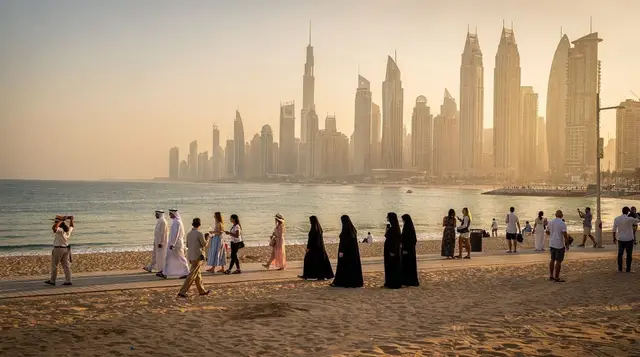
Dubai is more relaxed than many visitors expect walking into a mall or a beach club, and stricter than expected walking into a mosque. The practical rule that covers most situations: shoulders and knees covered in malls, souks, and any religious site, for both men and women. Beaches, pools, and beach clubs are the clear exception — swimwear is completely normal there and nowhere else. Visiting the Sheikh Zayed Grand Mosque in Abu Dhabi requires full-length, loose clothing and a headscarf for women, with robes available to borrow at the entrance for anyone underdressed.
During Ramadan, expect shifted restaurant hours and restrictions on eating or drinking in public during daylight fasting hours, even for non-fasting visitors. For a fuller rundown by venue type, the dress code guide goes into more detail.
Ramadan timing, if your trip overlaps
Ramadan shifts a fair amount about daily life in Dubai, and the dates move each year on the lunar calendar, so it’s worth checking whether your trip falls within it before finalizing plans. Restaurant hours change, with many venues closed during daylight hours and reopening after sunset for iftar, the breaking of the fast — hotel restaurants and licensed venues generally stay more accessible to tourists throughout the day, often behind a discreet screen or curtain out of respect for those fasting. Eating, drinking, or smoking in public during daylight hours is restricted for everyone, not just those observing the fast, and enforcement is real rather than symbolic.
On the upside, evenings during Ramadan take on a genuinely different, more festive character across the city, with extended mall hours, special iftar and suhoor menus, and a more relaxed daytime pace at major attractions given lower visitor volume.
Alcohol rules
Alcohol is only served inside licensed venues — hotel bars and restaurants, licensed standalone restaurants, and beach clubs — not in general supermarkets or most standalone cafes. Public drinking and visible intoxication outside those licensed venues are enforced, not just discouraged, so the same behavior that’s unremarkable at a hotel pool bar becomes a legal problem on a public beach or in a taxi. Visitors 21 and over can buy alcohol for personal consumption from licensed retail shops such as MMI or African+Eastern with valid ID, a change from the residency-permit requirement of past years. See Dubai’s alcohol rules for the specifics of where and how it’s sold.
Transport basics
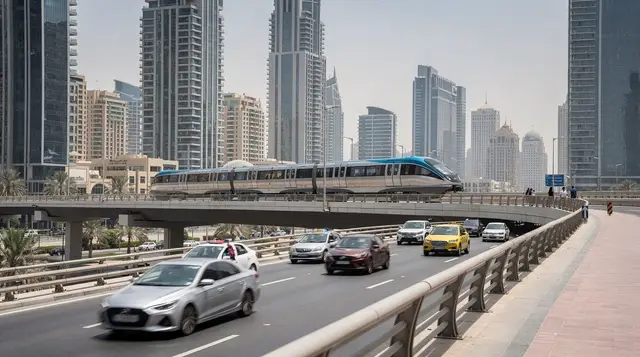
The Dubai Metro’s Red and Green lines cover the main tourist corridor along Sheikh Zayed Road and out to Dubai Marina, and it’s fast, air-conditioned, and cheap compared to taxis. A Nol card — a rechargeable tap-in, tap-out transit card sold in several tiers — covers metro, tram, bus, and water bus fares, and it’s worth picking up at the airport or any station on arrival rather than paying cash fares each ride. Where the metro doesn’t reach, particularly Old Dubai’s narrower streets or residential pockets, taxis and Careem (the region’s dominant ride-hailing app) fill the gap reliably and at reasonable cost — a typical 15-20 minute Careem ride within the city runs roughly AED 25-45 (7-12 USD).
RTA, the government transport authority, runs the metro, buses, and water taxis, and its own app is useful for checking routes and live timings. The getting around Dubai guide covers the full network including car rental, which only really pays off for day trips outside the city.
Airport arrival basics
Dubai International Airport (DXB) connects directly to the Red Line metro from Terminal 1 and Terminal 3, making the metro a genuinely practical option for arriving with light luggage and a hotel near a station — the ride into Downtown takes roughly 25-35 minutes and costs a few dirhams with a Nol card. For most visitors, especially those with heavier luggage or arriving late at night, a taxi from the designated rank outside arrivals is the simpler option, running roughly AED 50-90 (14-25 USD) to most central hotels depending on distance and traffic. Careem can also be booked from arrivals, though during peak arrival banks it sometimes takes longer to reach the pickup zone than simply joining the taxi queue.
Immigration processing is generally fast for most passport holders, and free airport WiFi is reliable enough to sort out a ride or confirm hotel details before leaving the terminal.
Baggage claim and customs are generally straightforward, though it’s worth knowing alcohol import allowances are limited for personal quantities and duty-free purchases should stay within posted limits — signage at arrivals makes the current allowance clear, and enforcement is real rather than a formality. Currency declarations are only required above a fairly high threshold (equivalent to roughly AED 60,000 or more), which rarely affects a typical tourist carrying normal spending money.
SIM cards and staying connected
International roaming rates are usually worse value than a local prepaid SIM or eSIM, and getting online reliably matters more here than in most cities since Careem, the RTA app, and Google Maps do a lot of the practical navigation work. Du and Etisalat/e& both run kiosks at Dubai International Airport where a tourist SIM with a reasonable data allowance costs roughly AED 60-100 (16-27 USD) for a week or two, activated on the spot with passport ID. eSIMs bought in advance are a workable alternative if you’d rather skip the airport queue, though data speeds and coverage from local carriers tend to be more consistent for anyone planning to rely on maps and ride-hailing throughout the trip.
Tipping norms
Tipping isn’t legally mandatory but is broadly expected in the same categories as most tourism-heavy cities: 10-15% at restaurants where service isn’t already included (many bills add a service charge automatically, worth checking before tipping on top), a few dirhams for taxi drivers rounding up the fare, and AED 5-10 per bag for hotel porters. Tour guides and desert safari drivers are commonly tipped AED 20-50 per person for a half or full day, though this is a norm rather than an obligation. It’s a more relaxed tipping culture than the US, but noticeably more present than in much of Europe or East Asia.
Common surprises for first-time visitors
A few things catch newcomers off guard consistently. Distances are larger than they look on a map — Downtown to the Marina is a genuine 20-30 minute drive, not a stroll, and the city’s low-density, highway-connected layout means walking between districts usually isn’t practical; see the neighborhoods overview if you’re choosing where to base yourself. Photography of people without consent, and particularly of government buildings or certain infrastructure, is more restricted than in many Western cities — ask before photographing individuals, especially local Emirati residents. Jaywalking and minor traffic offenses carry real fines rather than being treated casually.
And indoor air conditioning runs cold enough that a light layer is worth having even during the hottest months, since malls and metro cars are kept noticeably cooler than outdoor temperatures.
Safety basics
Dubai has a low violent crime rate for a city of its size, and petty theft is uncommon relative to many major tourist destinations, but ordinary travel precautions still apply — watch belongings in crowded souks and on the metro during rush hour, and use licensed taxis or Careem rather than unmarked vehicles. The two numbers worth knowing regardless of how the trip goes: 999 for police, 998 for ambulance, and 997 for fire, all free to dial from any phone, including one without an active local SIM. Heat, not crime, is the more realistic day-to-day risk for visitors in summer, so pacing outdoor time and carrying water matters more than most safety concerns typically raised about the city. The Dubai safety guide covers this in more depth, including practical notes for solo travelers.
Getting oriented on arrival
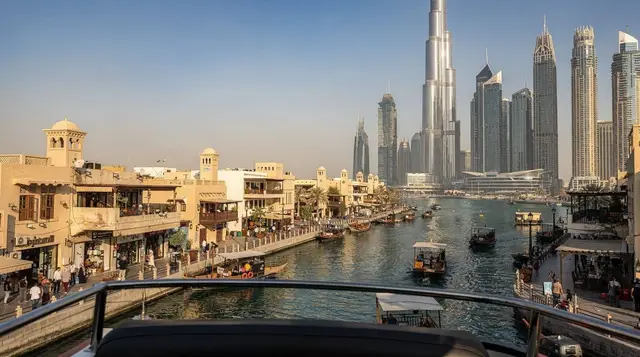
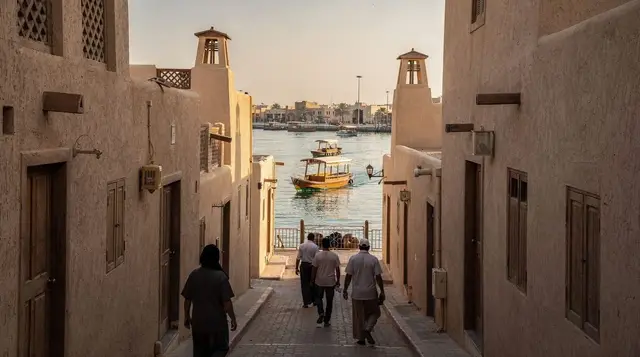
A reasonable first move after landing is a half-day overview tour or a half-day guided city tour covering Downtown, the Marina, and a stop in Old Dubai, which gives a working mental map of the city faster than piecing it together from scratch over several separate outings. For a slower, more textured introduction to the older side of the city, an Old Dubai souks, street food, and abra crossing tour covers the Gold and Spice souks along with the short, roughly AED 1 abra boat crossing over Dubai Creek — one of the cheapest and most characterful things to do in the city.
Neither is essential, but either shortens the learning curve considerably compared to figuring out the city’s layout unassisted on day one.
What to pack
Lightweight, breathable clothing covers most of the trip regardless of season, with at least one modest, fully-covering outfit set aside for mosque visits or more conservative venues. A light jacket or sweater is genuinely useful indoors given how cold air conditioning runs in malls, restaurants, and the metro. Sunscreen, a reusable water bottle, and comfortable closed shoes for souk and desert excursions round out the practical list — flip-flops are fine for beaches and pools but not for a day of walking through Old Dubai or a desert camp.
If a desert safari is on the itinerary, see desert safari — what to wear for specifics, since sand, dust, and evening temperature drops all factor in.
Best times to visit by priority
If comfort outdoors is the priority, November through March is the clear answer, accepting higher prices and bigger crowds, especially over the December-January holidays. If budget matters more than comfort, June through September brings noticeably lower hotel rates and thinner crowds at major attractions, in exchange for outdoor activity being genuinely limited to early morning, evening, or fully indoor options. The shoulder months — April-May and October — split the difference reasonably well, with moderate heat and moderate pricing.
For a trip built around a specific seasonal event, Global Village runs October through April, and Dubai Miracle Garden has its own seasonal window worth checking before booking dates.
| Season | Months | Daytime highs | Trade-off |
|---|---|---|---|
| Peak comfort | Nov-Mar | 20-30°C | Best weather, highest prices and crowds |
| Shoulder | Apr-May, Oct | 30-38°C | Moderate heat, moderate pricing |
| Low season | Jun-Sep | 40-48°C | Cheapest rates, outdoor activities limited to early/evening |
Public transport etiquette and practical notes
The Dubai Metro has designated women-and-children-only carriages, marked pink on the platform and inside the train, and using the general carriages instead when traveling as a mixed group or solo male traveler avoids an awkward on-the-spot correction from staff. Eating, drinking, and chewing gum are prohibited on the metro and at stations, enforced with real fines rather than treated as a suggestion. Priority seating near the doors is reserved for the elderly, pregnant travelers, and those with disabilities, and giving it up promptly when asked is a small courtesy that goes a long way in a city that takes public-transport rules seriously.
Business hours and what stays open when
Malls generally run late — many stay open until 10pm or later, even on weekdays, and later still on weekends, which suits visitors dealing with the heat by shifting activity to the evening. Government offices and banks follow more conventional Sunday-Thursday business hours with a midday close on Friday, relevant mainly if you need visa paperwork, a bank errand, or similar administrative tasks during your stay rather than pure tourism. Supermarkets and pharmacies are widely available with extended or 24-hour hours in busier neighborhoods, useful for anything forgotten in packing. See the Dubai neighborhoods overview for which areas have the densest concentration of late-night amenities.
Language and everyday communication
Arabic is the official language, but English functions as the practical everyday language for tourism, business, and most signage — menus, metro announcements, and street signs are almost universally bilingual, and the vast majority of hospitality and retail staff speak English fluently given the city’s large expatriate workforce. Learning a few basic Arabic phrases (shukran for thank you, marhaba for hello) is appreciated but rarely necessary to get by. Hindi, Urdu, Tagalog, and several other languages are also widely spoken given the makeup of the resident workforce, so language barriers are a minor concern here compared to many other international destinations.
Public holidays worth knowing about
A handful of public holidays affect opening hours and crowd levels enough to plan around. National Day (December 2) brings citywide celebrations, fireworks, and a noticeably livelier atmosphere, alongside busier roads and fuller restaurants. Eid al-Fitr and Eid al-Hajj, which follow the Islamic lunar calendar and shift dates each year, bring short public holidays with many local businesses closing or reducing hours, while malls and tourist attractions generally stay open and often busier than usual with local families out celebrating.
New Year’s Eve draws large crowds to Downtown and the Marina for fireworks displays, including one of the world’s most-watched Burj Khalifa shows, and hotel and restaurant pricing spikes accordingly — worth booking well ahead if your trip lands on December 31.
Health and travel insurance basics
Healthcare in Dubai is high-quality but not free for visitors, and private hospital or clinic visits without insurance can run into real money quickly for anything beyond a minor consultation, so travel insurance covering medical treatment is worth arranging before you land rather than assuming reciprocal coverage applies. Pharmacies are plentiful and well-stocked for common needs like sunburn, dehydration, or minor illness, and pharmacists can often advise on minor issues without a doctor’s visit. Tap water is treated and generally safe to drink, though most residents and visitors default to bottled or filtered water out of habit rather than necessity.
Frequently asked questions about Dubai travel tips
Is Dubai expensive for tourists?
It can be, but doesn’t have to be — budget travelers can manage on roughly AED 300-400 (82-109 USD) a day using the metro, food courts, and free attractions, while luxury travelers can easily spend AED 3,000+ (817+ USD) a day. See the Dubai budget guide for a full breakdown.
What currency does Dubai use and should I bring cash?
The UAE dirham (AED), pegged at roughly 3.67 to 1 USD. Cards are widely accepted, but carry AED 200-300 in small notes for taxis, tips, and souk bargaining where cash gives you more leverage.
Is Dubai safe for tourists?
Yes, it’s one of the lower-crime major cities for visitors, with strict enforcement around theft and public order. The main practical risks are heat exhaustion in summer and traffic, not crime.
Do I need to cover up in Dubai?
In malls, souks, and mosques, yes — shoulders and knees covered is the practical norm for both men and women. Beaches, pools, and beach clubs are the exception, where swimwear is fine.
Can you drink alcohol in Dubai?
Yes, but only inside licensed hotels, bars, and restaurants. Public drinking and visible intoxication outside licensed venues are enforced offenses, not just frowned upon.
What’s the best way to get around Dubai without a car?
A Nol card for the metro covers north-south journeys along Sheikh Zayed Road cheaply, and Careem or taxis fill the gaps the metro doesn’t reach, particularly for Old Dubai and residential pockets.
When is the best time to visit Dubai?
November through March, when daytime temperatures sit around 20-30°C. December and January are the most crowded and expensive months within that window.
Do I need a local SIM card in Dubai?
Most visitors get more reliable, cheaper data from a local prepaid SIM (du or Etisalat/e& kiosks at the airport) or an eSIM than from international roaming, especially for navigation and ride-hailing apps.
How many days do I need for a first Dubai trip?
Most first-timers find 4-5 days enough to cover Downtown, the Marina, Old Dubai, and one day trip such as Abu Dhabi or a desert safari without feeling rushed. See how many days in Dubai for a fuller breakdown by trip style.
Is it easy to get a visa for Dubai?
Many nationalities get visa-on-arrival or a straightforward e-visa; requirements vary by passport, so check well ahead of booking flights. See the Dubai visa guide for specifics by nationality.
Top experiences
Bookable activities with verified prices and instant confirmation on GetYourGuide.