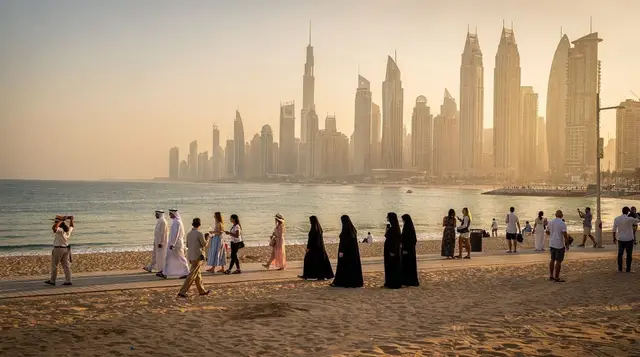
Common Dubai mistakes first-time visitors make
Dubai: Burj Khalifa levels 124 & 125 entry ticket + options
Duration: 1.5 hours
- Free cancellation
What are the biggest mistakes first-time visitors make in Dubai?
Underestimating the heat and scheduling outdoor activity at midday, underestimating distances between Dubai's spread-out districts and relying on walking instead of the metro or taxis, dressing too casually for malls or mosques, not booking timed-entry tickets for Burj Khalifa or Museum of the Future in advance, and assuming alcohol is available everywhere rather than only at licensed venues. Most are easy to avoid with basic planning.
Why these mistakes are worth flagging
None of the mistakes below are disastrous, and Dubai is forgiving enough as a destination that first-timers generally still have a great trip regardless. But each one is common, avoidable with a few minutes of planning, and either costs real money, wastes time, or causes an uncomfortable moment that a bit of foreknowledge sidesteps entirely. This list draws on the patterns that come up again and again for first-time visitors specifically.
| Mistake | Quick fix |
|---|---|
| Outdoor plans at midday | Schedule for morning or evening |
| Walking between districts | Use the metro or Careem |
| Casual dress at malls/mosques | Cover shoulders and knees |
| Skipping timed-entry booking | Book Burj Khalifa a few days ahead |
| Assuming alcohol everywhere | Check the venue is licensed first |
Underestimating the heat, even in winter
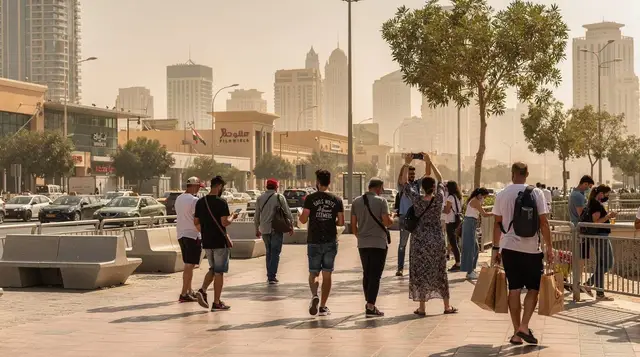
Even during Dubai’s comfortable winter months, midday sun is stronger than visitors from temperate climates expect, and outdoor activity without sun protection or hydration breaks catches people off guard. In summer (June-September), this mistake escalates from uncomfortable to genuinely risky — scheduling a walking tour or outdoor activity for midday in July is a real mistake, not a minor inconvenience. See the summer guide for how to structure a hot-season itinerary, and generally schedule outdoor time for morning or evening regardless of season.
Assuming Dubai is walkable like a compact city
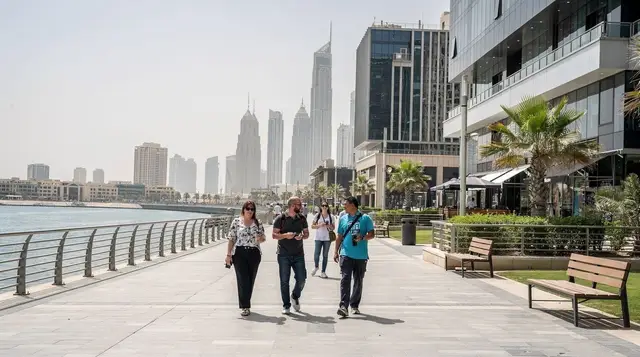
Dubai’s major districts — Downtown, the Marina, Old Dubai, Palm Jumeirah — are genuinely spread out, connected by highways rather than a walkable street grid, and the distance between, say, Downtown and the Marina is a real 20-30 minute drive, not a stroll. First-time visitors sometimes assume they can wander between neighborhoods the way they might in a European city center, then find themselves stranded far from transit in the heat. The metro guide and general getting around guide cover the Red and Green metro lines plus taxi/Careem options — plan routes between districts using one of these rather than assuming walkability.
Dressing too casually outside the beach
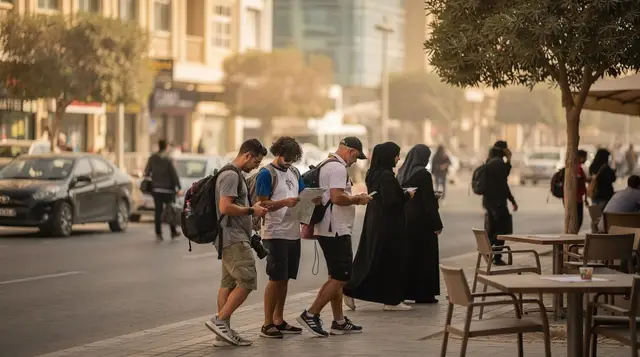
Swimwear, very short shorts, and sleeveless tops are fine at the beach or pool but not in malls, souks, or near mosques, where the general expectation is shoulders and knees covered. This isn’t rigidly enforced everywhere, but it’s a real cultural expectation, and dressing appropriately avoids the mild discomfort of being asked to cover up or feeling out of place. See the dress code guide for the specifics, including the stricter standard at mosques like Sheikh Zayed Grand Mosque in Abu Dhabi.
Not booking timed-entry attractions ahead
Burj Khalifa tickets and Museum of the Future admission are both timed-entry, and walking up without a booking risks either no availability at all or being stuck with an unfavorable time slot (midday instead of the better sunset window) rather than the one you wanted. Booking a specific date and time slot a few days ahead, longer during peak season, avoids this entirely and is one of the easiest mistakes to fix with minimal effort.
Assuming alcohol is available everywhere
Alcohol in Dubai is only served at licensed venues — hotel bars and restaurants, and some standalone licensed restaurants — not at every restaurant the way it might be in many other destinations. Visitors sometimes assume any restaurant will have a wine list and are surprised to find it doesn’t. See the alcohol rules guide for the full framework, including where tourists can legally purchase alcohol to bring back to a hotel room.
Packing warm clothes for a fundamentally hot climate
Dubai doesn’t have a genuine cold season — even “winter” daytime highs sit at 20-30°C (68-86°F) — so packing heavy jackets or sweaters based on the word “winter” alone is a common overcorrection. The actual packing gap runs the other direction: a light jacket or cardigan for cool evenings and for the notably strong air conditioning indoors, rather than a full winter wardrobe. The packing list guide covers the fuller list, including modest-dress and desert-safari-specific items.
Spending the whole trip in the “new” Dubai
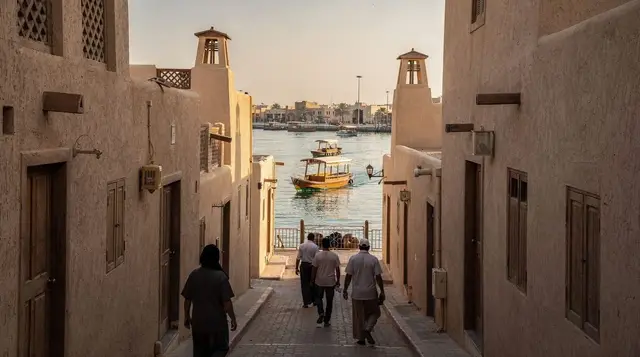
A genuinely common pattern among first-time visitors is spending the entire trip across Downtown, the Marina, and Palm Jumeirah — the postcard-modern side of the city — and never making it to Old Dubai, the souks, Al Fahidi’s wind-tower architecture, or an abra crossing on the Creek. This isn’t a mistake in the sense of doing something wrong, but it does mean missing a genuinely different, historically grounded side of the city that most visitors who do make it there rate as a trip highlight. This Old Dubai souks, street food, and abra guided tour is an efficient way to cover this side of the city in a single half-day if time is tight.
Renting a car without needing one
Some visitors default to renting a car out of habit, without accounting for Dubai’s often confusing multi-lane highways, aggressive local driving style, and the fact that the metro, taxis, and Careem cover the tourist-relevant areas well without the stress of unfamiliar driving. A car does make sense for specific day trips (Hatta, Al Ain, some Northern Emirates routes) where public transit options are limited, but it’s often an unnecessary complication for a trip confined mainly to Dubai city itself. The car rental guide covers when it does and doesn’t make sense.
Ignoring Friday’s different rhythm
Since the UAE shifted its weekend to Saturday-Sunday in 2022, Friday functions as a transitional day with its own rhythm — Friday prayers (Jummah) around midday affect some traffic and business hours, and Friday brunch culture (long, social, often alcohol-inclusive weekend brunches) is a distinctly Dubai institution worth knowing about rather than mistaking for an ordinary lunch. The Friday brunch culture guide covers what to expect if a Friday lands in your trip.
Not accounting for Ramadan or other date-sensitive shifts
Visitors who book a trip without checking whether it overlaps with Ramadan sometimes find daytime dining more restricted than expected. This isn’t a reason to avoid a Ramadan-timed trip — see the Ramadan visiting guide — but checking the dates against your itinerary ahead of time avoids an avoidable surprise.
Overpaying by not comparing tour operators
For popular activities like desert safaris and dhow cruises, prices and quality vary meaningfully between operators offering what looks like a similar product. Booking the very first or cheapest listing without checking recent reviews sometimes means an overcrowded, rushed version of the experience, covered in more depth in the tourist traps guide.
Not checking visa requirements before booking flights
Visa requirements vary significantly by nationality, and while many visitors qualify for visa-on-arrival or a straightforward e-visa process, assuming this applies universally without checking your specific passport’s requirement is a genuinely costly mistake if it turns out otherwise. Checking your specific nationality’s requirement well before booking flights, rather than assuming a friend’s experience with a different passport applies equally to you, avoids a last-minute scramble or a denied boarding at the departure airport. The visa guide covers the general framework by nationality category.
Traveling with prescription medication without documentation
The UAE has notably strict rules around certain medications, including some common prescriptions that are legal elsewhere but restricted or require specific documentation to bring into the country. Traveling with any prescription medication without a doctor’s letter or the original prescription, particularly for controlled substances or strong painkillers, risks a genuinely serious problem at customs that most visitors don’t anticipate. Checking your specific medications against UAE import rules before departure, and carrying documentation for anything prescription-based, is a mistake worth avoiding entirely rather than assuming it won’t come up.
Assuming Uber operates the way it does at home
Careem, not Uber, is the dominant ride-hailing app in Dubai, and while Uber does operate in the city, Careem’s broader coverage, local payment options, and driver availability generally make it the more reliable choice for visitors used to relying on ride-hailing apps elsewhere. Downloading Careem before arrival, alongside or instead of Uber, avoids the frustration of a first attempt at hailing a ride turning up limited options through the app you already had installed.
Not carrying enough cash for smaller vendors and souks
While Dubai is broadly card-friendly, including for taxis and most restaurants, smaller souk vendors, some market stalls, and informal transactions (a modest tip, an abra crossing at roughly 1 AED) often expect or strongly prefer cash. Carrying a reasonable amount of small-denomination AED notes avoids the awkwardness of trying to pay by card for a one-dirham abra ride or negotiating a souk purchase without exact change available.
Booking a hotel far from the metro without checking
Dubai’s metro Red and Green lines cover most tourist-relevant areas efficiently, and a hotel within reasonable walking distance of a metro station meaningfully simplifies getting around without relying entirely on taxis. Some visitors book based purely on a hotel’s price or star rating without checking its proximity to transit, then find themselves paying for taxis or Careem rides more often than budgeted, eroding what looked like hotel savings. Checking a specific hotel’s distance to the nearest metro station before booking, particularly for a budget-conscious trip, avoids this hidden cost.
Forgetting data and connectivity needs
Arriving without a data plan or local SIM/eSIM sorted in advance means relying on patchy hotel or mall WiFi for maps, ride-hailing apps, and translation tools during the exact moments — navigating an unfamiliar airport, finding a taxi, communicating with a driver — when reliable data matters most. Setting up an eSIM before departure or picking up a local SIM promptly on arrival (from an actual telecom store rather than an overpriced airport kiosk, per the tourist traps guide) solves this before it becomes a problem.
Assuming every restaurant serves alcohol or pork
Beyond the alcohol-specific point already covered, some visitors are surprised that a meaningful share of Dubai’s restaurants, reflecting the broader Muslim-majority population, don’t serve pork or pork-derived products at all, alongside the separate licensing question for alcohol. Checking a restaurant’s menu or asking ahead if either matters to your dining plans avoids a mismatch between expectation and what’s actually on offer at a given venue.
Underestimating public displays of affection rules
The UAE has genuine, sometimes strictly enforced expectations around public displays of affection — holding hands is generally fine and common, but more intimate displays (kissing, prolonged embracing) in public spaces can draw attention or, in rarer cases, actual enforcement action that surprises visitors from more permissive cultures. Keeping affection genuinely discreet in public, and reserving anything more for private spaces, avoids a situation that’s entirely preventable with basic awareness of the local norm.
Not accounting for Friday’s different schedule
Since the 2022 weekend shift, Friday functions differently than Saturday or Sunday — some businesses adjust hours around midday Friday prayers, and the day carries a different social rhythm (Friday brunch culture, in particular) than an ordinary weekday. Visitors planning a tightly scheduled Friday itinerary without accounting for this sometimes find certain activities or business hours don’t match expectations set by a typical weekday. See the Friday brunch culture guide for the specific social pattern this day carries.
Overloading a first day with jet lag still in effect
Especially for visitors arriving from significantly different time zones, scheduling an intensive first day — Burj Khalifa, a desert safari, and a late dhow cruise all in the same 24 hours — while still adjusting to jet lag often backfires, leading to a first day remembered more for exhaustion than enjoyment. Building in a lighter first day, with one anchor activity and genuine rest time, generally produces a better overall trip than trying to maximize every single day from the moment of arrival.
Not confirming operator details before a desert safari or cruise booking
A specific and avoidable mistake is booking a desert safari or dhow cruise without confirming pickup time, pickup location, and what’s actually included (dinner, drinks, specific activities) ahead of the day itself. Miscommunication on pickup logistics is one of the more common sources of frustration with these bookings, and a quick confirmation message or email the day before avoids most of it.
Ignoring travel insurance
Some visitors skip travel insurance for a Dubai trip assuming the destination’s overall safety and modern infrastructure make it unnecessary, overlooking that insurance covers far more than crime risk — trip cancellation, lost luggage, and especially medical costs, which can be significant in the UAE’s private healthcare system for a visitor without coverage. A standard travel insurance policy is inexpensive relative to the total trip cost and covers a real gap that Dubai’s overall safety record doesn’t address.
Not budgeting realistically for a multi-day trip
A related planning mistake is estimating a Dubai trip’s cost based purely on flights and hotel, without adequately budgeting for the meal, activity, and transport costs that add up meaningfully across a multi-day stay, particularly given how tempting the city’s dining and shopping options are once you’re there. The budget guide breaks down realistic daily costs across budget tiers, worth checking against your own trip length before finalizing an overall travel budget.
Assuming taxis are the cheapest way everywhere
Taxis and Careem are convenient but genuinely expensive relative to the metro over any real distance — a cross-city trip, say Downtown to the Marina, can cost several times more by taxi than the equivalent metro journey with a Nol card, detailed in the Nol card guide. Visitors who default to taxis for every trip out of habit, without checking whether a metro line runs the same route, sometimes spend a genuinely significant and avoidable share of their daily budget purely on short-distance transport that the metro would have covered for a fraction of the cost.
Not checking which observation deck actually suits your plans
Burj Khalifa’s various levels, the Dubai Frame, and the View at the Palm all market themselves as Dubai’s best view, and booking the first one that comes up in a search sometimes means paying for a experience that doesn’t match what you actually wanted — a sunset-specific package, say, when your schedule only allows a midday slot. The observation decks compared guide breaks down which deck suits which priority (height, price, crowd levels, view content) before you commit to a specific ticket.
The pattern behind most of these mistakes
Nearly every mistake on this list comes down to the same root cause: assuming Dubai works exactly like home, or exactly like a previous destination, without checking the specific local rule or norm that differs, whether that’s transport, dress, licensing, or simply which day of the week carries a different rhythm. Dubai is genuinely visitor-friendly and forgiving of honest mistakes, but a few minutes of pre-trip research on the handful of areas covered here — dress code, alcohol, transport, medication rules, visa requirements — closes almost the entire gap between a first-timer’s trip and a well-prepared one, and none of it requires more than an evening of reading before you pack.
Assuming every neighborhood has the same character
Downtown, the Marina, Old Dubai, Deira and Jumeirah each have genuinely distinct atmospheres — glossy and vertical in Downtown, waterfront and resort-casual in the Marina, dense and historic in Old Dubai and Deira — and treating the city as one interchangeable “Dubai” experience means missing how differently each area is meant to be visited and dressed for. First-timers who base an entire trip in a single neighborhood, most often Downtown or the Marina, sometimes leave without realizing how different Old Dubai or Deira feel by comparison. The neighborhoods overview guide is worth a read before choosing where to stay and how to structure sightseeing days.
Not planning around Friday and weekend crowd patterns
Beyond the specific Friday-rhythm point already covered, Saturday and Sunday now form the actual weekend in the UAE, and popular attractions, malls and brunch venues run noticeably busier on those two days than midweek. Visitors who assume weekday-level crowds apply throughout their trip sometimes find themselves in longer queues than expected at the Burj Khalifa or a popular brunch on a Saturday, simply from not checking which day of the week a given activity falls on. Booking headline attractions for a weekday where your schedule allows it, and reserving weekend slots further ahead, avoids most of this friction.
A final word on getting it right the first time
None of the mistakes covered here are unique to Dubai in spirit — every destination has its own set of local norms that catch first-time visitors off guard. What makes Dubai’s list worth reading closely is that a handful of the items (medication rules, alcohol licensing, dress code near mosques) carry genuinely more serious consequences for getting wrong than a typical travel faux pas would elsewhere, which is exactly why they’re worth a bit more attention before departure than the average packing-list tip.
Frequently asked questions about common Dubai mistakes
Do people underestimate the heat in Dubai?
Yes, constantly, even in winter — scheduling outdoor activities for morning or evening rather than midday avoids the worst of it, especially June-September.
Is Dubai walkable between major areas?
No — districts are spread out and highway-connected. Use the metro or taxis/Careem rather than assuming walkability.
What dress code mistakes do tourists make in Dubai?
Wearing swimwear or very short clothing in malls, souks, or near mosques rather than reserving it for the beach or pool.
Do you need to book Burj Khalifa tickets in advance?
Yes, ideally, to secure a specific time slot, especially the better sunset window, rather than relying on walk-up availability.
Can you drink alcohol anywhere in Dubai?
No, only at licensed venues like hotel bars and restaurants, not at every restaurant.
Do tourists overpack for Dubai?
Often in the wrong direction — too many warm layers rather than a light jacket for evenings and strong indoor air conditioning.
Is it a mistake to skip Old Dubai for only the modern skyline?
Many first-timers do, missing a genuinely different, historically grounded side of the city worth including.
Is it cheaper to take a taxi or the metro between districts?
The metro, by a wide margin, on any cross-city route — Careem and taxis are convenient but cost several times more over a real distance.
Are Dubai’s neighborhoods worth exploring beyond Downtown and the Marina?
Yes — Old Dubai, Deira and other districts feel genuinely different in character, and basing a whole trip in one area means missing that contrast entirely.
Top experiences
Bookable activities with verified prices and instant confirmation on GetYourGuide.